'This is why rivers and lakes are so dangerous to swim in'

 Getty Images
The current spell of record-breaking hot weather, coinciding with the May Bank Holiday and school half-term, has seen nine people die after getting into difficulties in England while swimming in lakes and rivers.
Many of the victims were young, including two teenage boys who died in incidents in Yorkshire.
But just why do these tragedies happen during heatwaves, and what can be done to prevent them?
According to one water safety expert, it is often down to the novelty of the experience of open water swimming.
"Unfortunately, being in a country that doesn't particularly get a lot of hot weather, as soon as we do get something warm, the temptation is there to jump in any body of water, whether it be coastal or inland rivers and lakes," says Steve Cavallo, an RNLI volunteer from Pontefract.
"We do get these incidents every year and we're trying to educate people to try to prevent this happening."
Cavallo adds that many reservoirs and lakes, particularly in former industrial sites such as quarries, have hidden hazards that can trap swimmers.
"You don't know what objects are below the surface. Unfortunately people throw stuff in rivers and lakes that shouldn't be there. It's easy to get caught up in that sort of thing."
On Monday, a 13-year-old boy, named locally as Reco Puttock, was pronounced dead after being pulled from Leadbeater Dam in Halifax, West Yorkshire.
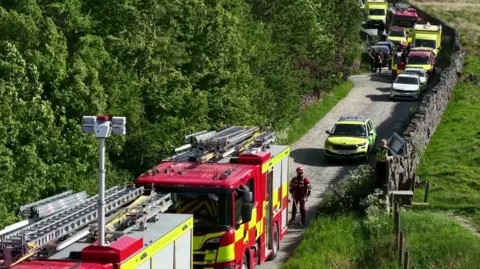
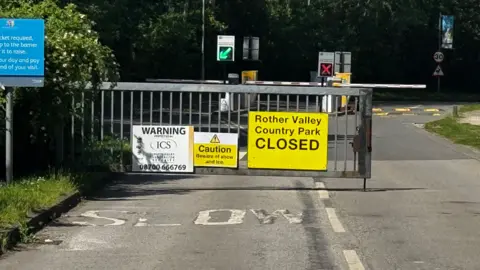
While in Rother Valley Country Park in Rotherham, South Yorkshire, the body of a teenage boy was recovered from a lake.
'The water doesn't warm up'
Royal Life Saving Society head of water safety and education Ashley Jones explains why leaping into a cold lake – despite how refreshing it looks – can be fatal.
"Even though the air has warmed up – and it's warmed up really quickly (this week) – the water doesn't warm up. So it's absolutely crucial that when we get into the water, we get in slowly," he says.
"If you were to run, jump or dive in, the first response you get is a gasp. And that big, sharp intake of air is really dangerous if there's water there. So if you're in the water and you gasp that can start the drowning process."
The next step is a marked increase in the heart rate, says Jones.
"Our heart rate goes up and our breathing goes up. And that can make us panic, and if we panic and we're splashing around that can combine to cause us to inhale and start the drowning process," he says.
 YappApp
The majority of accidental drownings take place at inland locations as opposed to coastal regions, says Georgia Beardmore from the Royal Society for the Prevention of Accidents.
"There are lots of different types of inland water location and they all present very different hazards," she says.
"So inland locations like reservoirs, canals and quarry lakes, you've got lots of man-made machinery that might be hidden beneath the surface. Also inland water locations might potentially be a little bit more remote than beach-side locations.
"A hazard that's consistent across all open water locations, whether that's inland or the sea and particularly at this time of year, is the fact the water is extremely cold, dangerously cold in fact," she says.
Beardmore says it is a trend a lot of people would find surprising.
"Everyone thinks about danger at the seaside. They don't necessarily think about danger in open water," she says.
RNLI volunteer Cavallo used to at be based at Spurn Point lifeboat station. He thinks one of the reasons there are more deaths inland is because of a lack of education.
"People aren't brought up around the water like coastal people are," he says.
"We have an education team and a water safety team and we get out to schools, colleges, watersports clubs and paddleboard clubs just to get this message out across all age groups - and the younger we do this the better, because it just becomes second nature."
'Remain calm'
Another risk factor is the "hero" rescue. This happened in Cornwall on Monday, when a man in his 60s suffered a cardiac arrest after going into the sea at Tregirls Beach to help two family members, who were brought to safety by others.
"So many times the rescuer becomes the rescuee," says Cavallo.
For many people, it is instinctive to jump in to try to help - especially if the person in trouble is a loved one - but "you don't know why that person's in trouble", says Beardmore.
"You don't know what hazards are in there and if someone is to get in that can often lead to multiple people being in difficulty," she says.
Andrew Black, a volunteer at York Rescue Boat, says the best thing to do is to "reach and throw".
"In York, we're quite lucky now we've got some new street furniture that's just been added that has throw lines and reach rescue poles at the waterside," he says.
"If there's nothing suitable, you could be looking for a branch, it could be anything. You could tie some towels together and try to get to them that way.
"But the most important thing is to try and stay calm yourself as that will help the person in the water to stay calm and encourage them to think about floating and trying to keep their head tilted back and remain calm while you wait for help to arrive."
And if you do find yourself in the water, try to float and use emergency equipment, says Beardmore.
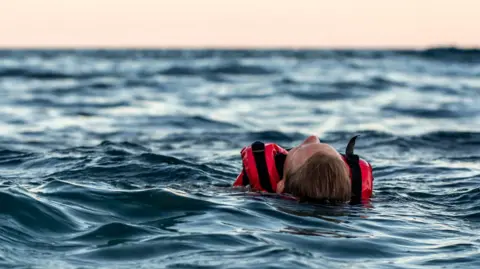
"Float on your back with your ears under the water, get control of your breathing, try and get calm and move your arms and legs if that helps you to stay afloat.
"Don't worry if your legs sink, everybody does float a bit differently and then once you've got control of your breathing again you can shout for help or swim to safety."
Tilt your head back and try and remain as calm as you possibly can for as long as you can, adds Black.
"It's obviously easy to say and very hard to do, but try and relax and slow your breathing down, which will then control your heart rate and give your body a chance to adjust to the cold water.
"And then you should, if you're able to stay calm sufficiently, you should be able to then start to slowly move your arms and legs and perhaps swim to the side or at least call for help."
May heatwave deaths
- On Sunday, Declan Sawyer, 15, died in Swanholme Lakes, near Lincoln
- On Bank Holiday Monday, three teenagers were confirmed dead. Reco Puttock, 13, went missing in Leadbeater Dam near Halifax; and an unnamed teenage boy's body was recovered from Rother Valley Country Park near Sheffield.
- The third child death on Monday was Lillianna Tomlinson, 16, who died in a river near Kingsbury Water Park, Warwickshire.
- A man in his 60s also died on Monday after suffering a cardiac arrest while trying to rescue relatives from the sea on a beach in Cornwall.
- On Tuesday, Junior Slater, 12, was named as the boy who died in the River Ribble at Ribchester, Lancashire.
- On Wednesday, a 17-year-old boy was confirmed dead after an incident at Pick Mere in Cheshire and another teenage boy died at Hawley Lake in Farnborough, Hampshire.
- Earlier it was confirmed that a teenage boy's body had been recovered from a pond in Swanscombe, Kent.
- Also today a 14-year-old boy was confirmed to have died in the River Thames near Oxford.
As well as the 10 deaths in England, nine of them in inland open water, a 72-year-old woman also died swimming at a beach in Pembrokeshire, Wales.
Listen to highlights from West Yorkshire on BBC Sounds, catch up with the latest episode of Look North.
