Restrained man was not killed unlawfully - coroner

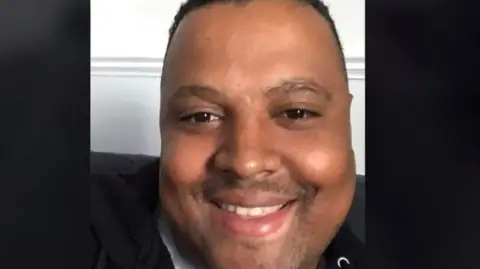 North Yorkshire Police
A man who died after being restrained for seven minutes in a York jewellery shop was not killed unlawfully, a coroner found.
Sam Diatta, 39, went into cardiac arrest while being held face down in Mappin and Webb jewellers following an altercation with a security guard on 26 July 2022.
Diatta was suffering an acute mental health episode when he went in and told Gary Prothero he had 18,000 TikTok followers and wanted to take pictures of watches, demanding three free watches in return, the inquest heard.
When Prothero asked him to leave, he threw punches at him until he was restrained by the guard and customers. North Yorkshire coroner Jon Heath concluded his death did not amount to manslaughter.
CCTV footage showed Diatta, who had bipolar disorder, being tackled to the floor by Prothero and another customer, with two further members of the public coming to help, meaning he was being held down by four men when police arrived.
Two pathologists said that the medical cause of death was hypertensive heart disease combined with the effects of being restrained, with one telling the inquest that the position Diatta was being held in would have reduced his breathing.
North Yorkshire Police arrested four men after Diatta's death, but later said no one would face any charges.
On Thursday, the coroner said Diatta's family had asked him to consider that the "disproportionate use of restraint was an unlawful act" as it was "dangerous and likely to cause injury".
But Heath said none of the four men knew of Diatta's mental health issues or heart condition and did not believe he was struggling to breathe.

The coroner said Prothero had been hit in the face and was acting in self-defence when he initially restrained Diatta.
He said the other men involved thought there had been a robbery and restrained Diatta because the police had been called.
The inquest heard that Diatta had been discharged from a psychiatric hospital four days before his death.
The coroner recorded a narrative conclusion that Diatta died as a consequence of naturally occurring heart disease combined with the effects of being restrained.
In a statement read after the hearing by their barrister, Parissa Najah, Diatta's parents George and Judy and his sister Teba said: "On the fateful day of Sam's death he was suffering an acute mental health episode.
"He was restrained, face down on the floor for more than seven minutes, during which time he shouted: 'I can't breathe'. Tragically, those words were not heeded.
"Being restrained in that position, for so long, by several men was established by the coroner as being part of the medical cause of Sam's death.
"The family remain convinced that Sam was not well enough to be living in the community in the days prior to his death, due to the concerns about his mental health and how it had deteriorated.
"Their view is reinforced by the fact that, just four days after his discharge from hospital, Sam lost his life in circumstances that could have been avoided."
'We choose forgiveness'
Teba Diatta said: "Sam wasn't a bad person. He was having a really bad day due to his mental health and he was a lovely, gentle soul.
"He was very forgiving. He was kind, he was loving, he was generous. We really miss him. And we just don't want him to be remembered for an act of violence on a day that he was so poorly."
She added: "We choose forgiveness, we don't want to hold it against any of the people involved."
After his death, Diatta's family called him "a gentle giant, who was kind and generous and loved by all who met him".
They said: "Sam was half Senegalese and his family in Senegal meant the world to him.
"He was a keen sportsman and supported both the England and Senegal football sides. He also played for York RI rugby team.
"Sadly, in his later teenage years Sam developed mental health issues which stayed with him throughout his life.
"He had a strong Christian faith and with two others led the Christian Union at York College."
Listen to highlights from North Yorkshire on BBC Sounds, catch up with the latest episode of Look North.
