Safety warning after nine water-related deaths during heatwave

 Supplied
People have been warned of the dangers of swimming in open water after multiple deaths during the recent heatwave.
The Royal Life Saving Society (RLSS) issued a warning following the fatal incidents, most of which involved children, saying "warmer weather unfortunately sees an increase in accidental drownings".
At least seven young people died in the water, the youngest being 12-year-old Junior Slater, who died in a Lancashire river on Tuesday afternoon. A man in his 60s and a woman in her 70s have also died in other incidents.
RLSS warned water temperatures remain very cold despite increased air temperatures, and cold water shock canmake swimming difficult and harder to get out of the water.
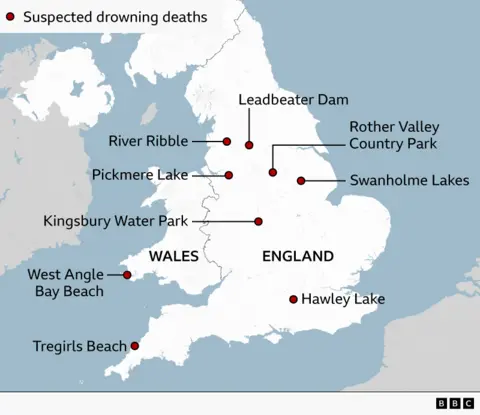
- At Swanholme Lakes in Lincoln, Declan Sawyer, 15, was found dead after emergency crews were called to reports of him getting into difficulty at about 14:30 on Sunday
- Also on Sunday, a 72-year-old woman was pulled from the water at West Angle Bay beach, Pembrokeshire in Wales
- On Bank Holiday Monday, a 13-year-old boy named locally as Reco Puttock was pronounced dead after being pulled from Leadbeater Dam in Halifax, West Yorkshire; the body of a teenage girl, Lillianna Tomlinson thought to be aged 16, was recovered from Kingsbury Water Park, Warwickshire; and the body of a teenage boy was recovered from a lake in Rother Valley Country Park in Rotherham, South Yorkshire
- Also on Monday, a man in his 60s died after running into the sea to help two relatives who had got into difficulty at Tregirls Beach near Padstow, Cornwall, police said
- On Tuesday, 12-year-old Junior Slater died after getting into difficulty in the River Ribble in Lancashire. His family have paid tribute to "our little blue-eyed boy"
- On Wednesday, Cheshire police found a body in Pickmere Lake during the search for a 17-year-old boy who went missing after swimming at the beauty spot
- On the same day, the body of a teenage boy who reportedly went missing after going swimming was recovered by police at Hawley Lake near Farnborough
A leading network for drowning prevention has recommended swimming in supervised locations with lifeguards where possible and entering the water slowly to reduce the risk of cold-water shock.
Cold-water shock is an involuntary physiological response when the body is suddenly immersed in water.
It causes blood vessels in the skin to close, which increases blood flow resistance, and as a result forces the heart to work harder and causes blood pressure to increase.
According to the Royal National Lifeboat Institution (RNLI), anything below 15C is defined as cold water, and average UK and Ireland sea temperatures are 12C, and some rivers can be colder even in summer.
Speaking to BBC Breakfast on Wednesday morning, Jim Bridge from Water Safety Partnership urged those who find themselves in difficulty in the water to "float to live".
"So lie on your back with you head back, with your ears submerged, use your arms and legs to stabilise yourself and just let your breathing come back to a normal breathing pattern.
"And when you're feeling confident that you've gotten used to the water and your breathing's normal, you can shout for help or swim to save yourself."
On Tuesday, the UK recorded the hottest day in May with temperatures reaching 35.1C at Kew Gardens in London.
For two days in a row, parts of south-east England went above 34C.
Nearly all weather stations across England and Wales also broke their local May temperature records on Monday and Tuesday.
The Met Office says a heatwave happens when an area reaches a certain high temperature for at least three days in a row.
Wednesday brings a reprieve from the record-breaking temperatures which have likely peaked, as cooler air moves over northern and eastern areas of England.
However, National Rail warned until Thursday services could be altered as the hot weather "can cause overhead lines to expand and sag, can cause line-side fires and it can resort in rails to buckle", a spokesman said.
Speed restrictions could also be imposed. Currently there is major disruption between Lancaster and Oxenholme Lake District which is expected until the end of the day.
Train companies affected include Avanti West Coast, Northern and TransPennine Express.
The Met Office has also issued a yellow thunderstorm warning for much of Wales, south-west England and parts of the Midlands from 15:00 to 23:59 on Wednesday.
It could bring torrential downpours of rain, frequent lightning, large hail and strong, gusty winds.
But over the next few days it will still remain hot in many areas and health officials confirmed heat health alerts would be extended for 24 hours.
The UK Health Security Agency (UKHSA) said amber alerts for the South West, South East, London, East and West Midlands, and East of England will remain until 17:00 on Thursday, with yellow heat-health alerts for the North West and North East.
Separately about 18,000 customers across Kent are still experiencing water supply issues as of Wednesday after the system buckled from extremely high demand during the hot weather.
South East Water's head of operations control Matthew Dean said on Tuesday they pumped 660 million litres of water to customers across the region, which is about "100 litres more than the average for a day".
"We are doing everything we can to get water into our reservoirs, but some customers will continue to have intermittent water supply until reservoir levels have been restored."
