Zambia is the world's walking safari capital

 Barbara Noe Kennedy
As safari crowds grow across Africa, Zambia's walking safaris offer a quieter, more immersive way to experience wildlife.
Our guide, Thomas Mulonga, leads us single file through the mopane woodland of Mosi-oa-Tunya National Park, near Victoria Falls, Zambia. I'm on high alert, scanning the bush for signs of life, half hoping, half fearing we will find something. Two armed wildlife scouts bracket our group, rifles slung across their shoulders.
We are tracking near-threatened southern white rhinoceros, though it's hard not to think about what else moves through this dry savannah: notoriously aggressive hippos, unpredictable Cape buffalo prone to ambush, elephants slipping through the trees, cantankerous baboons barking in the shadows. We've seen many of them before from the safety of a vehicle. But now we are on a walking safari – and on foot, the calculus is different.
Mulonga walks as if he belongs to the landscape, pausing often and listening more than speaking. He stops and points to a shallow indentation in the dust.
"Fresh," he mouths.
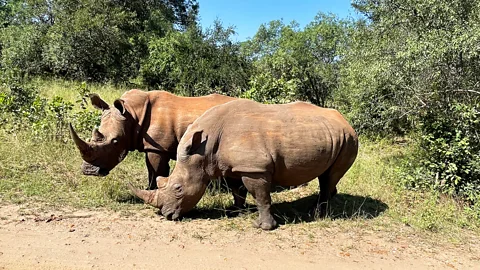
Then we see him. An imposing patriarch lies sprawled in the sun, massive and still, like a sleeping dog.
"It's Louis II," Mulonga says quietly.
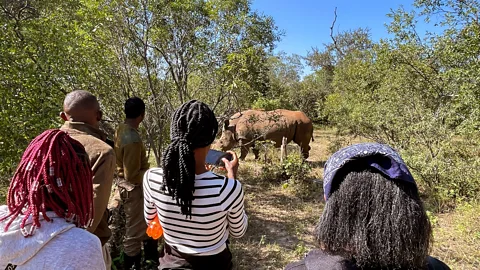
We are close enough to see the craggy folds of the white rhino's dusty, crepey skin, etched with what resemble dry riverbeds meandering across his immense frame. There is no windshield on a walking safari, no engine for a quick getaway – only open bush and a few yards of earth between us.
A walking safari, I begin to understand, is not simply about seeing wildlife. It's about entering a world up close and on its own terms.
 Barbara Noe Kennedy
On foot, you're on your own
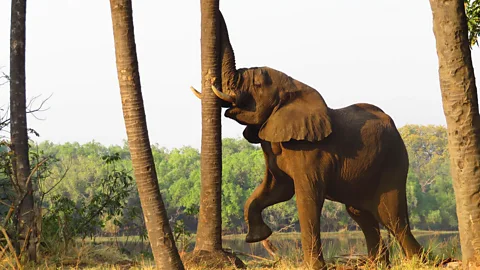
Wildlife tourism is booming globally, and premier African reserves like Kenya's Masai Mara and Serengeti National Park in Tanzania now grapple with convoys of vehicles jostling for predator sightings. Their fragile ecosystems are feeling the strain.
Zambia's white rhino
Zambia once teemed with southern white and black rhinos, but by the late 1980s, poaching driven by the illegal horn trade and weak protection had devastated both populations. Southern white rhinos were declared extinct in Zambia by 1989, followed by black rhinos in 1998. Through determined conservation efforts, international partnerships and the support of local communities, both species are slowly returning. Today, Zambia is home to 60 black and 54 white southern rhinos. Walking safaris help fund the anti-poaching patrols and community-based conservation programmes working to secure their future.
At the same time, conservationists and many safari operators are advocating for lower-impact models that prioritise higher-quality, immersive experiences. Zambia's deep-rooted practice of walking safaris – tracking wildlife on foot through the bush with expert guides presents a compelling alternative.
Moving slowly through their habitat is an exercise in respect and sustainability. On foot, the rhythm changes. There is no need to race from sighting to sighting. Time slows, and the smallest details come into focus.
"A walking safari is a completely different way of experiencing nature," Mulonga tells me. "You are not just seeing it. You are inside it."
That reawakened attentiveness is part of the appeal, says Gareth Jones, cofounder of Chikunto Safari Lodge & Camp in Zambia's South Luangwa National Park. "It's a sensory experience. You're smelling, listening, touching the ground, hearing your guide talk about the seasons, looking at spoor. You become fascinated by the small things – the ants, the geckos, the dung beetle rolling its little ball."
Sue Marullo, from Washington DC, recently experienced Mosi-oa-Tunya this way. "There was something about walking on the earth, walking in the same footsteps as the animals," she says. "There was a spiritual connection there. I've seen the great animals on safari in Kenya, but there was something more powerful about the connection in Zambia, being a guest in their home, as it were."
 Alamy
AlamyA radical movement
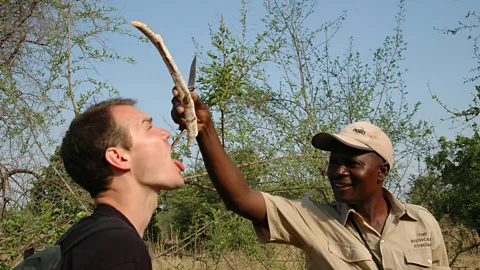
Zambia's modern walking-safari tradition is often traced to the 1950s, when pioneering British conservationist Norman Carr began guiding visitors on foot through what is now South Luangwa National Park – a radical act in an era when safari largely meant hunting trophies. His belief that wildlife was worth more alive than dead helped shift Zambian tourism toward observation and ecology.
Pick your park
South Luangwa National Park is most popular for its varied scenery and abundant wildlife, while Lower Zambezi and Kafue National Parks offer wilder, less-visited alternatives. Mosi-oa-Tunya is convenient for those visiting Victoria Falls (note: Mosi-oa-Tunya has white rhinos, but no big cats). Recommended companies include Chikunto Safari Lodge & Camp in South Luangwa National Park and Nick Travel and Tours in Livingstone. Itineraries encompass multi-day treks between remote bush camps; others fold shorter guided walks into traditional vehicle safaris.
The model later spread across Africa, with small groups, expert guides and low-volume camps. Yet, walking safaris remain a niche choice, with Jones estimating that only 2 to 3% of African wildlife travellers pick a primarily walking-based safari. Most first-time visitors still prefer traditional game drives, he says, which cover more ground and offer marquee sightings from the perceived safety of a vehicle.
Few places match Zambia's depth of guiding culture, which relies on expertise. Guides are often trained through rigorous certification systems that require years of bush knowledge, tracking skills, species identification and safety protocols. Many grow up near these landscapes, learning to read spoor and seasons long before formal exams begin.
That expertise is essential on a walking safari, where guests are fully immersed in the wild. They must follow guides and armed scouts at all times, walking in single file, staying close and remaining silent so guides can read animal behaviour and respond early, if needed.
 Barbara Noe Kennedy
As more travellers seek quieter, more authentic wildlife experiences, Zambia's long under-the-radar status may now be an advantage. "Our strength is our weakness," Jones says. "Walking safaris may never command the market share of high-volume game-driven destinations, but that restraint has preserved something increasingly rare. Zambia has never been about mass tourism."
Impressions more precious than photographs
Back in the bush, Louis II stirs.
After Mulonga assures me that we're at a safe distance, I breathe easier, pausing to take in everything else: the dry rustle of leaves, the sharp, turpentine scent of mopane. The sun-baked ground radiates heat through the soles of my shoes.
More like this:
Slowly, he pushes himself upright on short, stubby legs. Mulonga signals for us to step back slowly, waits a moment, then waves us forward. We follow, again in single file, watching the rhino – now joined by his friend Jackie – pause to nibble on a leafy shrub.
I remember something Mulonga told us earlier: the greatest threat to these animals is not the average visitor, but the people who come armed with very different intentions. I think of Louis II's father, whom I had the chance to see years earlier on a different walking safari, lost to poaching for his beautiful horn.
I realise then – the scouts' guns are not to protect us from the wild, but to protect the wild from those who come to harm them.
On foot, there is no barrier between human and animal. There is only presence – and understanding. In an age when travel often prizes speed, checklists and spectacle, Zambia offers another possibility: to move more slowly, notice more deeply and leave with something more lasting than photographs.
We stand a while longer, watching Louis II feed in the afternoon light, listening to the chirring of insects and the breeze through the mopane trees. To walk here is both a privilege – and a responsibility.
--
If you liked this story, sign up for The Essential List newsletter – a handpicked selection of features, videos and can't-miss news, delivered to your inbox twice a week.
