Peregrine falcon chicks hatch in university nest

 University of Leeds
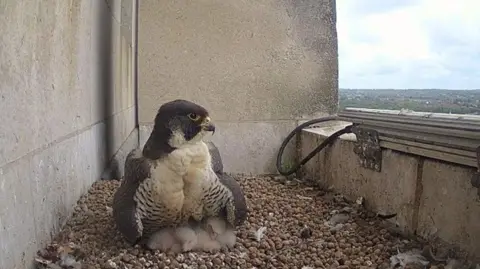
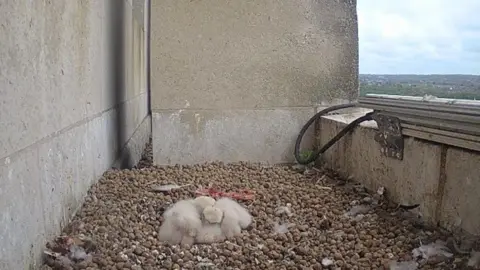
Four peregrine falcon chicks have hatched in a nest on a university building in Leeds.
The chicks hatched between Wednesday and Friday last week in their nest on the University of Leeds Parkinson Building on Woodhouse Lane.
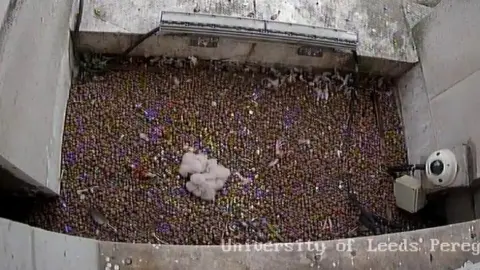
The birds of prey have nested in the Parkinson Tower intermittenly since 2018, and can be viewed on the university's webcams.
The university's sustainability team, which monitors the nest, said the birds would soon be ringed with help from the Yorkshire Wildlife Trust, so their progress could be followed.
Peregrine falcons are the world's fastest animal, capable of diving at speeds of more than 200mph (320km/h).
They are large, blue-grey birds with pointed wings and can often be spotted around the university.
 University of Leeds
Michael Howroyd, biodiversity programme lead in the sustainability service at the university, said the eggs were laid on 21, 23, 26 and 28 March.
Hatching of the first egg began at about 04:00 BST on 29 April.
The university said peregrine falcone chicks begin to fledge about 35 days later, becoming entirely independent after a couple of months.
He said a peregrine falcon which fledged from this nest last year was now nesting in Lister Mills in Bradford.
"I think it's great that our babies are having babies themselves and spreading out in Yorkshire," he said.
Howroyd added the cameras received more than 250,000 views each year.
"I think the reason the peregrines capture so much attention is that they bring the outside inside.
"They give people the chance for a moment of connection with nature in the middle of their day."
 University of Leeds
Listen to highlights from West Yorkshire on BBC Sounds, catch up with the latest episode of Look North.
