How ospreys were 'tricked' into breeding in Dorset

 Birds of Poole Harbour
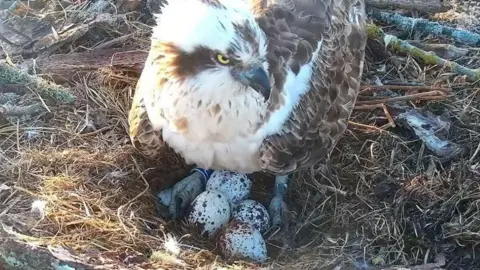
Dorset's much-loved ospreys are incubating another bumper clutch of four eggs and all eyes are on their nest cam, waiting for the first chick to appear.
Female CJ7 and male 022 were the first of two pairs to breed at Poole Harbour as a result of a five-year translocation project which began in 2017.
The reintroduction of the birds of prey to the region has been a complex operation, mainly because the males tend to return to their birthplace to breed.
But with no breeding ospreys on England's south coast for about 180 years, convincing the birds that Dorset was home required an elaborate deception.
"When you have wiped out a population of something, there are traits that prevent them from returning in that area," explains Birds of Poole Harbour charity founder Paul Morton.
"It's the males that set up the territories so, over time, we tricked them that this was their natal site."
 Birds of Poole Harbour
Years before the project began, migrating ospreys had been spotted in Poole Harbour, en route from Scotland to their wintering grounds in north Africa.
"In the autumn we would get two or three ospreys passing through.
"It was obvious there was enough food for them so we applied for a licence to bring ospreys from Scotland," said Morton.
Male ospreys exhibit natal filopatry, meaning they return to their birthplace to breed, while females are attracted to areas where there are other ospreys.
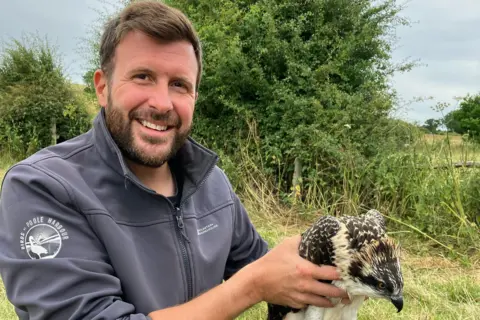
Working with the Roy Dennis Wildlife Foundation, which monitors dozens of nests in central-eastern Scotland, about 14 chicks a year were removed under licence at five weeks old, when they were still unable to fly but able to feed themselves.
"They are individually put in a carboard box that feels like a nest, and driven overnight so it's cooler," said Morton.
"They arrive at dawn and are put in holding aviaries for about two-and-a-half weeks with a couple of other birds so they become like a little family and we minimise human contact."
The team prepped 9-10 kg (20-22lb) of fish each day in thumbnail-sized pieces, gradually increasing the portions until the birds were able to grab a half trout in their talons and tear it with their beaks.
"We put the pieces through a letterbox so the ospreys can feed themselves – all the time they are being monitored on CCTV because we need to make sure they are eating, pooing and flapping."
 Birds of Poole Harbour
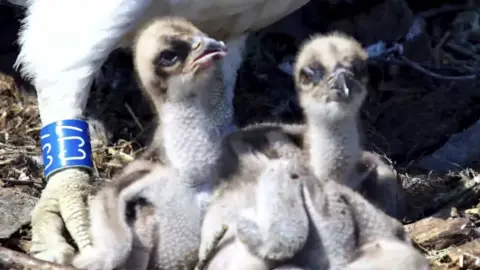
In July, the ringed and tagged birds were released.
"Then the hard work really starts," said Morton.
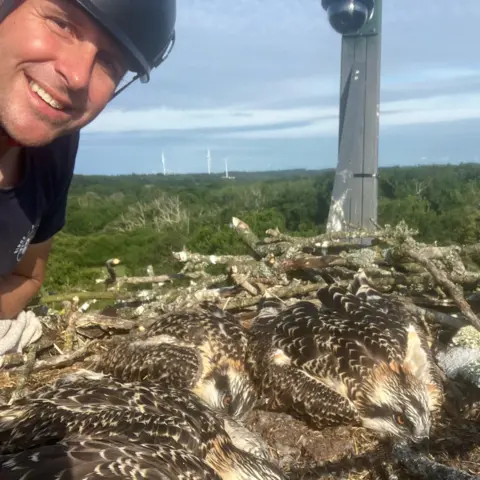
"When a osprey flies for the first time, it still returns to the nest three to four times a day to get fed, and this goes on for about a month.
"So we would sneak out in the morning and put whole fish on the nests.
"That time is the most crucial part of the project because if they flew off into the sunset they would die.
"After a week, they would get braver and go several hundred metres.
"After a month they are all over the place, mapping the area."
 Birds of Poole Harbour
By the time the juveniles migrate in August or September, the location is imprinted on their memory so, when they are ready to breed, usually after two or three years, they will return.
Both of the breeding males in Poole Harbour came from the translocation project.
Last week, a three-year-old male - 5H3 - that fledged from CJ7 and 022's nest was also spotted, raising hopes that he too will attract a passing female.
As they are part of a scientific project, the birds do not have names and their ring numbers are assigned from a sequence ordered on a strip.
Reflecting on the project's success, Morton said: "It's insane but there's a much greater story than just the ospreys in all of this.
"Within hours in the one location we've seen white tailed eagles, red kites, peregrine falcons – all of which have been persecuted in the past.
"Species recovery is occurring and the ospreys are symbolic of a bigger set of stories that are going on here."
