'One of the most memorable nights of my life': Queen Elizabeth II's secret night out on VE Day

 Getty Images
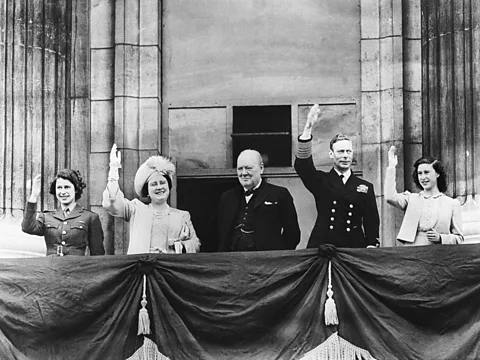
VE Day marked the surrender of Nazi Germany and the end of World War Two in Europe. In 1985, Queen Elizabeth II told the BBC how, as a teenage princess, she slipped out of Buckingham Palace to join the joyous crowds outside.
On 8 May 1945, a carefree teenage Princess Elizabeth slipped out of Buckingham Palace incognito with her sister Margaret, and vanished into the dancing crowds who were revelling in the defeat of the Nazis. It's an episode that sounds like fiction, which could be why it has been dramatised in a film, a novel and a hit TV series. But it really happened.
We know this because in 1985, for the 40th anniversary of VE Day, Queen Elizabeth II told veteran BBC royal correspondent Godfrey Talbot all about it. She spoke about how she felt the "thrill and relief" of hearing that the war in Europe was over. After six years of sadness and horror, people were ready to celebrate.
Her father King George VI was happy to let his daughters experience the joy close up, writing in his diary that day: "Poor darlings, they have never had any fun yet." Elizabeth II recalled four decades later: "It was one of the most memorable nights of my life."
It was one of only four times – as far as we know – that she walked undetected among crowds of regular people. One of those who joined the royal sisters on their VE Day expedition was their cousin Margaret Rhodes. She wrote in her autobiography: "I suppose that for the Princesses it was a unique burst of personal freedom; a Cinderella moment in reverse, in which they could pretend that they were ordinary and unknown."
Princess Elizabeth was 13 at the outbreak of World War Two in 1939. Those six years of conflict saw her mostly confined within the walls of Windsor Castle while growing into her public role as heir to the throne. In October 1940, at the height of the Blitz, she made her first radio broadcast on the BBC. While it was aimed at children sent to North America to escape the bombing of Britain's cities, it was a message with wider resonance. "We children at home are full of cheerfulness and courage," she said. "We are trying to do all we can to help our gallant sailors, soldiers and airmen. And we are trying, too, to bear our own share of the danger and sadness of war."
The Royal Family became for many a powerful symbol of national resolve, and the decision to keep both princesses in Britain was a morale booster. Windsor Castle is about 22 miles from Buckingham Palace, so the sisters were still close enough to London to witness the city's blazing skies during the Nazi air raids. On one occasion a bomb fell near the castle as they sat in the air-raid shelter. "We all went pink when we heard it," Princess Margaret later recalled.
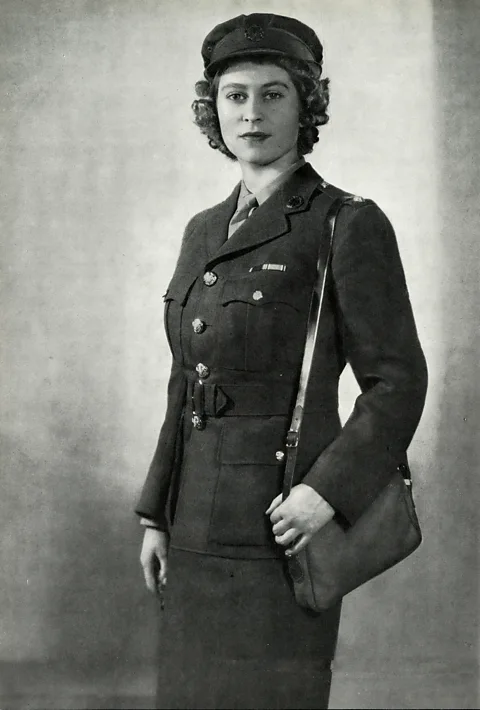
Elizabeth turned 18 in the year before the war ended, wearing a military uniform in the Auxiliary Territorial Service, or ATS. As Second Subaltern Elizabeth Windsor, she spent three weeks learning to become a qualified Army driver and maintenance mechanic. Her khaki-coloured uniform cap would later be put to good use again.
 Netflix
When Nazi Germany finally surrendered to the Allies on 7 May 1945, it marked the end of six long years of fighting in which the UK suffered about 450,000 deaths – of whom about 67,000 were civilians. The next day was designated Victory in Europe Day, or VE Day. The BBC reported that by 9:00, dense crowds had already converged on Whitehall, Westminster and Buckingham Palace, London's symbols of government and royalty. Church bells rang out and street parties were held all over Britain.
A brief period of rejoicing
At 15:00, Prime Minister Winston Churchill's broadcast officially announced that the war in Europe was over. "We may allow ourselves a brief period of rejoicing but let us not forget for a moment the toils and efforts that lie ahead," he said. King George VI also gave a speech, broadcast from bomb-scarred Buckingham Palace, in which he thanked the nation. Both men reminded listeners that Japan was not yet defeated.
Reporting from the Palace, the BBC's Howard Marshall said that thousands of people had gathered "to share this historic day with the King and Queen". He described how "the whole scene is one dense mass of people in the gayest colours", with red, white and blue dominating the view. The monument featuring a stern-faced Queen Victoria was covered with people who had clambered up to get a better view.
The Royal Family appeared on the Palace balcony again and again at the crowd's insistence, joined on one occasion by Churchill. Marshall, in another BBC radio report, described the ecstatic reception to one of these appearances. "Everywhere it's an absolute mad scene of hats being flung into the air, children lifted on their parents' backs, flags flung into the air, a great flutter of waving hands from hundreds of thousands of people." Given Princess Elizabeth's vantage point above the crowd, how could she resist joining them below?
She told the BBC in 1985: "I think we went on the balcony nearly every hour – six times – and then when the excitement of the floodlights being switched on got through to us, my sister and I realised we couldn't see what the crowds were enjoying. My mother had put her tiara on for the occasion so we asked my parents if we could go out and see for ourselves. I remember we were terrified of being recognised so I pulled my uniform cap well down over my eyes. A Grenadier officer amongst our party of about 16 people said he refused to be seen in the company of another officer improperly dressed, so I had to put my cap on normally."
In History
In History is a series which uses the BBC's unique audio and video archive to explore historical events that still resonate today. Sign up to the accompanying weekly newsletter.
Her younger sister Princess Margaret was then aged 14. For her, one of the most thrilling things was seeing the floodlights after years of the blackout that had plunged London into darkness every night to confuse enemy bombers. She told the BBC in 1995: "Everything was dark and gloomy. Suddenly the lights came on and lit up the poor old battle-scarred Palace. My mother was wearing a white dress with a tiara and it all sparkled. There was a great roar from the crowd. It was terribly exciting."
The sisters decided to venture further into the city and soak up more of the atmosphere. As the late queen recalled: "I remember lines of unknown people linking arms and walking down Whitehall, all of us just swept along on a tide of happiness and relief." Another member of their party was her cousin, John Elphinstone, who was just home after spending four and a half years as a prisoner of war. She recalled his amazement at being able to walk "freely with his family in the friendly throng". She added: "I also remember when someone exchanged hats with a Dutch sailor, the poor man coming along with us in order to get his cap back."
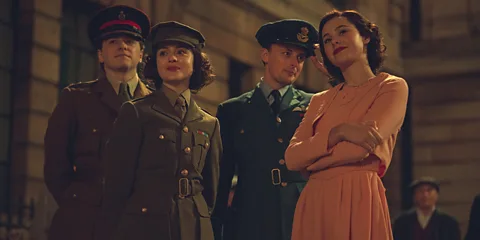
Although VE Day is dramatised in The Crown's season six episode "Ritz", the portrayal gives them just two accomplices, Lord Porchester, known as Porchey, and Group Captain Peter Townsend, later to become Margaret's forbidden first love.
 Getty Images
A conga line through the Ritz
Elphinstone's sister, Margaret Rhodes, recalled in her autobiography, The Final Curtsey: "We could scarcely move; people were laughing and crying; screaming and shouting and perfect strangers were kissing and hugging each other. We danced the conga, a popular new import from Latin America; the Lambeth Walk and the Hokey-Cokey."
Another friend, Jean Woodroffe, was one of Elizabeth's first ever ladies-in-waiting. She told the BBC in 2006 about how they managed to sneak undetected into one of London's most formal establishments. "What was amusing is that we went into the Ritz Hotel through one door and out of the other door, the other end, doing the conga. And the extraordinary thing was that nobody seemed to take much notice."
More like this:
After all that excitement, it was time to slip back into the crowds outside the Palace. The late queen recalled: "After crossing Green Park, we stood outside and shouted, 'We want the King,' and we were successful in seeing my parents on the balcony, having cheated slightly because we sent a message into the house to say we were waiting outside."
In subsequent years the late queen was known for occasional discreet outings, such as trips to West End shows, but so far as is publicly known she made only three further spontaneous, anonymous walkabouts, all to celebrate the end of the war. Princess Margaret told the BBC: "There was VE night plus one and then there was VJ and VJ plus one, so we got quite good at it."
Elizabeth II shared her diary entries from the time with her cousin Margaret Rhodes for her autobiography. The then princess wrote the next day, 9 May: "Out in crowd again – Trafalgar Square, Piccadilly, Pall Mall, walked simply miles. Saw parents on balcony at 12.30 am – ate, partied, bed 3am!"
They made two similar excursions that August for Victory over Japan Day, or VJ Day. On the day itself, she wrote: "Out in crowd, Whitehall, Mall, St J [James's] St, Piccadilly, Park Lane, Constitution Hill, ran through Ritz. Walked miles, drank in Dorchester, saw parents twice, miles away, so many people." On day two, she wrote: "Out in crowd again. Embankment, Piccadilly. Rained, so fewer people. Congered into house. Sang till 2am. Bed at 3am!"
Seventy-five years later, Elizabeth II, aged 94, gave a poignant televised address to mark the anniversary of VE Day. It was 2020 and the UK was in the grip of the Covid-19 pandemic, its darkest emergency since World War Two. "Today it may seem hard that we cannot mark this special anniversary as we would wish. Instead, we remember from our homes and from our doorsteps."
Reflecting on her teenage experience of VE Day, she spoke of her vivid memories of the jubilant scenes. "The sense of joy in the crowds who'd gathered outside and across the country was profound," she said. On the table in front of her, along with a portrait of her late father, was the same khaki-coloured cap she wore to disguise herself on that unforgettable night in 1945.
--
For more stories and never-before-published radio scripts to your inbox, sign up to the In History newsletter, while The Essential List delivers a handpicked selection of features and insights twice a week.
