'It was one of the key moments of my life': The thrilling fossil discoveries that sparked Attenborough's love for nature

 BBC
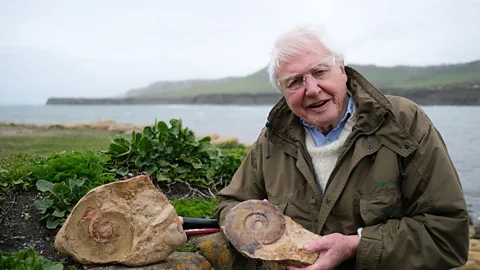
BBCFossils fascinated Sir David Attenborough throughout his childhood. The BBC retraces the steps of Sir David's formative experiences roaming the British countryside.
For Sir David Attenborough, it was a moment that would shape his childhood – and quite possibly his entire career.
It was the late 1930s, and he had cycled into the English countryside. Arriving at an exposed rock face, he began searching among fallen fragments below. He picked up a promising stone, and split it apart with his hammer.
"There, perfect in every detail, glinting as though it had just been polished, was a coiled seashell… an object of breathtaking beauty," he recalled in 2009. "And my eyes were the first to see it since its occupant died 200 million years ago."
Sir David Attenborough at 100
As Sir David Attenborough turns 100 years old, we look back to the key influences of his extraordinary career as a naturalist and broadcaster. You can read more on the eccentric photography pioneer who inspired his work here.
It was a fossil ammonite – a spiral-shelled creature around the size of his palm. Due to their coiled appearance, local people once believed they were snakes, but they were actually cephalopods: a marine mollusc similar to the modern-day nautilus, which swam in ancient oceans.
"I suppose it's true to say that it was one of the key moments of my life," he said. "I have been repeating that moment, off and on, throughout my life and the thrill has still not worn off."
This ammonite was just one of many ancient creatures Sir David collected as a teenager, near his boyhood home in Leicester, England. He was an avid fossil-hunter – and would continue to find and acquire interesting specimens throughout his life. "I spent a lot of time as a boy searching for fossils in the Leicestershire countryside. Indeed, fossils still give me great pleasure," he told me in a letter in May 2025, shortly after his 99th birthday.
Ever since I was a teenager, I've also collected fossils. So, one recent spring, I decided to trace Sir David's trips from his childhood home to the local sites he visited, hoping to gain a better understanding of his life before fame. How did his boyhood fossil-hunting hobby influence the young naturalist?
Collecting treasure
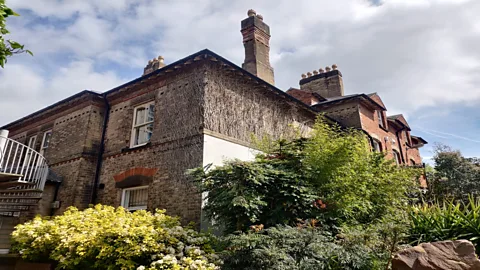
Sir David spent much of his childhood in Leicester, in the English Midlands. Today, the Attenborough family home sits in the middle of the city's university, its current occupants members of the science and engineering department.
 Richard Fisher
However, traces of the Attenborough family remain across the campus. Round the corner is an arts centre dedicated to his brother Lord Richard Attenborough, an actor who played many roles in his lifetime, including – aptly – the founder of Jurassic Park in the 1993 movie, who uses amber fossils to extract dinosaur DNA.
Looming over the brothers' former home is the 52m-tall (170ft) Attenborough Building – a brutalist 18-storey tower known as the "cheesegrater". Perhaps contrary to expectation given the two brothers' fame, the tower was named after Sir David's father Frederick, an academic historian and principal of the university.
In 2016, letters written by Frederick Attenborough during the 1930s and 1940s about his son were unearthed – and they hint at a boy fascinated by Leicestershire's geology, and who then wished to pursue the earth sciences as a career.
Speaking on his 90th birthday, Sir David explained that his father didn't necessarily know much about rocks and fossils himself, but "he did say, 'There are ways of finding out: you can go to the museum or there are some good books, you can read about that.' And so [he] encouraged us to find out for ourselves".
The letters also mention Sir David's collection of carefully labelled fossils, minerals and other treasures.
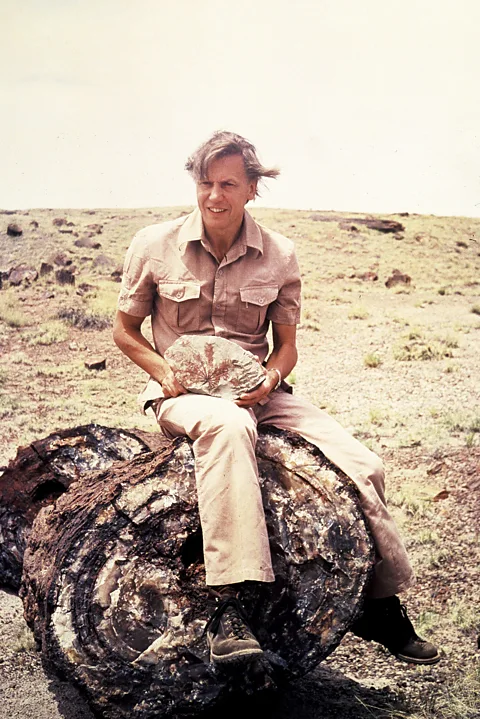
In his 2002 autobiography, Sir David described its contents – what he called his "museum". "Its backbone was my fossil collection gathered from Leicestershire rocks. It also contained butterflies, birds' eggs (legal at the time), abandoned birds' nests…bun pennies, champion conkers, the shed skin of a grass snake, and a fragment of Roman brickwork."
Via his father's university work, researchers and other visitors would often pass through the family home – and this gave him the opportunity to show off the collection. One day, a Nobel-winning biochemist visited with his daughter, the young archaeologist Jacquetta Hawkes (nee Hopkins), and he toured her through his specimens with pride. "When she showed interest in my fossils I felt I was walking 18 inches off the ground," he recalled in an interview with Mail Online in 2014.
Afterwards, Hawkes sent him a parcel, which he gladly received. "There was a pearly nautilus, a desiccated pipe-fish, some Roman tesserae and a medieval silver coin, a few grey shards of Anglo-Saxon pottery, cowrie shells from the Pacific and pieces of coral. Each was packed separately. Each was a treasure. It was one of the most memorable days of my childhood," he wrote in his autobiography.
When he was 12 years old, he also added a piece of Baltic amber (fossilised resin) to the collection, given to him by a young girl staying with the family. During World War Two, Sir David's parents took in some of the many children fleeing Germany. "I remember one girl, Marianne, she was 12 – about the same age as I was – and came from a city on the Baltic coast where her father was a doctor," he recalled in a 2004 film called the Amber Time Machine.
"He had given one small precious thing as a sign of his thanks to whoever it was who cared for his daughter. It felt surprisingly warm and light in my hand, but what made me fall in love with amber is what I discovered inside it. I found something miraculous: there were insects preserved in astonishing detail. I burned with questions: what sort of world were they from? They must have lived a long time ago, but how long?"
 Richard Fisher
Fossil firsts
Once he was old enough, Sir David explored far and wide in search of fossils to build his museum further. Aged 13, he spent three weeks alone cycling to the Lake District in North West England, staying in youth hostels. "I doubt many parents would let children do that now," he told the Mail Online in 2014.
Still, the geology close to home in Leicestershire also offered more than enough treasures to find. Many of the rocks in this central region of England are from the early Jurassic – and contain a variety of fossilised prehistoric life. Even today, palaeontologists still make significant discoveries: in 2021, a 10m-long (33ft) ichthyosaur – a "sea dragon" – was found in the Rutland reservoir, less than 50km (30 miles) to the east of Sir David's old home.
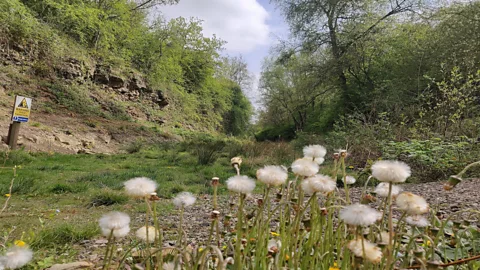
While exploring Sir David's boyhood trips, I traced one of the routes that he would have cycled in search of fossils. Travelling east out of the city from his home, the young man would have soon emerged into meadows and farmland, pedalling up and down steep country roads.
"There you could find pits where a honey-coloured limestone was quarried for smelting iron. In that there were some of the loveliest fossils imaginable," he recalled in his autobiography. "I would leave home early in the morning on my bicycle, with special home-made collecting bags strapped to the carrier over the back wheel, and sometimes would not come back until after dark with the bags loaded with specimens, each carefully wrapped in newspaper for protection."
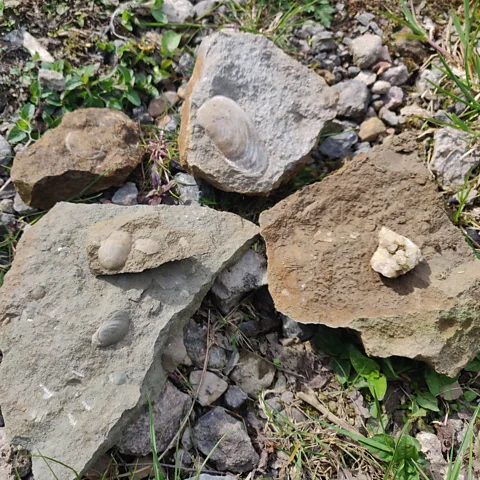
Another frequent destination was the village of Tilton on the Hill, one of the highest places in East Leicestershire. Today, it is little-changed: with a village shop, traditional pub and a church that dates from the 12th Century. It has special significance because it lends its name to Tiltoniceras, a Jurassic-era ammonite discovered in 1913 at Tilton Railway Cutting, a few kilometres east of the village. "When I found out… I decided that I must be living in one of the world centres of palaeontological treasure," Sir David recalled in his autobiography.
 Richard Fisher
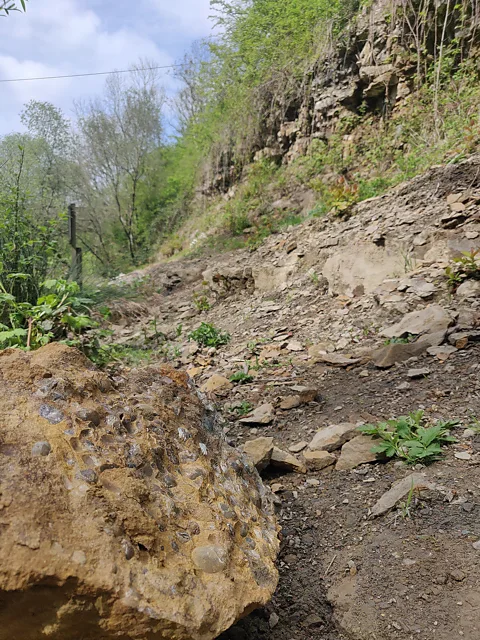
Over the decades, Sir David has often mentioned this ammonite and the cutting where it was found – and he returned to film there for a 2020 Netflix documentary. As a boy he would have known that the site was particularly rich for fossils because the rockfaces were relatively fresh. A few decades earlier, in the 1870s, workers had carved into the sandstones, ironstones and clays to make way for a railway line between Market Harborough and Melton Mowbray (famous for its pies). So, while he may have had to step over rails and sleepers to reach the rock-face, he would have been rewarded with abundant ammonites, but also bivalves and brachiopods (shelled creatures like mussels or clams), gastropods (with spiral shells) and belemnites (squid-like cephalopods).
"The moments of success when that rock fell apart and revealed a shell that hadn't seen the Sun for 200 million years, and that I was the first human being to see, seemed to me then – as to be truthful it still seems to me now – to be moments of magic," he recalled in a 1989 series about palaeontology for which he returned to Leicestershire. "It's a beguiling business, for you know that even if you've not found anything so far, the very next blow of your hammer might reveal something amazing."
 Richard Fisher
When I visited the cutting in April 2025, the railway had long since closed – it shut down in the 1960s – and the only sound was insects buzzing in the overgrown grass. Today, it is designated a Site of Special Scientific Interest, which means that while fossil hunters can search for specimens in fallen fragments, they are prohibited from bashing at the rock faces with their hammers. The kind of ammonites that Sir David remembered seeing can be found at the top of the outcrop, in what's called the Marlstone Rock: a mixture of limestone and sandstone that formed in a shallow, tropical sea 190 million years ago. But even more ancient shells are packed into a layer further down the rock face.
Tales of Charnia
Tilton Railway Cutting is not the only site in Leicestershire that has yielded fossil firsts over the years. Another location nearby would become even more famous, when a fossil was found that changed our understanding of life's origins. It was discovered by two schoolchildren, only 11 years after Sir David left school himself – much to his chagrin later in life. "The rocks to the north-west of the city were of no interest to me…they didn't contain any fossils. So I didn't waste my time by looking there. How misguided I was," he recalled in 2011.
 Alamy
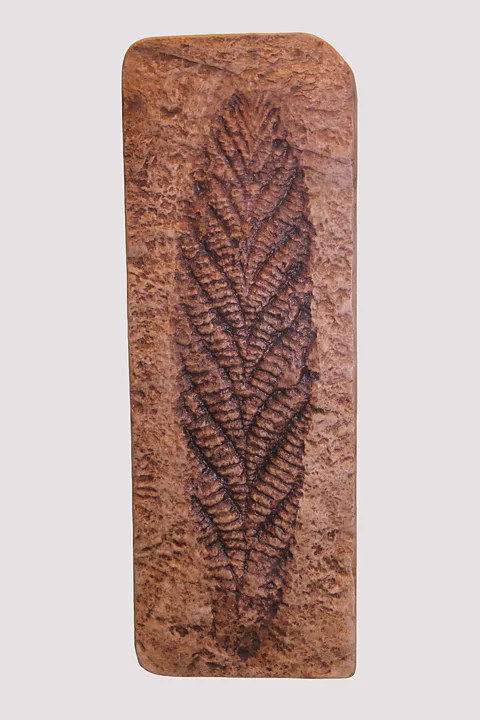
AlamyOne day in 1957, a schoolboy called Roger Mason cycled with two schoolfriends to climb in a quarry in Charnwood Forest, near the village of Woodhouse Eaves. (The area is now a Unesco geopark). There, they spotted something curious: a fossil with leaf-like branches that was unmistakably once alive. Mason knew that this shouldn't have been possible, because the rocks were pre-Cambrian in age, which would have made the fossil around 570-550 million years old. The geological consensus at the time was that life's origin happened later.
It would turn out that Mason and his friends weren't the first to spot it. In 1956, another schoolchild, Tina Negus, had seen the fossil, but her teachers hadn't believed her. When Mason told his father, however, he persuaded a geologist at Leicester University to take a look. He confirmed it had indeed been a living creature, and published the find in Proceedings of the Yorkshire Geological Society. It was named Charnia masoni, after Mason, and despite its appearance it was an animal, not a plant.
"It caused a geological sensation," Sir David recalled in a 2011 BBC radio programme about the fossil. Reflecting on his own childhood fossil-hunting, "I couldn't help wishing that I hadn't paid so much attention to the accepted geological wisdom of the time, and that I had been the schoolboy who found that key fossil in the Charnwood."
One can only wonder whether the attention from such a find might have changed the broadcaster's future path. Mason also, went on to study earth sciences – but unlike Sir David, would become a professional geologist.
Collecting continues
While Sir David may not have become the geologist he aspired to be in his teens, he would continue to collect fossils throughout his life, even when he was working on other projects.
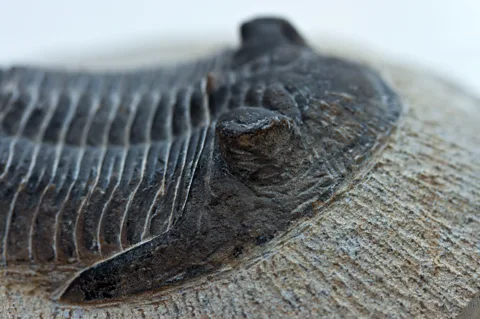
In 2011, for example, he told the story of how he was once duped by a fossil-trader into buying a pair of "copulating" trilobites: a scuttling creature with multiple legs and large eyes, a bit like a giant woodlouse. In a break between filming in the Atlas Mountains of Morocco, he tracked down a seller in a remote village.
 Alamy
Alamy"He had hundreds of them in a great pile in his back room," he recalled. "I started to try and sort through them, but… it was really quite dark and difficult to see. The owner kept producing specimens he called 'very special – very good!' Still, I couldn't make up my mind… He pulled my sleeve, 'This one,' he said. 'Very very special, very, very rare. Two! Together! Making love!!' I was astounded… Could I resist a pair of love-making trilobites? Of course not."
More like this:
However, later Sir David realised his mistake. "Of course, they were two separate specimens. One that was partly curled had been stuck to the underside of the other with some rather unconvincing plaster. It was, I suppose, a lesson. But I still have the pair of them. They are tucked away in my cellar so I am not continually reminded of my gullibility. But whether they are copulating or not, no one could reject creatures with eyes like theirs."
Trace fossils
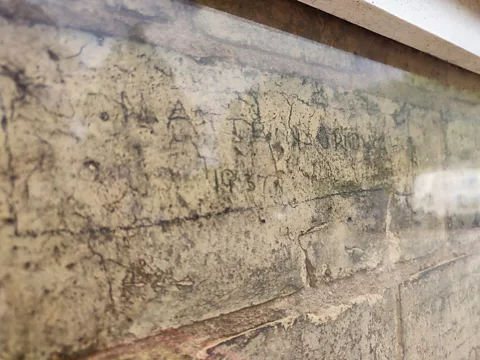
Back at Sir David's childhood home on the Leicester University campus, his museum of ammonites, rocks and other ephemera is no longer inside. However, on the side of the building you can see a "trace" fossil of a different kind, hinting at the people who once lived in the home.
 Richard Fisher
Behind a clear plastic panel, you can make out the faint scrawls of the Attenboroughs on the brick. At some point in the 1930s, they each signed their names, leaving behind the trace of the family who once lived there – and the boy whose fascination with fossils would shape a life exploring the natural world. Sir David's career would take him all over the globe, bringing nature's far-flung wonders closer to me and you, but it all began here, with a bicycle, a few local rock faces, and a teenager's prized collection of ancient creatures.
--
For essential climate news and hopeful developments to your inbox, sign up to the Future Earth newsletter, while The Essential List delivers a handpicked selection of features and insights twice a week.
