How much of our personalities are determined at birth?

 Emmanuel Lafont
Laurie Clarke delves into the devilishly complex forces that shape our personalities – and the new research revealing ever more about how our genes do, and don't, make us who we are.
In 2009, Abdelmalek Bayout faced a nine-year prison sentence in Trieste, Italy, for stabbing and killing a man who had mocked him in the street. Aiming to reduce the sentence, his lawyer made an unusual legal argument.
His client's DNA, he said, indicated the presence of the "warrior gene", a mutation that decades of scientific research had tied to aggressive behaviour. Because of this, the argument went, he couldn't be held fully accountable for his actions. The appeal was successful: a year was sheared off Bayout's sentence.
From the 1990s, evidence had accumulated of some kind of link between violent behaviour and a variant of a gene called monoamine oxidase A, or MAOA. By 2004, it had earned the media-friendly moniker of the "warrior" gene.
Since then, however, our understanding of how genes influence traits and behaviours has deepened significantly. "Initially, people thought that behaviours were influenced by a few genes with very large effects," says Aysu Okbay, assistant professor of psychiatry and complex trait genetics at Amsterdam UMC in the Netherlands. "That has been completely debunked."
Instead, over the past 15 years, a far more nuanced picture has emerged. Even traits thought to be highly heritable, like height, have proven far more complicated to isolate on the genome than once assumed.
Now, though, new methods for large-scale genetics studies are beginning to widen the picture. By revealing ever more about how our genes do – and don't – make us the people we are, they are yielding new insights into the devilishly complex forces that shape human nature.
The age-old question
People have long been fascinated by the extent to which our temperament and the trajectory of our lives is set at birth. Still, the origins of "personality", the relatively stable pattern of thoughts, feelings and attitudes that make up an individual, have proved difficult to pin down. (Read more about the millennia-long efforts to define personality types).
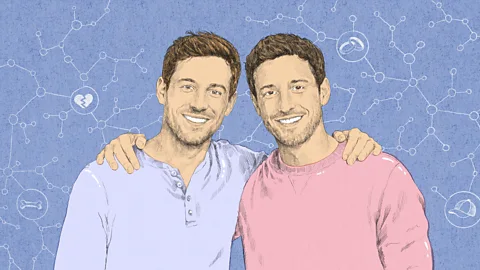
The question of "nature or nurture" was popularised in its current sense by English polymath (and the founder of eugenics) Francis Galton, who in 1875 helped pioneer a way of studying traits in twins. But his methods were rudimentary, and it wasn't until the 1920s that scientists began comparing the similarity of identical twins, who share 100% of their DNA, with fraternal twins, who share only 50%.
Twin studies have been popular ever since. Today, scientists have convened on the idea that personality consists of five broad dimensions: openness, conscientiousness, extraversion, agreeableness and neuroticism (often called The Big Five personality traits). And many twin studies have now examined whether these personality dimensions are passed down genetically.
 Emmanuel Lafont
A 2015 comprehensive meta-analysis of more than 2,500 twin studies between 1958 and 2012, covering almost 18,000 complex human traits, found (unsurprisingly) that identical twins are typically more similar than fraternal twins. But their personalities are certainly not identical.
For the 568 traits that were descriptions of temperament or personality, the study found that 47% of differences could be attributed to genetic differences. The remaining portion, it concluded, must be accounted for by environmental influences. Other studies seem to support this – only around 40-50% of personality differences are genetic.
The Jim twins
In 1979, American psychologist Thomas Bouchard set out to track down twins separated in infancy. He found that identical twins raised apart were often strikingly similar.
Most famously, Bouchard came across identical twins called Jim who had been separated at birth and reunited at age 39. "The twins were found to have married women named Linda, divorced, and married the second time to women named Betty," he wrote in a 1990 study. "One named his son James Allan, the other named his son James Alan, and both named their pet dogs Toy."
Critics, however, have argued that Bouchard's studies contained methodological flaws, and noted that such coincidences could easily occur between unrelated persons, if one drew from enough data.
Twin studies have always been an inexact art, often relying on estimates based on the differences between twins and other family members. But around 2010, huge strides in genetics began opening up other exciting new avenues to scientists interested in measuring personality differences.
The missing heritability problem
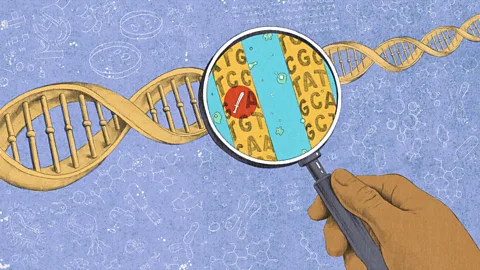
The human genome is an unwieldy beast: there are 23 chromosomes, containing around 20,000 genes between them. These are further subdivided into about three billion "base pairs" – the smallest unit in the genome – which are typically conceptualised as pairs of letters that unfurl in a particular sequence.
All humans share 99.9% of their DNA, meaning only a miniscule 0.1% of the genome accounts for our differences. While this helpfully limits the surface area that scientists need to examine, it still leaves several million base pairs to rake through. Despite the 2000s yielding cheaper and more easily accessible genomic data, locating the source of our differences within it has proved far trickier than once expected.
The past 15 years, though, has seen an explosion of genome-wide association studies, a method which examines millions of the smallest parts of the genome that can vary among humans, and tries to find associations between these and different personality traits.
The early days of these studies struggledto consistently identify DNA variants related to personality. We now understand one reason for this: human traits are "polygenic", with many different genetic variations each contributing a tiny effect that add up across the whole genome. For complex traits like personality, effects could be spread across thousands of DNA variants.
But even when combining a range of different DNA variants, the effects on personality remain smaller than anticipated. Heritability estimates currently span from 9% to 18% for Big Five personality traits, far below the 40% suggested by twin studies. What explains this "missing heritability"?
Perhaps by increasing the number of participants in these studies and improving their design as we grow our understanding of how different genes interact, stronger genetic effects will be discovered.
Today, though, when comparing the heritability estimates from twin and genome-wide association studies, it’s hard to know which is true, says Okbay. "It's probably somewhere between the two."
What about 'nurture'?
If it's possible that "nature" contributes less than we once thought, it might be tempting to attribute more of our personality to "nurture": the circumstances we grew up in, the people who surround us, the life events that shape our unique histories. It turns out, though, that understanding how our environment shapes our personality is just as complex.
Since studies show that personalities can change over time, you might assume that winning the lottery or losing a leg might trigger a transformation. But it turns out that one-off major life events only have a negligible impact on who we are. Factors like how we are raised or our social interactions also account for only a small portion of personality differences, studies repeatedly find. And while marriage might make one slightly less open, and childbirth may marginally reduce extraversion, taken individually, these events don't dictate much of who we become.
 Emmanuel Lafont
Exposure to certain kinds of trauma during childhood has been found to predict psychopathology and poorer cognitive functioning in later life, which can manifest in personality variables such as increased neuroticism. But adversity experienced as an adult seems to be far less consequential.
"That's been the big surprise in this research area… that if a big traumatic life event happens to you in adulthood, it doesn't leave this huge trace," says Brent Roberts, professor of psychology and at the University of Illinois at Urbana-Champaign, US.
The trauma narrative is beloved by popular culture – the idea that we experience personal growth as a result of the bad things that happen to us. But "trauma doesn't make you who you are", says Roberts.
What about the first environment we ever experience, floating in the amniotic sack? A growing body of research suggests that mothers experiencing stress during pregnancy could impact the temperament of their unborn child – part of a hypothesised phenomenon called "foetal programming".
For example, a 2022 study found that mothers who experienced greater fluctuations in stress had infants who expressed more fear, sadness and distress at three months old. There is not yet a clear understanding of why this happens, though an epigenetic mechanism – meaning changes in the gene expression rather than the DNA itself – is one of the candidates under consideration.
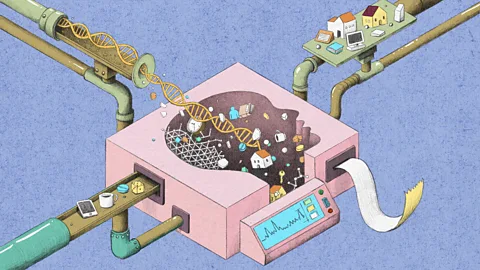
Overall though, researchers have concluded that in addition to being polygenic, personality differences are "poly-environmental". Like the many DNA variants across the genome that add up to a given trait, each of our life experiences exerts a small effect, which together combine to have a greater impact.
Genetic and environmental impacts also interact in ways we haven't yet fully grasped. For one, the environment appears to be able to activate or switch off certain genetic predispositions. "Genetic predisposition does not mean that in every environment, people behave in the same manner," says Jana Instinske, research assistant in the department of psychology at Bielefeld University in Germany.
A way through
These are incredibly knotty problems, but, at least on the genetics front, scientists claim to be making breakthroughs with the latest genome-wide association studies. The key? Hugely increasing the number of participants – with the latest analysing hundreds of thousands or even millions of people's genetic data at once.
"It's only now that we have sufficiently many individuals and genotype samples," says Okbay. "With this many small effects, you need really, really large samples to be able to detect them."
Studies conducted in the past decade have turned up hundreds of DNA variants associated with each of the Big Five personality traits. "A lot of the focus right now is on getting [the genomes of] more and more people, so we can discover more and more genes and build on what others have done before," says Daniel Levey, assistant professor of psychiatry at Yale University in the US.
More studies of people with non-European ancestry are needed however, adds Levey. "There are going to be very important cultural differences that we're missing out on by being laser-focused on one group," he says.
We are still far from understanding exactly what the tiny permutations across the many pages of our genetic code tell us about how personalities take shape. But some interesting findings are already emerging.
More like this:
Levey's study, for example, suggested that CRHR1, a gene related to the regulation of the body's stress response, is strongly linked to neuroticism in nervous system tissues. This gene has previously been linked to psychiatric illnesses including depression, anxiety and OCD, all of which are also associated with neuroticism. It suggests that this personality trait is closely tied to how the body naturally responds to stress.
Another highly anticipated study currently being peer-reviewed provides evidence for theories situating the seat of personality in the prefrontal cortex – the area of the brain responsible for complex functions like planning and decision-making. It finds that associations for all Big Five traits (except agreeableness) are enriched in genes expressed in this part of the brain. Interestingly, the study says, since dopaminergic neurons were not "among the most enriched neuron types", it could present a challenge to neurobiological theories of personality that posit an outsized role for dopamine in mediating extraversion and openness.
Many caveats and unknowns remain, even for the most studied areas of behavioural genetics such as the connections between violence and the so-called warrior gene. Studies indicate that in some groups of males, both the presence of certain moderator genes and certain environmental risk factors (such as an abusive upbringing) could increase the potential for violent behaviour in certain scenarios. But the results are far from clear cut.
So far, efforts to boil human behaviour down to a handful of genes or life events have failed. It turns out that humans are just far more complex.
What emerges above all is the mutability of the human condition, says Instinske. "It's not that if you have a certain genetic predisposition, you will always, throughout your entire life, behave in a certain way."
--
For trusted insights on health and wellbeing, sign up to the Health Fix newsletterby senior health correspondent Melissa Hogenboom who also writes the Live Well For Longer and Six Steps to Calm courses.
