The Ardèche: France's stunning outdoor playground

 Getty Images
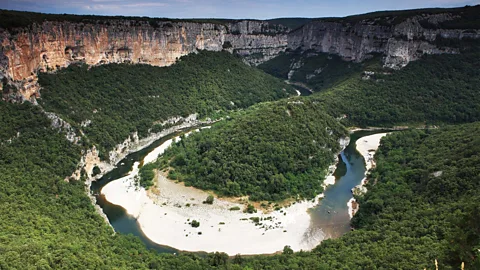
It's filled with rock-strewn ravines, stunning villages, more than 6,000km of cycling trails and blissfully few crowds.
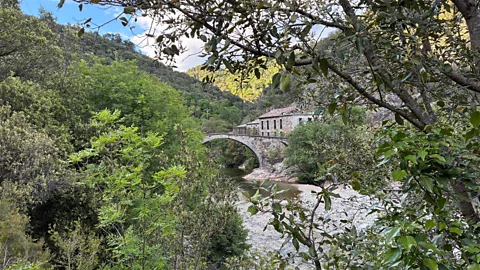
My bike glides downhill and the wind washes over me in an exhilarating wave. To the right, a waterfall tumbles down an emerald hill. Stone houses line the road up ahead. Minutes later, the medieval village of Chambonas appears, its charcoal-turreted castle perched on a hill. I pedal on, take a sharp left after crossing a bridge, and roll into the village of Les Vans, exhausted and elated.
I've just spent three days cycling around rolling mountains, past rock-strewn ravines and through forests and stone villages in the western Ardèche, where signs for homemade goat cheese, chestnuts and honey frequently appear on the roadside.
Despite its beauty, many international travellers never explore the Ardèche. Located between two of France's popular destinations (Lyon and Provence), it's one of the nation's most rural corners, which adds to its appeal. Its forested mountains, rushing rivers and steep karst valleys have made it a veritable playground for outdoor enthusiasts and a refreshing alternative to the crowds who descend on the streets of Paris or the beaches along the Riviera each summer.
 Erin Henk
Due to its unruly mountainous geography and low population density, the Ardèche is the only of France's 101 departments without passenger train service, an airport and a highway. Instead, its historic Train de l'Ardèche tourist steam train, centuries-old vineyards, medieval villages and ancient caves evoke a sense of France as it once was.
As I'm discovering, the Ardéche boasts more than 6,000km cycling trails and a rushing river, making it easy for adventurous travellers to explore the region's hills and rivers on two wheels and with a paddle. So, after filling up on Dauphiné ravioli at Don Camillo restaurant and strolling Les Vans' cobblestone lanes, I head east and explore the best of this rugged region.
Serpentine river
It's a 35km cycle (or drive) east from Le Vans along section six of the Grande Traversée de L’Ardèche to the village of Vallon Pont d'Arc. As I pass by rock formations, forest and sprawling vineyards, I'm lured by the sparkling Ardèche River snaking along the trail, and decide to take a 7km guided kayaking tour through some of its most scenic spots with Base Nautique du Pont d'Arc.
"You can drive for two hours and feel like you're crossing five different countries," Fabien Pignede, my guide with Base Nautique du Pont d'Arc, says of his home department as we paddle along the Ardèche River. "Different altitudes result in different ecosystems. That creates a lot of diversity."
 Getty Images
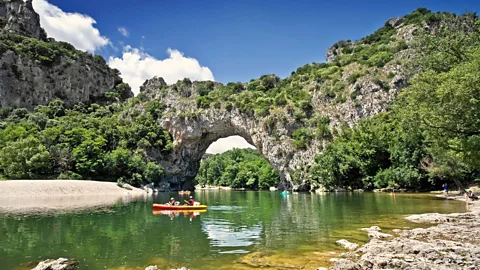
This serpentine river was carved a canyon out of limestone 30 million years ago. Today it's the 1,575-hectare protected Réserve Naturelle des Gorges de l'Ardeche (Ardèche Gorges Nature Reserve), and one of the most striking natural landscapes in France. Ripe with opportunities for hiking, canyoning, climbing, water sports and spelunking, it's also home to some 500 plant and 100 animal species.
On the water, Pignede and I paddle through forests of holm oak and Aleppo pine, under towering limestone cliffs and past sandy beaches where eager swimmers embrace the unusual May chill. After about an hour, the stunning Pont d'Arc emerges: a 54m-high (177ft) natural rock bridge carved by the currents 124,000 years ago. At the height of summer, this place is clogged with canoes and kayaks, but in late spring there are just a handful of other kayakers and cliff climbers.
Chauvet Cave was discovered next to Pont d'Arc in 1994. With paintings dating back 36,000 years to the Paleolithic era, it's 14,000 years older than the better-known Lascaux cave in Dordogne. Though the cave is too fragile to be open to the public, the nearby Grotte Chauvet 2 offers a visitor-friendly replica with a museum, and I'm soon wandering amongst replicas of a cave lion and woolly rhinoceros in its Aurignacian Gallery.
After my visit, I return to Vallon Pont d'Arc. From here, experienced cyclists could continue along route D290, known as the "Route des Gorges", which starts in Vallon Pont d'Arc and offers nearly a dozen incredible viewpoints of the river's oxbow bend and surrounding cliffs. It's not unusual to cross paths with wild goats as you navigate the winding, narrow mountain roads. Instead, I opt to head south.
 Alamy
AlamySubterranean worlds
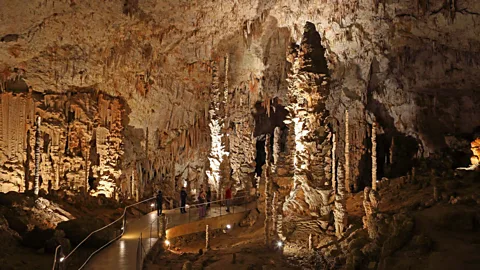
After winding 20km south along route D217, I arrive at the Aven d'Orgnac, the only cave classified as a Grand Site de France, a label that both recognises its importance and guarantees it is sustainably managed. I don't like heights or tight spaces, but I find myself strapped into a harness, teetering over a 50m drop into a dark passage below.
Locking ankles with my descent companion, Chloé, we steadily lower our ropes, careful to keep the same pace. We pass through darkness until everything expands into a glorious yawning space resembling an underground cathedral, expertly lit to reveal a cluster of towering stalagmites like gravity-defying sandcastles.
"It's like the Sagrada Familia!" Chloé says, as if reading my mind.
More like this:
Though I chose to enter the cave the same way as those who discovered it in 1935, travellers don't have to rappel like I did. In addition to a standard tour, they can descend into this 121m-deep cavern for wine tastings (Les Vignerons Ardéchois actually age their wine inside this cave) or embark on an aerial climbing course along the cave's ceiling called the "via-cordata".
 Erin Henk
From the land
There are countless signs advertising châtaignes (chestnuts) and chestnut-based products across the Ardèche. After stopping to taste everything from chestnut sorbet to a chestnut-baked financier cake to a Chestnut Kir Royale cocktail, I venture to the medieval village of Joyeuse to learn more about the region's most prized product at the Espace Castena museum.
The museum shows how the Ardèchois have long relied on chestnuts for food and its trees to help build their homes. Today, half of France's chestnuts, (about 5,000 tons per year) come from the Ardèche. The region holds a huge chestnut festival each autumn, and as a sign in the museum attests, the nut is a strong source of local pride: "The chestnut is not a wild tree, it is the fruit of the labour of its people."
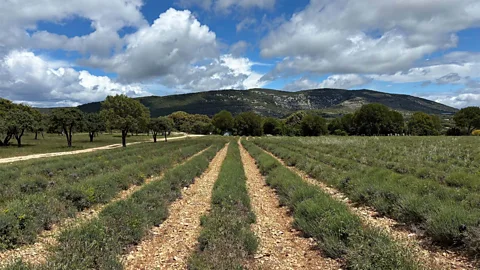
Signs for lavande (lavender) also dot southern Ardèche. One of the best places in the area to learn about them is La Maison de la Lavande, a 23-hectare estate with an on-site museum in Saint-Remèze. When I arrive, the fields have not yet exploded in purple, but I can still see violet speckles emerging in tidy lines of squat bushes. Nicolas Jouve, my guide, explains how pesticide elimination slows down cultivation but allows for a competitive product. "It remains artisanal," he says. "We're trying to showcase French craftsmanship."
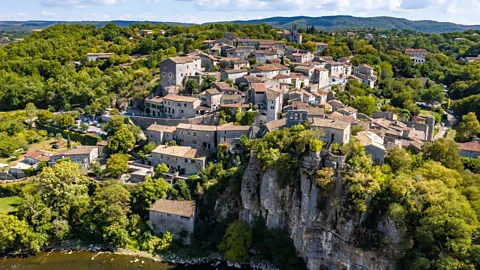
According to vintner Nelly De Boel France, owner of Famille De Boel France winery in Lemps, the region's steep slopes have historically thwarted large-scale agriculture. Instead, growers have had to create terraced faïsse gardens to survive.
 Getty Images
"The land is wild and dynamic and that has impacted everything," she tells me. "Everything had to be worked by hand. The land makes the people as well. It shapes their character."
Perhaps the most intimate way to explore this wild, dynamic land is the way its earliest residents did: on two feet. In addition to the Ardèche's 6,000km of cycling trails, it also boasts 6,000km of hiking paths. So after exploring the area by bike and kayak, I lace up my boots, follow a trickling stream up a rocky incline and climb past jagged rocks and pines to hike along the Tour du Tanargue trail.
As I step up the path, I turn around and gaze over the treetops behind me. Green mountains fold into one another in the distance and a breeze ruffles the nearby chestnut and pine trees. A couple of cyclists clad in Tropicana orange whirl past along the mountain road below. Apart from them, I seem to have this corner of France to myself.
--
If you liked this story, sign up for The Essential List newsletter – a handpicked selection of features, videos and can't-miss news, delivered to your inbox twice a week.
