Why the tech industry wants to take away your screen

 BBC/ Serenity Strull/ Getty Images
Some tech leaders have a vision for a world where you spend a lot less time looking at your phone. Is it the solution to screen time, or just a new dystopia?
If you've ever wanted your ears to have eyes, then I've got great news. It seems Apple is gearing up to release AirPods with cameras in them as soon as next year.
Apparently, these cameras aren't for taking pictures. According to Bloomberg, they'll feed information about your surroundings to its virtual assistant Siri, unlocking a whole set of new possibilities for how you might interact with your devices without looking at them.
Apple hasn't confirmed or denied the news, but the Bloomberg report comes from a journalist with a stellar reputation for leaking the company's secrets. And it's part of a broader trend.
For the past 60 years or so, screens have been the predominant way we have interacted with computers. Now it's possible they could fade further into the background.
Together with smart glasses and other wearable products like AI pendants you hang around your neck, some of the biggest tech companies are building a suite of devices that could let you spend far less time with screens. If this vision comes to pass, it might revolutionise the way we interact with computers.
This may or may not be a rosy picture. It would usher in either a softer and more humane relationship with the technology we use every day, or a future where tech invades even more of our lives.
But before we get there, you and millions of others will answer a more fundamental question: does anybody actually want this?
A farewell to screens?
Last week, Snap, the company behind Snapchat, unveiled a new pair of AI-powered smart glasses called Specs. They come with a spectacular price tag: £1,995 in the UK and $2,195 in the US.
And the biggest news about Specs was a TV appearance where the glasses seemed to be crushing chief executive Evan Spiegel's ears in a way that looked decidedly uncomfortable. (He later said his ears just look like that.) The Specs are significantly larger and heavier than most competing smart glasses – though a spokesperson tells the BBC they're comfortable enough to be worn for hours.
But Specs may have unprecedented features. Most importantly, the company says you can use them independently of other devices. Smart glasses usually need to be paired with your phone.
"For decades, computers have asked us to look down, sit still or step out of the moment," said Spiegel in a press release. "Specs are the beginning of a new era in computing."
 Getty Images
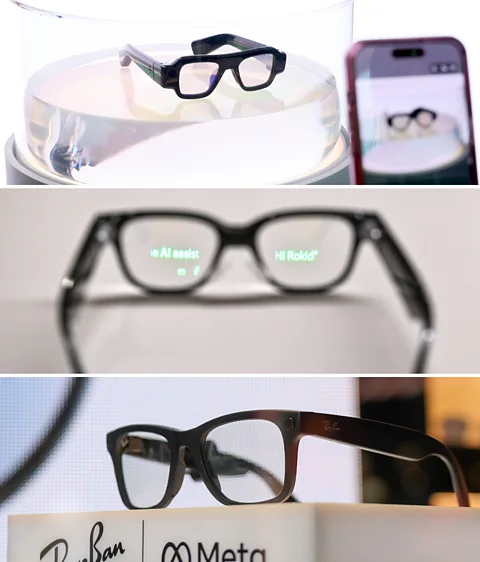
To be clear, the specs have a display in the lenses, as do some models of Meta's smart glasses, but they're not designed to replace your field of vision or even be a constant presence. Instead, the glasses will temporarily overlay a display on top of the world as you see it through your glasses.
There may not be a large group of people with the wallet and ear strength to bear a product like this. But for those who fit this unusual demographic, Specs offer something that really is new.
The market for smart glasses and other computers you wear on your body, meanwhile, is booming. Meta's smart glasses are the most popular with a reported seven million pairs sold, and just this week the company just announced a new line of cheaper models. However, these devices raise serious privacy concerns.
Smart glasses are controversial, to say the least. There's an entire genre of people on the internet who make money using the Meta smart glasses' built-in camera to harass strangers and surreptitiously record them. It can often be difficult to tell whether they're filming. (Meta and Snap's glasses have a little light that turns on that's supposed to alert people. Many argue this isn't enough.)
I talked to CNBC reporter Brandy Zadrozny on The Interface, the podcast I host for the BBC, about the privacy concerns.
"I was on my morning run and I asked a parks department worker when the water fountains were turning on, and he had the Meta glasses on," said Zadrozny. "Even for me, a tech reporter, it was so jarring. There's going to be so much backlash."
But Meta is reportedly considering audio-only smart glasses that don't use cameras. And if anyone can navigate this privacy minefield, it might be Apple. Privacy is core to Apple's marketing. And it's easy to imagine how its rumoured new product could skate around the privacy concerns.
Assuming the reporting is correct, the AirPods cameras won't let you take pictures or video like a regular camera. And Apple could – theoretically – process all of the camera's visual information on your on your phone without sending it to the cloud or saving it afterward.
So if we set the privacy concerns aside for a moment (and to be clear I'm not saying we should) what might this new world look like?
I see two ways to look at it. One is positive. Cameras in your AirPods could let you interact with all kinds of information about your physical environment without ever touching or looking at a screen.
You could ask questions about things you're looking at, open your fridge and get recipe ideas based on the ingredients you have without typing them in, or get navigational directions based on what's in your field of vision. And it would unlock new, far less intrusive ways to control devices, like hand gestures.
Maybe you don't want to do any of that stuff, but think of it this way. Right now, there's an extremely limited number of computing tasks you can accomplish without staring at a big glass rectangle.
Don't throw away your phone just yet
"Apple would not embed technology like this unless they had very credible use cases in mind," says Ben Wood, chief analyst at the tech industry market research firm FDM CSS Insight, and a noted expert on wearable tech. "It's almost limited by our imagination – what people will be able to do with these devices."
This surrounds what I think is one of the more interesting promises about AI. At its most successful, AI would let us talk to computers the way you would talk to a person who can operate your device on your behalf.
More like this:
And Apple is already launching a revamped, AI version of Siri which takes baby steps in that direction.
It all means you could move through the world, doing things with your devices, without taking your eyes off what is around you. In an era where screen time continues to be a persistent worry for some, this could be a very welcome change.
But here's a potentially grimmer vision of what may come. The tech industry is heavily invested in screens. Apple, for example, is a company that makes almost all its money selling products with screens on them.
If screenless devices go mainstream, then it could just be another way to get us to interact with technology more often. We all could start at screens just as much as we do now, and then have new screen-free technology for those moments when need your eyes for something else, like when you’re walking around.
"I'm a firm believer that the smartphone is going absolutely nowhere, it's part of the fabric of society," says Wood. "But I think there is a desire, by the tech industry and by some users, to lift our heads."
--
For more insights, sign up to our Tech Decoded newsletter, where Thomas and Lily Jamali break down the biggest stories of the tech world, and help you live a better digital life. Sign up for free here.
