The 14-course dinner redefining Zambian cuisine

 Courtesy of Sungani Restaurant
Fine dining in Zambia has long meant replicating European techniques. But chef Sungani Phiri's new home restaurant is boldly elevating Zambia's ingredients – and its culinary profile.
I'm sitting at an outdoor verandah with my family in a suburb of Livingstone, Zambia, when chef Sungani Piri brings out our fourth course.
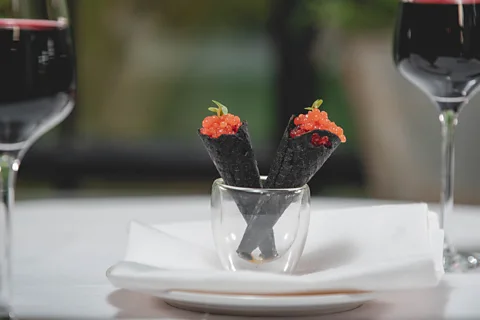
It's a black cone-shaped canape made of cassava, served on a bed of millet inside a black potjie – a three-legged cooking pot. Filled with avocado ice cream and topped with edible gold flecks, it's almost too pretty to eat. But I take a bite; it's simultaneously sweet and savoury. The gold, Phiri informs us, is an homage to the Copperbelt, Zambia's mining region.
These dishes are Zambia on a plate, yet unlike anything most travellers – or locals – will have encountered in the tourist capital, where restaurants usually cater to international tastes and fine dining has long referenced European techniques. Visitors hoping to try traditional Zambian cuisine typically encounter buffets of stews, boiled vegetables and nshima, the porridge-like cornmeal that is our staple food.
But Sungani Restaurant, whose fine dining tasting menu is entirely rooted in Zambia's indigenous ingredients and culinary memory, offers travellers a whole new way to experience Zambia's flavours – and a window into Zambian culture itself.
This is also Chef Phiri's home. And there are still 10 courses to go.
 Courtesy of Sungani Restaurant
New frontiers
Visitor itineraries to Zambia usually focus on activities that celebrate its immense natural riches, like walking safaris through Mopane forests or hiking the magnificent Victoria Falls; the world's largest waterfall. Rarely do travellers venture to quiet city suburbs, let alone dine there. But just half an hour's drive north of the Falls, Phiri has been quietly developing the country's first molecular gastronomic experience, and making its cuisine a destination in itself.
Before launching Sungani last year, Phiri trained with two-Michelin-starred chef Sven Niebremer in South Africa, then served as head chef at Royal Chundu lodge in Livingstone and Botanica in Lusaka.
Phiri's groundbreaking "New Zambian cuisine" was born from an argument. After culinary school, he planned to embrace the European fine dining techniques he'd been taught. But his sister challenged the notion as "pretentious" if done without grounding them in Zambia itself. Inspired, Phiri decided that his own fine-dining restaurant would elevate Zambia's culinary tradition and began experimenting with ingredients he had grown up eating.
"When I place a chibwantu root in someone's hands before they eat, I'm not just showing them an ingredient – I'm taking them somewhere," he explained. "To the river, to the bush, to a Zambian childhood. For an international guest it opens a door they didn't know existed. For a Zambian guest, it's a moment of recognition and pride – seeing something deeply familiar treated with reverence and wonder."
His decision to host the experience inside his own residence was equally deliberate. "When you want to honour someone here, you don't take them to a restaurant – you bring them to your table," he said.
In April 2025, Phiri welcomed his first guests and launched a tasting menu called The Rebirth. "I’m trying to use food to show the standard of the finest things this country produces and then translate that onto a plate," he said.
 Courtesy of Sungani Restaurant
Locally grown, locally loved
Upon arriving, my family and I are greeted by Alibesi Mwale Phiri, Phiri's wife and director of operations. "Twamilandilani," she said – "welcome" in Nyanja, one of Zambia's many local languages. "Please feel at home."
Plan your trip:
Travellers can reserve a table at Sungani Restaurant via email, phone or the restaurant's website. The tasting menu experience costs $215 USD (£160) and must be paid in advance. Booking at least three days out is recommended, though reservations can be made 7-14 days ahead. Because the menu is driven by seasonality, dishes and the number of courses may vary.
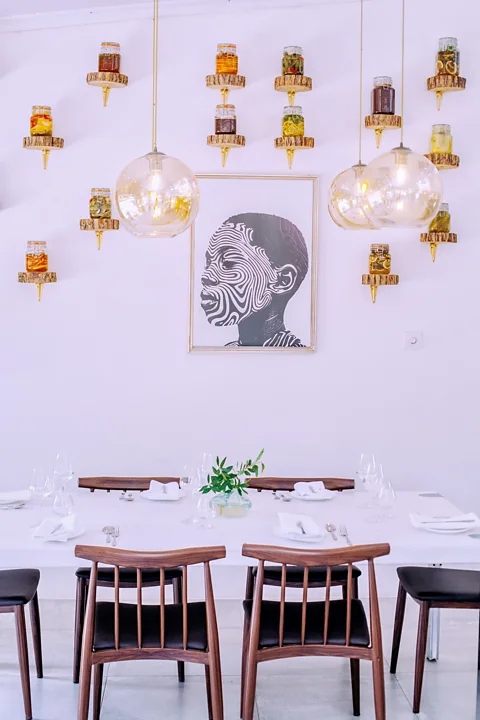
The restaurant seats just 22 people, with guests dining on a verandah beside the family's open-plan kitchen, divided by an island. A dining table functions both as the "chef's table" and family dining table. Phiri explained that all the restaurant's ingredients are sourced within a 100km radius, with his inspiration coming from farms and fish markets. "What's ready [in season], what's abundant, what's being overlooked. The menu follows that conversation," he said.
Depending on the season, the tasting menu spans 14 to 16 courses, many inspired by the Southern Province, where Livingstone is located. The project also doubles as a training ground for young Zambian chefs, three of whom were waiting on us that evening. "Groups of chefs come to learn here, and the first thing we focus on is indigenous ingredients," Phiri said. "Most young Zambian chefs have never cooked with them seriously."
Fourteen voyages into Zambia
Dinner begins with a welcome drink made from tart mundambi, Zambian hibiscus, topped with a square of hibiscus candy. The pink, frothy beverage transforms an ingredient more commonly associated with fruit jellies into something elegant and refreshing.
 Courtesy of Sungani Restaurant
Several starters arrive in slow succession, beginning with a marshmallow made from pureed bondwe, a spinach-like vegetable usually served alongside nshima. The avocado and cassava cone comes next; cold, crunchy and creamy on our tongues. A savoury dumpling filled with free-range "village chicken" is served alongside an egg yolk, julienned carrots and bok choy. We are offered the "onion shot" – shot glasses of room-temperature onion soup – before receiving beef pâté with delele (okra) and crayfish pai tee: crispy pastry shells stuffed with crayfish from the Zambezi River.
Phiri returns with a sheaf of chibwantu reeds in hand for the ninth course, a palate-cleansing cocktail called "Where It All Began". The reeds are used as the raw ingredient in Zambia's traditional fermented beverage, but here it is transformed into a gin-based cocktail served inside a snail shell and garnished with green apple slices.
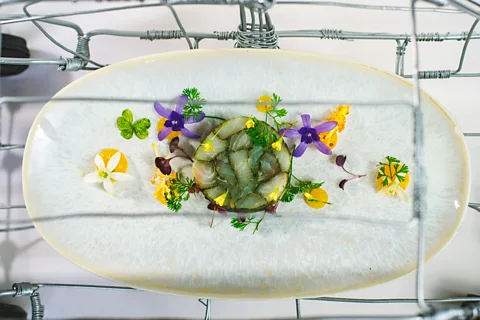
After a bread and jam platter – called, aptly, "The Journey To Home" – which includes freshly baked cassava wraps and a sweet, dense bread made from mabisi (sour milk), the tasting experience returns to the water. Zambezi bream, a species similar to tilapia, has fed communities along the river for generations and is typically served whole and grilled. Phiri's show-stopping version has thin slices layered into a mosaic and flavoured with lemon zest, ginger syrup and parsley powder. Okra caviar and edible gold flecks complete the dish.
The standout ingredient in the steak course is dried caterpillars (ifinkubala). In traditional Zambian cuisine, they are deep fried, but Phiri grinds them to powder to create the steak rub. "The ingredient is fully present, but the technique creates a bridge," he explained, acknowledging that some international diners may baulk at eating insects.
More like this:
After the steak, we are ready for something sweet – the final course. We are presented a frozen cube of vitumbuwa cheesecake inspired by the eponymous Zambian-style beignet that is usually eaten as a snack or on-the-go breakfast. Phiri's version is filled with coffee-flavoured cream, a nod to Zambia's northern coffee-producing region.
"Every region has something to say," said Phiri. "The tasting menu is my way of bringing Zambia to one table."
By the time we complete the culinary experience, both our bellies and brains are stuffed with Zambian culinary history. For me and my family, Phiri's dining experience has achieved something simple, yet precious: it showed us how our national cuisine can be elevated, giving us new respect for the beloved ingredients. But most of all, it's putting Zambia on the map, one delicious ingredient at a time.
"Zambian cuisine deserves to be told on the world stage, on its own terms," said Phiri.
--
If you liked this story, sign up for The Essential List newsletter – a handpicked selection of features, videos and can't-miss news, delivered to your inbox twice a week.
