Chasing the rare 'lunar rainbow' at Victoria Falls

 Sarah Steger
A "moonbow" is one of nature's rarest sights – and Victoria Falls is one of the few places on Earth where travellers might catch it.
The first thing I noticed was not the darkness, but the sound.
It began as a low, distant rumble, easy to mistake for wind. But as the path narrowed and the trees thinned, the noise deepened into something more primal, swelling into a relentless roar that pressed against my chest. By the time I reached the edge of the waterfall, the sound was no longer just something I heard but something I felt, pounding through me like the blood through my veins.
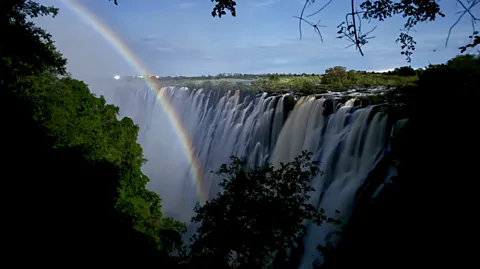
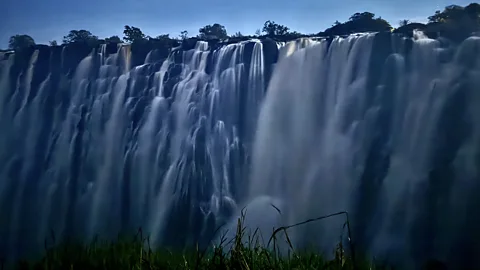
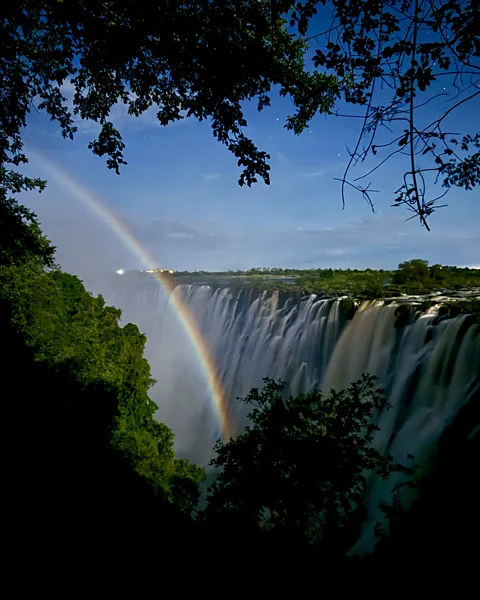
There were no floodlights. Only the pale wash of a rising full Moon and the thick blue-black ink of the Zambian night. Beyond the darkness, water plunged more than 100m (328ft) into the gorge below, sending vast columns of spray high into the air.
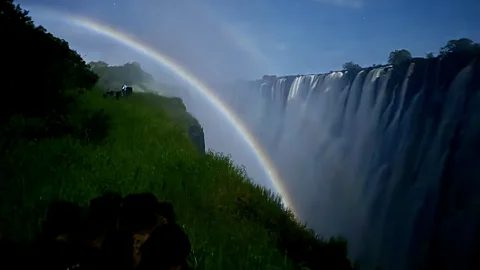
Then slowly, almost imperceptibly, the reason we had come began to take shape: a pale smudge in the spray, easy to miss unless you were looking directly at it. Then a curve emerged: a soft, luminous band stretching across the darkness, suspended above the gaping gorge below.
This was the "moonbow" – a lunar rainbow formed not by sunlight, but by moonlight.
 Sarah Steger
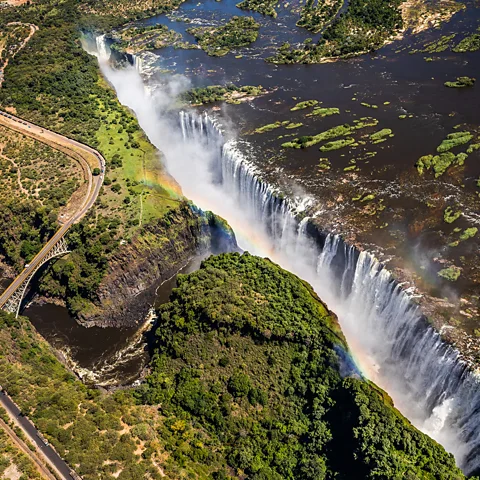
Straddling the border between Zimbabwe and Zambia, Victoria Falls – known locally as Mosi-oa-Tunya or "The Smoke That Thunders" – is one of the world's great waterfalls. Around one million people visit each year, most of them in daylight. But after dark, during the full Moon period, the experience changes completely.
I had not planned to be there at night. Just hours earlier, I had crossed into Zambia after a long, confusing border process from Botswana, exhausted from more than five weeks driving solo across parts of southern Africa. By the time I reached Livingstone, the only thing I knew for certain was that I wanted to see the falls.
Being there for the moonbow felt like a lucky accident. When I arrived at the park entrance about noon, a parking attendant asked if I wanted him to hold my parking spot until later that night. When I asked why, he explained that the full Moon was rising – and this was one of the rare nights when the falls might reveal their nocturnal rainbow.
So I bought two tickets – one for daylight and one for after dark.
That afternoon, I crossed Knife-Edge Bridge, a narrow 40m- (131ft) long span running parallel to one section of the cascade, and was drenched within seconds. The air itself seemed to turn to water, every gust of wind carrying a fresh barrage of heavy droplets that soaked through my clothes and skin. At each viewpoint, the falls revealed themselves in fragments – a vast curtain of white mist here, a churning void there – until finally, at the edge of the trail, the full scale came into view: a near-continuous curtain of water stretching across the horizon.
 Getty Images
After an hour of watching in silent awe, I made my way back to town, where I set up my tent and stocked up on some much-needed supplies. That evening, still not fully dry, I returned to the falls.
Moonbow-viewing tips:
• For the best chance of seeing a moonbow, plan your trip around the full Moon, ideally two to three nights before and after when the moonlight is strongest, says tour guide Omen Mudenda.
• The best viewing months are usually February to July, when Victoria Falls has a strong volume of water and spray.
• Bring a waterproof jacket or poncho, comfortable non-slip shoes, a camera with low-light settings and an extra warm layer during the cooler months.
• Because access to the falls at night is controlled, Mudenda recommends booking a guided moonbow tour ahead of time, particularly during peak travel periods. A guide can also help visitors move safely between viewpoints as conditions shift through the night.
Moonbows form in much the same way as daytime rainbows – through the refraction, reflection and dispersion of light in water droplets.
Moonbows are rarer than rainbows because they are fainter and so are best seen when the Moon is near full and at its brightest," Dr Kimberly Strong, a physics professor at the University of Toronto, later explained.
For a moonbow to appear, several conditions must align: a bright Moon low in the sky, cloud-free skies and enough water droplets in the air. The observer must also be positioned with the Moon behind them and spray in front.
Victoria Falls is one the few places in the world where moonbows can be seen with some regularity, thanks to the sheer volume of water mist rising from the falls. Even so, there is no guarantee. The window is narrow, usually limited to a few nights each month and only visible for a few hours each time.
 Sarah Steger
By 20:00, a small group of people had gathered along the dark path, waiting for the Moon to rise high enough. Waiting for the light to align. Waiting for something that may or may not appear at all.
The waiting itself became part of the experience. Now and then, someone eagerly pointed into the mist, convinced they'd spotted it; a faint arc that dissolved as quickly as it appeared.
And then, finally, there it was.
Seeing the moonbow felt surreal after so much uncertainty. The reactions of the people around me mirrored my own: quiet gasps and half-laughed disbelief. For a while, no one uttered a word, as if speaking too loudly would make it disappear.
The moonbow had none of the sharpness of a daytime rainbow. Its light was diffused, its colours subdued and its edges softer. Strong told me that because moonlight is so much fainter than sunlight, moonbows appear dimmer and their colours are harder for the human eye to distinguish.
Around me, cameras clicked softly, their long exposures revealing what the eye could not fully capture: streaks of red, blue and violet hidden within the pale white arc.
 Sarah Steger
"Many guests say it feels almost spiritual standing in the darkness, hearing the falls, feeling them and suddenly seeing a rainbow created by moonlight," said Omen Mudenda, a tour guide with Victoria Falls Expeditions. "It is a memory that stays with people for life."
I spent more than two hours watching the moonbow, moving between viewpoints and footbridges, trying to find the best angle and take in the scale of what I was seeing.
More like this:
By 22:30, the cold had begun to settle in. My clothes, long since soaked through, clung heavily to my skin as the arc started to dissolve back into the cloudy spray, leaving nothing but darkness and the constant rush of water in its wake.
Back at camp, under the same full Moon, the world felt unusually still. I cooked in the dark, piecing together a makeshift meal, still damp and slightly disoriented from the experience.
Later, lying awake, I thought about how easily I could have missed it. A different turn at the border. A longer delay. A decision to skip the night visit altogether.
"Optical phenomena like moonbows are captivating because they are so beautiful but also so fleeting," Strong said. "You have to be in the right place at exactly the right time, making it a magical experience when you do see them."
The moonbow is not usually something most travellers simply stumble upon. It requires timing, patience and a willingness to wait without certainty – qualities that today feel almost as rare as the phenomenon itself.
--
If you liked this story, sign up for The Essential List newsletter – a handpicked selection of features, videos and can't-miss news, delivered to your inbox twice a week.
