Attacks inquiry revealed miscarriage of justice, victim's mother says

 Supplied
A public inquiry into the Nottingham attacks revealed a "catastrophic collapse of responsibility" and an "undoubted miscarriage of justice", the mother of one of the victims has said.
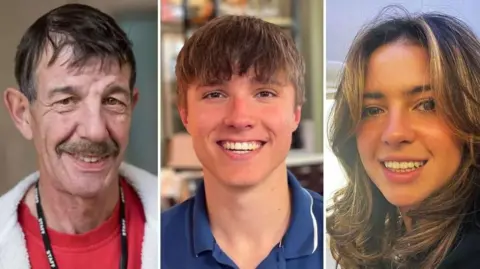
Valdo Calocane, who had been diagnosed with paranoid schizophrenia in 2020, stabbed to death Barnaby Webber, Grace O'Malley-Kumar and Ian Coates, and tried to kill three others in Nottingham on 13 June 2023.
The lead-up to the attacks and the aftermath were scrutinised during a 14-week public inquiry, which concluded on Friday.
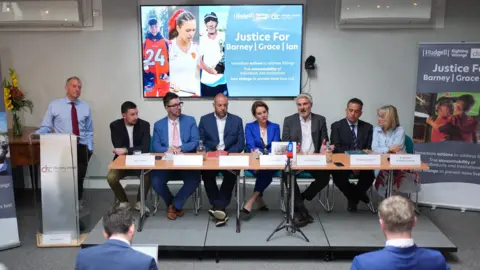
Speaking at a joint press conference held by the bereaved families in London on Monday, Barnaby's mother Emma Webber said: "It has been brutal, bruising and harrowing beyond measure - but it was so very necessary."
Emma added there had been "cover-up over candour".
She said: "This wasn't bad luck. It was a catastrophic collapse of responsibility. An undoubted miscarriage of justice that must now be addressed."
Emma is urging the government to meet the families within the next month, adding they would be calling for "urgent re-examination".
Emma said: "The findings of this inquiry will not be made until spring of next year, however, that does not prevent action from being taken now.
"This isn't about vengeance, it's about doing the right thing. Excuses stop here and accountability starts today."
Speaking to BBC Woman's Hour earlier, Emma added the families would be "looking at every single option", and that they were expecting to meet the Attorney General.
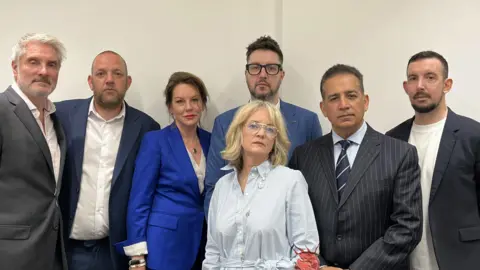
Lawyer Neil Hudgell, who represents the bereaved families, told the press conference there was "no legal platform" for the families to change Calocane's sentence, and said part of their approach was to go to the prime minister and the health secretary.
Prime Minister Sir Keir Starmer's official spokesman said: "We're determined to ensure that nothing like this can ever happen again, and the Nottingham Inquiry is helping to build a clearer understanding of the events that led to this.
"We're committed to delivering the fundamental changes needed to prevent violence by those who are mentally unwell."
The Nottingham Inquiry - the hearings of which began on 23 February, heard from 164 witnesses and ended last week - laid bare a series of failings by authorities, including the NHS and police, in the years leading up to the attacks and in the aftermath.
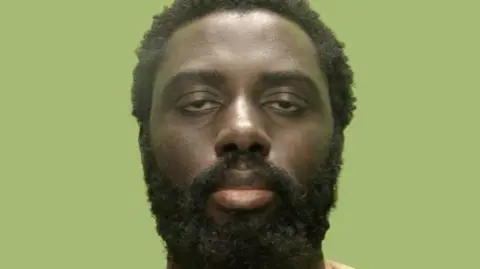
Calocane is currently serving an indefinite hospital order after pleading guilty to three counts of manslaughter on the grounds of diminished responsibility, and three counts of attempted murder in relation to survivors Wayne Birkett, Sharon Miller and Marcin Gawronski.
The bereaved families have maintained the attacks were avoidable and never been happy with Calocane's sentence.
Now oral evidence has concluded, the core participants of the inquiry will share closing statements at hearings in September, before the chair of the inquiry - retired senior judge Deborah Taylor KC - is expected to release a report with her recommendations next year.
Ian's son, James Coates, said for "what felt like a very long time", he and the other bereaved families believed "institutions did everything they could".
"Unfortunately, we were delusional in our belief that justice would be served," he added.
"For two and a half years, we've watched organisations close ranks, mark their own homework, and the inquiry must be the true reckoning."
Speaking to the BBC after the press conference, James's brother Lee Coates said while the inquiry had highlighted numerous failings, he did not have much faith in the organisations involved to make changes.
"I still think there's a hell of a fight on our hands," he added.
As the bereaved families approach the third year since the attacks, they said they were "disappointed" not to have heard from any authorities in Nottingham.
Darren Coates, Ian's eldest son, said the lack of communication and a lack of a memorial to the victims of the attacks was a "kick in the teeth".
"To me it's like they've moved on already, and I know it's three years and it's our tragedy, but it happened in our city.
"And they were quick to shake our hands and take a picture, and promise us the world," he said.
The leader of Nottingham City Council, councillor Neghat Khan, said: "The council will reflect on the lessons and recommendations from the inquiry when they are published.
"Nottingham will never forget, and our thoughts are with the families of Ian, Barnaby and Grace, and those who suffered injuries on the tragic day in June 2023."
At the press conference, Barnaby's father David Webber said: "I can't get to my death bed without change.
"How many people need to die? How many people need to be assaulted for change to happen?"
Later, David told the BBC: "I don't want to be seen as a campaigner, but I know that's sort of what we had to become.
"Where it ends I don't know. I don't know if it ever will."
Dr Sinead O'Malley-Kumar said: "We can't have these inquiries without meaningful change afterwards."
In 1993, the Ritchie Inquiry was set up to examine the care and treatment of Christopher Clunis - a mentally ill man who killed musician Jonathan Zito in December 1992 - and led to the publication of numerous recommendations.
Sinead said: "The recommendations of the Ritchie report were put in place, they were short-lived and they fell away."
It was important, she said, for any recommendations made to be "enforced".
 Nottinghamshire Police
None of the organisations involved in the inquiry will have a legal obligation to implement changes in response to any recommendations made by the chair of the Nottingham Inquiry.
Held at Mary Ward House in London, it heard how staff at a number of organisations, including Nottinghamshire Police, inappropriately viewed records or information related to the fatal attacks.
In May, Nottingham University Hospitals NHS Trust confirmed it had dismissed 11 members of staff for inappropriately accessing medical records, while 12 had received final written warnings and two had first written warnings.
The Independent Office for Police Conduct launched five investigations into police forces after the attacks.
During the inquiry, the director general of the policing watchdog admitted it had "let down" the affected families.
The former chief constable of Nottinghamshire Police, Kate Meynell, admitted in her evidence that Calocane should have been arrested before he killed Barnaby, Grace and Ian.
A warrant for his arrest was issued in September 2022, after he failed to appear in court for assaulting PC Barnaby Pritchard. Calocane had attacked him a year earlier while he was being detained under the Mental Health Act.
Calocane was in hospital when he was due to appear in court after being sectioned on another occasion. However, police had nine months to execute the warrant.
Police bosses admitted not arresting Calocane had been a "serious and systemic and operational failure".
Dr Sanjoy Kumar, Grace's father, said it was "perhaps the biggest missed opportunity".
 Yui Mok/PA Wire
At Calocane's sentencing hearing in January 2024, the court was told he had no previous convictions.
However, the inquiry heard he had a history of police interactions linked to violent incidents, including the assault on Pritchard, dating back to 2020.
Calocane had been sectioned four times while under the care of Nottinghamshire Healthcare NHS Foundation Trust, before he was discharged to his GP in 2022.
The inquiry heard he was discharged by the trust's Early Intervention in Psychosis service, because he failed to turn up for appointments, and that the team had "lost" him.
David Webber added: "I hate to say it, but even people like Calocane deserved the help.
"He didn't want it and he was not prepared to have it, but he should have had it."
In May 2020, Calocane was experiencing a psychotic episode when he kicked in the door of a woman's flat at Brook Court in Radford.
The woman fell from the window as she attempted to flee and was left needing metalwork and screws surgically fitted to her spine.
She said a police officer told her Calocane could not be prosecuted at the time because of his mental health.
Speaking at the press conference earlier, Ian's son Lee Coates added: "I think if people did their jobs properly back in 2020, we wouldn't be sat here now."
Greg Almond, head of serious injury at Rothera Bray Solicitors - which is representing survivors Wayne and Sharon - said: "Wayne Birkett and Sharon Miller are Nottingham residents - ordinary, hard-working people who were walking to work on the morning of the attacks.
"A consistent and troubling theme that emerged following the attacks, is that the survivors were treated as an afterthought and their basic rights as victims were not properly delivered. On several occasions, they learned distressing information from the media that should have been communicated to them sensitively by the police.
"Moving forward, action must be taken to improve public safety. We must recognise that major cities outside London, the south east and Manchester need the same level of attention and investment, rather than being overlooked. Nottingham is a major city and must be properly funded and supported.
"Survivors now want accountability, transparency, and meaningful change so this cannot happen again."
Listen to BBC Radio Nottingham on Sounds and follow BBC Nottingham on Facebook, on X, or on Instagram. Send your story ideas to eastmidsnews@bbc.co.uk or via WhatsApp on 0808 100 2210.
