Staffing levels in team that treated killer 'dangerous'

 The Nottingham Inquiry
The staffing levels at an NHS mental health service that treated Valdo Calocane for paranoid schizophrenia before he killed three people in Nottingham were "dangerous", a public inquiry has heard.
Calocane, who killed Barnaby Webber, Grace O'Malley-Kumar and Ian Coates on 13 June 2023, was sectioned four times while under the care of Nottinghamshire Healthcare NHS Foundation Trust until he was discharged in 2022.
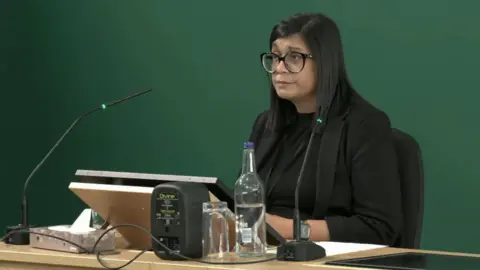
Dr Vidyah Adamson, clinical lead for Early Intervention in Psychosis (EIP) services at the trust, joined the organisation in 2020.
On Tuesday, Adamson told the inquiry into Calocane's killings that she had raised concerns to bosses about the volume of patients staff were dealing with.
 Supplied
The Nottingham Inquiry, hearings of which began in London on 23 February, is exploring the Nottingham attacks, as well as the events leading up to them and the aftermath.
Earlier, Adamson was asked to explain a presentation she gave to bosses back in August 2020.
In it, she found the EIP service was "really struggling" and the dedicated operation was disbanded in 2017.
She added there had been "no investment to the service over many years" and there were "no dedicated" EIP staff.
The presentation also showed the Nottingham city area had a patient-to-care-co-ordinator ratio of 27:1, which Adamson said were "dangerous levels".
The inquiry would go on to hear the recommended guidance is 15:1.
 Nottinghamshire Police
Counsel to the inquiry Rachel Langdale KC asked if Adamson stood by that assertion.
She said: "It was a serious risk to patient safety in my professional opinion, if you were looking at caseloads beyond 25.
"It was professional recommendation that caseloads above 25 would mean that you aren't able to deliver good EIP care.
"This reflected my professional concerns and they were raised with my line manager and the clinical commissioning group."
'It was failing'
She added there was a push to recruit more staff "in order to meet national standards".
The inquiry also heard that in Adamson's notes from March 2021, she said: "I think it's fair to say that the EIP service in Notts Healthcare was really struggling."
Langdale asked: "Basically it was failing, wasn't it?"
Adamson replied: "Yes."
Asked about record-keeping within the trust, Adamson said there had been "no proactive monitoring of any of the quality standards" when she came into the post in January 2020 and data was "not gathered properly" .
She said there had been "circling conversations with commissioners" who said they were improving things but "didn't provide data to prove this".
"There was no way to demonstrate any improvements that were happening because they were not capturing the data to allow that," she added.
"When I first joined - both EIP managers before me raised concerns around mixed caseloads, caseload sizes - I was trying to understand and address that."
Calocane is currently serving an indefinite hospital order at a high-security facility after he pleaded guilty to three counts of manslaughter on the grounds of diminished responsibility and three counts of attempted murder.
Later on Tuesday, Amber O'Brien - the professional lead for mental health at the Royal College of Nursing - told inquiry chair and retired senior judge Deborah Taylor KC that it was "no secret" that the system was unsafe because of staffing levels.
Inquiry counsel James Weston asked her: "Accurate note-taking is one of the core principles of good nursing, isn't it?"
O'Brien replied: "I want to make it clear that the current pressures in the system make it incredibly difficult for nurses to practise safely.
"It's no secret, actually, amongst nurses that the current system is unsafe.
"And note-taking and record-keeping is impacted by workforce shortages, massively."
The inquiry continues.
Listen to BBC Radio Nottingham on Sounds and follow BBC Nottingham on Facebook, on X, or on Instagram. Send your story ideas to eastmidsnews@bbc.co.uk or via WhatsApp on 0808 100 2210.
