Derby firms driving new high‑speed freight tech

 BBC
BBCDerby-based rail firms are developing faster high‑speed freight technology to speed goods from ports into the East Midlands.
Rail companies Alstom, Yellow Rail and Rail Operations Group have joined forces to boost freight train speeds for services running into the East Midlands Freight Terminal near Kegworth in Derbyshire.
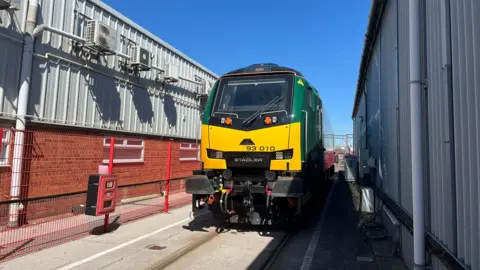
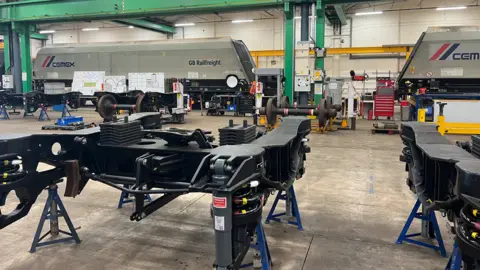
The project is progressing at the city's Litchurch Lane site, centred on the new 110mph (160kmh) Class 93 locomotive, but developers must now redesign the wagons, which travel at 75mph (120kmh), so the trains can run at full speed.
Enabling freight trains to run faster will remove thousands of lorries from roads, ease congestion and cut emissions, the firms added.
Christine Fernandes, UK transformation director at Alstom, said: "The limitations on freight trains include the speed at which they travel, meaning they take longer to complete journeys.
"The network is already quite heavily used, so increasing their speed would reduce journey times and create more capacity, allowing additional freight trains to transport commodities more quickly."
Noel Travers, CEO of Buckland Rail, said the developers were trying to redesign the part of the wagon called the "bogie", which is the component that links the wagon body to the wheel sets and track.
Travers said its suspension system was one of the sections needing "major upgrades" to be able to travel as fast as the Class 93.
The Class 93 locomotive, derived from the Class 68 and Class 88 designs, can reach 110 mph thanks to its "tri‑mode" system that enables operation via overhead electric, diesel, or battery power.
"Rail freight makes much much less pollution than the equivalent road freight," added Travers.
"A freight train with 22-25 wagons on it would take 25 lorries off the road network, so moving freight to the railway is going to be better for our environment, but it's also going to be better for our everyday life."
Listen to BBC Radio Derby on Sounds and follow BBC Derby on Facebook, on X, or on Instagram. Send your story ideas to eastmidsnews@bbc.co.uk or via WhatsApp on 0808 100 2210.
