Would you give up your seat on the Tube for me?

 Getty Images
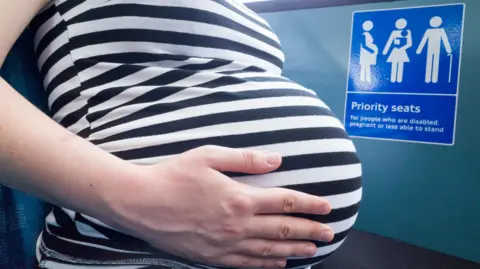
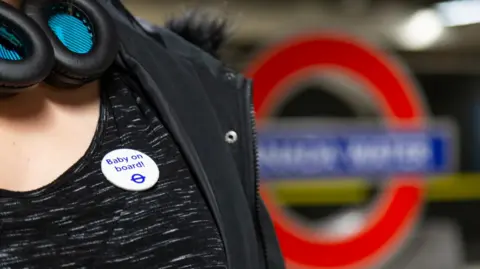
It's a small badge that made a big difference. For the past 20 years, Transport for London's "Baby on Board" scheme has reshaped behaviour on public transport through a simple social signal. But does it still work?
I recently observed a lady wearing her Baby on Board badge waiting, like me, for the northbound Victoria line at Oxford Circus during the rush hour commute home. I clocked the familiar look of wariness as she scanned the Tube seats as the train pulled into the platform.
I too became anxious for her. If no one offered their seat up, I was prepared to give up their seat for them - they just didn't know it yet.
As the doors slid open, she made a beeline through the throng for the closest priority seat occupied by a young woman. She asked to sit down. The exchange happened swiftly and without drama. I sighed with relief for her.
I don't mean to sound so dramatic but watching her brought back vivid memories of my experience navigating the Tube during both my pregnancies.
 Transport for London
As a born and bred Londoner, my brothers and I developed a love for the Underground and bus network early on as our parents took us on regular adventures across the capital during our formative years.
Like many in the capital, the different Tube lines are a roadmap of the various phases of my life, from university to my current job at the BBC, and everything in between.
This week marks 20 years of TfL's Baby on Board badge. And just like my beloved Underground lines, every pregnancy can take you on wildly different journeys.
I didn't require a badge until my second trimester for both pregnancies, mainly due to Pelvic Girdle Pain - a painful condition of the hips and pelvis affecting your stability and balance.
But for many women, it's the first trimester, marked by nausea, fatigue and anaemia - often before they are visibly pregnant - when a seat may be needed most. The reality though is that every stage of pregnancy can bring its own physical challenges, regardless of whether there's an underlying medical condition.
While badges are available online and through the London Transport Museum, I picked mine up at my then-local station, East Finchley.
I was thrilled when it was first handed to me as I loved the iconic roundel as a proud Londoner. At long last, this small circular badge would solve all my commuting woes during the dreaded Northern Line rush hour, when I was most physically in need.
I imagined myself striding onto the carriage as passengers parted to reveal an inviting priority seat waiting to lovingly deliver me to my destination.
Or so I thought.
The first few weeks wearing the badge were a baptism of fire – my experience of passengers offering any seat was 50/50.
I soon became something of a Tube crusader, on the hunt for a seat. It often felt like a wild gamble. The commute into and home from work had become a daily plunge into the unknown: would there be any available seats? Would I have the courage to usurp someone from theirs? Would I be ignored? Sworn at? The variables were endless.
Like the time I found myself standing between two men occupying the priority seats on the Piccadilly line; one was a university student on his laptop, the other a man in his 30s with his EarPods on. I waved at both of them while asking (and what felt like announcing to the entire carriage) if I could sit down. I was very visibly pregnant and deep into my third trimester.
The response? The student briefly looked up, sneered, and returned to his laptop. EarPods stared blankly ahead, seemingly unmoved by the sight of a tired pregnant woman waving at him from inches away. Then waving again because I genuinely couldn't tell whether he had seen me. "Charming," I muttered while throwing my hands up in the air, deeply embarrassed at having been refused a seat while others watched on. The day was only just beginning.
On another occasion I found myself squeezed between commuters during another early morning rush. I slithered my way to a priority seat and asked if I could sit down while clutching my bump, my badge in full view. The lady in her 30s was on her mobile and pointed to it, continuing her conversation while I continued to stand.
 Getty Images
But there were also moments of kindness.
Like the woman in her 50s who loudly asked if I needed a seat before firmly declaring to the entire carriage that if I wanted one, she would "find" me one, ready to take on the challenge with gusto.
Towards the end of my second pregnancy, I'd encountered the good, the bad and the ugly of riding the Tube while pregnant and was getting bold.
Once, I confidently strode up to a woman in the priority seat and politely asked if I could have hers. She looked up at me and my bump and then pulled back her coat and revealed her own, responding "I'm pregnant too, sorry".
I stumbled back also apologising.
 Transport for London
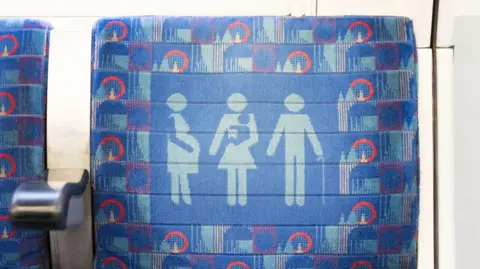
Of course, not everybody sitting in a priority seat is able to visibly demonstrate why they may need one, which is why TfL has long encouraged passengers to be more mindful through campaigns such as Priority Seating Week.
Elderly passengers, for example, may need a seat despite not using a walking aid, while others may be living with hidden disabilities or chronic conditions.
While some of my experiences may draw parallels with those living with hidden disabilities or chronic conditions, unlike pregnancy, for many it's a permanent reality.
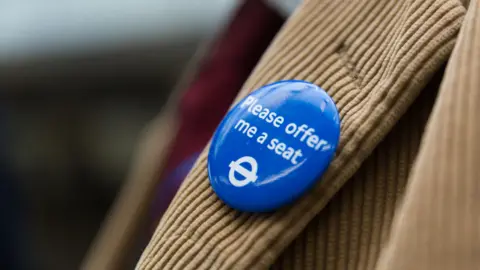
Perhaps that's the real point of badges such as Baby on Board and Please Offer Me a Seat. Not that they have the power to magically summon a seat - although occasionally they do - but that they interrupt the bubble many of us retreat into during the daily commute. Forcing us, however briefly, to look up from our phones, remove an earbud, and acknowledge the people around us.
Because somewhere between Oxford Circus and East Finchley, between the rush hour crush and expertly avoiding eye contact, Londoners still remain capable of the most wonderful acts of kindness and humanity.
And on a transport network carrying millions of people every day, that matters far more than we perhaps give ourselves credit for.
Listen to the best of BBC Radio London on Sounds and follow BBC London on Facebook, X and Instagram. Send your story ideas to hello.bbclondon@bbc.co.uk
