'The calmest assisted baby birth I've ever seen'

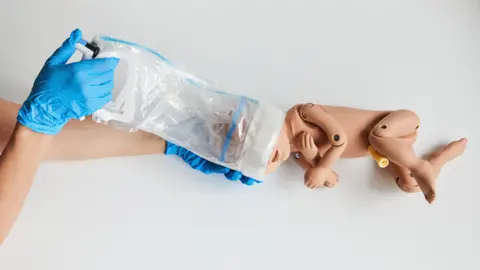 NHS North Bristol Trust/ Maternal Newborn Health Innovations
Women who helped test a newly-launched birth device invented by a car mechanic have said it provided a "desperately needed" alternative to "bonkers" outdated options invented in the 16th Century.
A trial of OdonAssist, an inflatable air cuff used to guide a baby through the birth canal, began in 2018 at Southmead Hospital in Bristol and it was launched on 5 May.
Health officials said the tool, which was invented by an Argentinean mechanic to remove corks from bottles, has been used to deliver 300 babies in Europe.
Ella Radford, from Bristol, used OdonAssist and said it was a "lovely" experience to see her child born in a "calm way" with none of the marks synonymous with a forceps delivery.
'Hardly felt a thing'
Radford said she was "lucky" to have been able to see the first iteration of the device as part of her work as a midwife at the hospital and she immediately signed up to use it when she fell pregnant.
She said it was the "calmest way" she had ever seen a baby be delivered by an instrument and it left the baby with no marks, unlike forceps and ventouse deliveries.
"I had an epidural after my long slog [and] I hardly felt a thing," she said.
"It was just lovely. I would 100 percent have it again if it was an option.
"Seeing so many different varieties of birth, it just seems different.
"It just makes more sense to inflate that cuff and push the vaginal muscle away from the baby instead of pulling on the baby's head."
 Georgie Jacobs
The only other option currently available is the ventouse, a suction cup placed on the baby's head.
This can leave behind a mark or a bruise.
Radford said instruments such as forceps and ventouse had been around for "such a long time" and had never been tested in a way that would be "accepted to today's standards".
She said: "Options are out there. More parents need to know about this."
Georgie Jacobs, 35, from Bristol said the devicemade her feel like she was still in control.
"Ventouse and forceps were invented such a long time ago so it seems absolutely bonkers that we have these methods that are so outdated now," she said.
"We basically use metal to pull a baby out.
"When I saw the science behind the OdonAssist and how gentle it was I agreed to use it.
"I had to have an episiotomy to use it but I've been told since it's gone through the trial they don't always need to do that."
 Google
She went on to say the experience was "much more gentle on baby and mum".
She said: "It's been so long since we've had new innovations in this field for women.
"Women have options when it comes to birth."
The device works by inflating and gently gripping the baby's head to allow for an obstetrician to assist the birth, if needed.
As the baby's head is born, the device is then removed to allow them to take their first breath as normal.
The device was invented by car mechanic Jorge Odon in 2006.
He based the idea on a party trick to extract a loose cork from inside an empty bottle and his idea was developed by a team of midwives, doctors, engineers and specialists in medical equipment over eight years.
Initial testing of the device was carried out by the World Health Organisation in Argentina and South Africa.
In 2025, OdonAssist was awarded CE certification, which confirmed that it was safe to be used in hospitals across Europe.
 NHS North Bristol Hospitals Trust
Dr Jo Crofts, consultant obstetrician at North Bristol NHS Trust, said at the start the team thought it would be "a challenge asking women who were about to have a baby to take part in something so new".
However, she said hundreds of "extraordinarily generous" women came forward to offer their support.
"Thanks to their help we now have an alternative to forceps and ventouse, something which the women we care for tell us is desperately needed," she said.
Dr Emily Hotton, obstetrics and gynaecology resident doctor and investigator in the clinical trials, said she was "incredibly proud" of her team's "phenomenal" work.
The developers behind the device, Maternal Newborn Health Innovations, said OdonAssist would not available outside the UK and Europe until local regulatory approvals and clearances had been obtained.
Follow BBC Bristol on Facebook, X and Instagram. Send your story ideas to us on email or via WhatsApp on 0800 313 4630.
