Why the Isle of Man stays cooler than the UK

 BBC
BBCParts of the UK are facing soaring temperatures and warnings of extreme heat this week.
The Isle of Man is also seeing a rise in its temperature, with Thursday set to see the mercury rise to near the record for June.
While the UK record of 40.3C (104.5F) was recorded in Lincolnshire three years ago, the hottest ever Manx day is 28.9C (84F) back in July 1983 – some 11C (51.8F) adrift.
And that is something operational meteorologist at Ronaldsway Met Office, Colin Gartshore, says is simply down to geography.
Sandwiched between the larger islands that make up the UK and Ireland, the key to the Isle of Man's lower temperature is the surrounding Irish Sea.
 MANX SCENES
The body of water is limited to about 15C (59F) in the summer months, leading to cooler air ashore.
Gartshore explained: "Fundamentally, we're quite a small island surrounded by a reasonably sized sea, and that sea is much colder than the land during the summer months, so essentially it has a big effect on the temperatures we see.
In contrast to land-locked areas in the UK, where the air is not changed by the passage over any water, the island's 227 sq mile (572 sq km) size means "you're never more than a few miles from the sea", he said.
"You're able to achieve much higher temperatures when you're on a bigger landmass than you are on a smaller island, essentially.
"The influence that it has on the air is quite marked," he said. "That means that the air can't warm up as much as it can do.
"That limits the temperature we can achieve in some months."
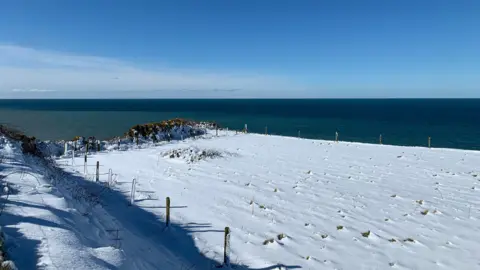
And its not just the summer heat that the island's geography affects, Gartshore said its position and surrounding sea also "keeps us warmer than we would be in winter".
The lowest temperature of -9.1C (15.6F), recorded in the 1960s, is a stark contrast to the -28C (-1.8.4F) seen in the UK.
"Again, it's kind of the ameliorating effect that the Irish Sea has on the temperatures", he said.
And with an upward trend in temperatures, the island has "come nowhere near" its lowest for more than 40 years.
The second highest temperature recorded on the island was 28.1C (82.6F) – set three years ago in June 2023, making it the hottest day of that month since records began in 1947.
And while the gulf between the temperatures reached in the UK and the Isle of Man will never be bridged, Gartshore said the rising trend does mean Manx records would likely be broken within the next decade.
"The fundamentals won't change, the relative distance [to UK temperatures] isn't going to change, but the absolute value [of the temperature] here will be higher than it's ever been," he said.
Read more stories from the Isle of Man on the BBC, watch BBC North West Tonight on BBC iPlayer and follow BBC Isle of Man on Facebook and X.
