Red heat warnings enter third day after UK's hottest June day on record

 Getty Images
The UK may have experienced its warmest June night yet, according to forecasters, after a record temperature for the month of 36.7C (98.1F) was recorded on Thursday afternoon.
That high was at Merryfield, Somerset, according to Met Office provisional figures, making it also the hottest day of 2026.
A rare red warning of extreme heat has been extended for London and parts of south-eastern England until 21:00 BST on Friday, affecting millions of people for the third consecutive day.
The warning of a danger to life had been in place on Thursday in southern, central and western areas of England and parts of Wales.
During the heatwave, schools have closed, a hosepipe ban has been brought in for people in Kent and train services have been disrupted.
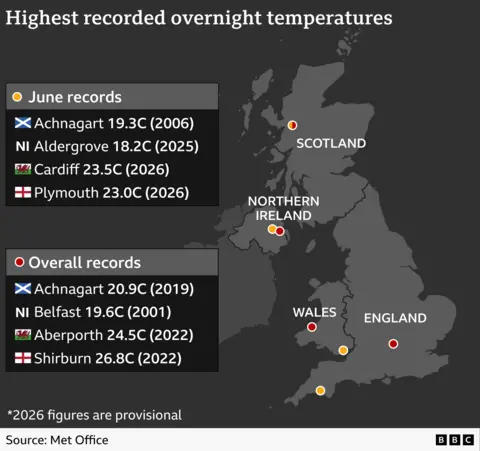
On Wednesday, the UK saw its warmest June night on record, according to provisional figures, making it difficult for many people to sleep.
Overnight temperatures in Cardiff did not drop below 23.5C, exceeding the previous record of 22.7C set in 1976.
But that record may have been broken again overnight, following the soaring daytime temperatures.
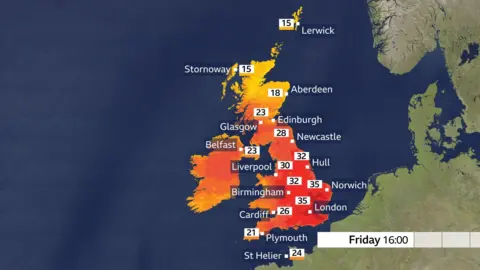
All four of the UK's nations recorded their highest temperatures of the year so far on Thursday.
Merryfield’s 36.7C high surpassed England’s 36.1C recorded in Gosport, Hampshire, on Wednesday which had broken the longstanding record for June set in both 1976 and 1957.
Wales recorded its highest temperature of the year and hottest ever June day with a provisional temperature of 35.6C in Bute Park, Cardiff. Previously, the highest Wales June temperature stood at 33.7C - recorded in 2000.
Scotland saw it highest temperature of the year in Threave, Dumfries and Galloway, with 31.2C.
Northern Ireland recorded its highest temperature this year with 30C in Castlederg, County Tyrone.
The conditions are being driven by a "heat dome" - an area of high pressure that stalls over a region and traps heat - settling over western Europe bringing extreme conditions across the continent.
But scientists have warned climate change is exacerbating conditions.
"Climate change [is] loading the atmosphere with extra heat and making extreme temperatures far more intense than they would have been in the past," said Dr Akshay Deoras, senior research scientist at the University of Reading.
Between 2015 and 2024, the number of days exceeding 30C in the UK more than trebled compared with the 1961-1990 average, the Met Office says.
The Met Office had said people should expect population-wide adverse health affects "leading to serious illness or danger to life", substantial changes in working practices and daily routine required, high risk of failure of heat-sensitive systems with loss of power, along with transport delays during the heatwave.
A wider amber warning was also in place in Wales, southern England, the Midlands and part of northern England, on Thursday, with areas as far north as Manchester expected to see temperatures reach above 30C.
And a separate amber warning for extreme heat, lasting from midnight on Friday until 23:59 covers south-east England, eastern England and parts of the Midlands.
The night is expected to be hot and sticky. Temperatures away from northern Scotland will not drop below the high teens and for some in England and Wales will not dip below 22C or perhaps 23C all night.
There could be further records broken by the morning for high overnight minimums.
Warnings are also in force for thunderstorms across Scotland, Northern Ireland,and parts of England and Wales too. These will be fierce but localised.
Friday is another hot day for many but it will feel significantly cooler in Northern Ireland and Scotland.
The worst of the heat and the humidity is likely to move further eastwards and it will feel a little cooler further west.
Within the red warning area temperatures could peak for some at 37C or 38C.
Temperatures in the wider amber warning stretching across the Midlands and East Anglia are still likely to reach the low 30s.
At least six NHS trusts in England have declared critical incidents because of the heatwave, sources have told the BBC.
It comes amid reports the extreme heat has caused problems with IT systems, cancer equipment, lab testing and scanners.
London Ambulance Service said it had recorded its highest ever number of life-threatening emergencies as temperatures soared across the capital "driven by the extreme heat" across the capital.
In Wales, a 50-year-old man died after entering the water at a Welsh beach on Wednesday, South Wales Police announced on Thursday.
The force said they were called to Aberavon beach at around 16:25 to reports of a man needing medical assistance in the water. His death is not being treated as suspicious.
 Getty Images
National Rail has warned people to only travel if absolutely necessary on Friday if their journeys are from or within the red or amber weather warning zone.
Meanwhile, more than 2,400 schools in England and Wales have been closed. Prime MInister Sir Keir Starmer said schools had to decide for themselves what appropriate measure to take.
South East Water announced a temporary hosepipe ban for around 850,000 people living in Kent due to “high temperatures and record demand for water".
