Fire crews in 11-hour rescue of cow from underground ice house

 SFRS
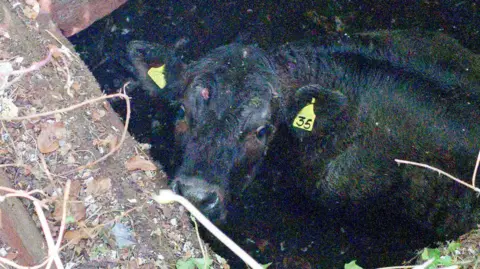
SFRSSpecialist fire crews had to battle for 11 hours to free a 500kg (1,100lb) cow after it plunged into a hidden underground Victorian ice house in the Borders.
The incident happened on a farm near Kelso after the heifer got in through a small hatch but there was no obvious way of getting her back out.
The Scottish Fire and Rescue Service (SFRS) sent a range of resources to the rescue operation.
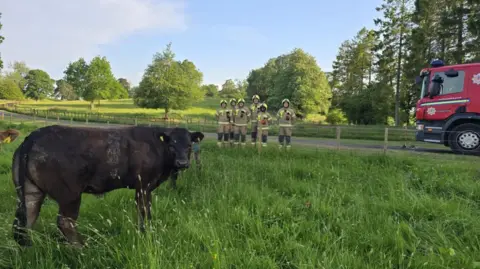
Using a digger from a local farm they were eventually able to create enough space for the cow to climb out to freedom and return to the farm unscathed.
 SFRS
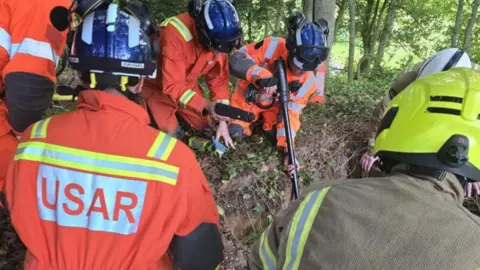
SFRSThe events unfolded last Tuesday with the SFRS sending its urban search and rescue (USAR) team, one heavy rescue unit and on-call firefighters from the Kelso community station.
During the rescue, a drone from Tweed Valley Mountain Rescue team was lowered on a rope to explore the bunker the cow had fallen into.
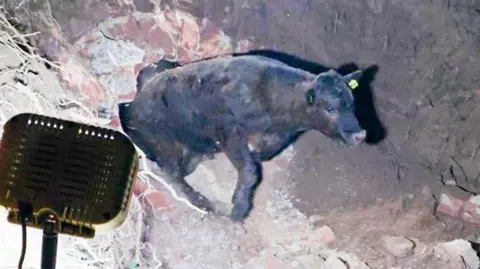
It confirmed the presence of an old door which had been bricked up and filled in.
Using a digger from the local farm, the ground was removed to expose the old walls of the building, which then allowed USAR and heavy rescue teams to create space for the cow to climb out to freedom.
 SFRS
SFRSThe rescue was overseen by owner Tom Baird, estate staff, farm contractors and a local vet.
The heifer is now back on the farm unscathed after her "underground adventure".
SFRS group commander Les Mason thanked everyone involved in ensuring there had been a "positive and safe outcome" to the incident.
"As a humanitarian organisation, our highly skilled crews answer a wide range of calls to help animals in distress across the country," he said.
"Our response by trained and equipped firefighters can prevent members of the public from putting themselves in danger by attempting their own rescue.
"It also means there is a higher chance of the animal being rescued safely."
The heifer's owner also said a "huge thank you" to everyone who helped to get her out.
"Their professionalism and training ensured she was rescued safely and is back on the farm with very little sign of what she went through for 11 hours," he said.
 SFRS
SFRSIce houses arrived in Britain in the 17th Century and were mostly built underground and often brick-lined to provide strength and temperature regulation.
By the following century they had become a popular feature on large estates and would be filled in winter with ice from frozen watercourses nearby in order to keep food cold.
According to The Society for the Protection of Ancient Buildings about 3,000 were built across Britain but they became largely obsolete after the production of the first home fridges at the start of the 20th Century.
Some ice houses enjoyed a second life as air raid shelters during World War Two.
