'Helping end-of-life patients helps us live fully'

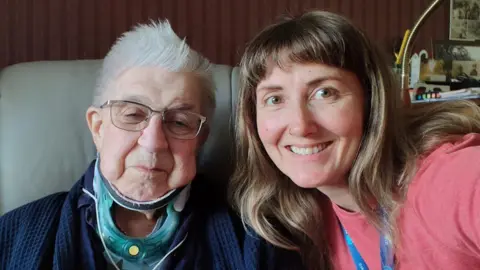 Hazel Bugler
"The reminder that we will all die is very difficult, but also really real, and it's the only truth we all have."
Those are the words of 44-year-old Hazel Bugler from Bristol, who has spent the past year visiting her elderly neighbour Eric, 86.
Living - in his own words - "in the shadow of cancer", recovering from a recent serious accident and managing alone after the death of his wife, Eric was matched with Bugler by St Peter's Hospice as a "hospice neighbour".
The chiropractor and yoga teacher was inspired to volunteer after losing both her parents suddenly in her twenties, said: "I think opening yourself up to end of life can actually allow you to live fully."
Bugler - who Eric describes as a "blessing" - told the BBC that each visit with her neighbour had taught her to "just really value each moment a little bit more".
"You might put just a little bit more emphasis on the light coming through the magnolia in his window," she said, adding: "I think being alive to that present moment just really kind of reminds [us] that all we ever have is the present moment."
'Bit of their identity back'
The neighbours volunteering for St Peter's Hospice may be part of a 1,600-strong team of people giving their time to the charity, but their hold a unique role in how the organisation cares for those at the end of their lives.
"The hospice neighbours try to go in and not concentrate on the illness," said Denise Clifford, the charity's hospice neighbours engagement manager.
She said instead "we concentrate on the person that's still alive, give them a bit of their identity back pre-diagnosis".
But what about those who are too unwell to be at home, and are receiving end-of-life care in hospital?
At Swindon's Great Western Hospital, a team of "butterfly volunteers" working with the Anne Robson Trust visit patients on wards - playing music, reading aloud, offering hand massages or even just sitting quietly.
Volunteer co-ordinator Tanya Stubbs explained that over the past 12 months the volunteers had visited nearly 600 people and spent nearly 800 hours at the bedside of end-of-life patients.
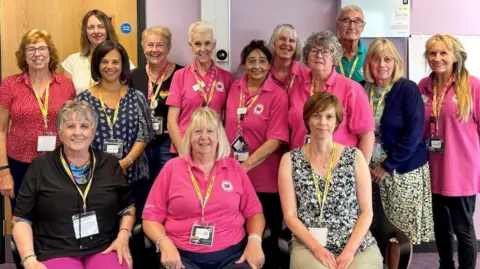 Great Western Hospital
She said: "Some of our volunteers have worked in nursing and have retired, some have joined us because they had someone they knew died who was supported by the service and they want to give back.
"Ultimately, the aim is to make sure that nobody dies alone and to make sure someone is with them so it's not as scary a time."
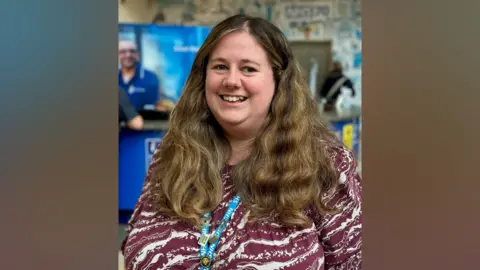 Tanya Stubbs
The volunteers also offer support to families who often feel uncomfortable leaving their loved one's side in their final days, giving them vital respite.
"Our volunteers have a sense of belonging, their work is vital, and they get satisfaction of giving something back," said Stubbs.
"Quite often, the families are just grateful to have someone to get to know them and listening to their stories about how their life has been led - it gives them time to treat people as people and not just a patient in a bed."
Follow BBC Bristol on Facebook, X and Instagram. Send your story ideas to us on email or via WhatsApp on 0800 313 4630.
