Chernobyl's effect on NI, a Christmas card row and Casement Park - government files

 Getty Images
The Chernobyl nuclear disaster led to fears that milk, meat and vegetables in Northern Ireland were contaminated with radioactive material.
Checks on foodstuffs were carried out after a radioactive cloud passed over Northern Ireland in early May 1986.
That is according to government files now made public.
The files, from 2005 and earlier, have been made available by the Public Record Office of Northern Ireland (PRONI) and are now on Ulster University's CAIN (Conflict Archive on the Internet) website.
How was Northern Ireland affected by the Chernobyl disaster?
In the early hours of 26 April 1986, one of four nuclear reactors at the Chernobyl power station exploded.
A week later, on 3 and 4 May 1986, the radioactive cloud passed over Northern Ireland.
Government files from 1988 reveal that led to concerns that milk, meat, fish, fruit and vegetables in Northern Ireland could be contaminated with radioactivity.
There were particular concerns over lambs in areas of County Londonderry and County Antrim.
But "unacceptable levels of radioactivity" did not reach the food chain, according to the files.
The concerns later led to controls and restrictions on 123 farms in 1987.
Why did a Christmas card sent by Sinn Féin in 2004 cause concern?
The government files also reveal that a Christmas card sent by Sinn Féin to staff at Coleraine social security office prompted an investigation by civil servants after complaints were made.
The card was sent to staff with the message: "Thanks for all your help and support over the year."
It was displayed along with other cards, including from the PSNI, in the office.
But there was a complaint that some staff "felt offended by the card" and wanted it to be removed.
Civil servants investigated the matter, in case the display of the card breached the requirement for a neutral working environment.
But four months later, in April 2025, it was decided that the card did not infringe that requirement and cards should not be censored.
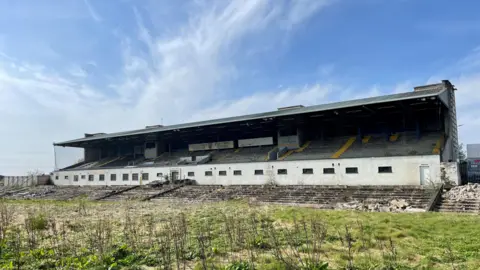
Plans to develop a 47,000-capacity GAA stadium at Casement Park were being debated over two decades ago
 PA Media
A government memo from 2003 briefed ministers on plans for a new National Stadium for Northern Ireland.
At the time, it was hoped one multi-sport stadium could be built for football, rugby, GAA and athletics.
There were also hopes it could become an Olympic venue in 2012 if the games were held in London.
But the governing bodies of each sport were reluctant to take a decision to move from their current stadiums until they knew what the long-term future of a National Stadium was.
The GAA, according to the memo, had a "highly ambitious" proposal to build a 35,000-seat stadium at Casement Park, with additional room for 12,000 standing spectators.
The cost at the time was estimated to be £15m.
In the event, the site of the former Maze prison was chosen for the multi-sport stadium but the plans did not go ahead.
The redevelopment of Casement Park has also been repeatedly delayed.
Government concern about the future of Linfield Football Club
A confidential government memo from 2003 stated that Linfield was facing "severe financial difficulties" and there were concerns that the club "may be reaching insolvency".
That, it was feared, could put Windsor Park's status as the home ground for the Northern Ireland team in doubt.
Some officials were promoting the idea of a National Stadium at the Maze at the time.
A statement was prepared for the then Northern Ireland Office minister Angela Smith if the "story about Linfield and the consequential implications for International Soccer" was reported in the media when she was on leave.
The minister was advised to say that the government was monitoring the situation, but it was "a matter for the Irish Football Association in the first instance".
