The 'smart' baby technology raising today's children

 Owlet Baby Care
A new wave of millennial parents are adopting 'smart' technology for their babies. It is a new type of parenting that has turned nurseries into connected data centres.
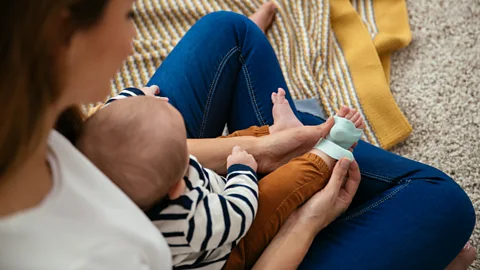
When new mum Lindsay Elliott faced the challenge of separation anxiety from her daughter Hazel, she found an unlikely saviour: a sock. To help calm any worry about Hazel’s health, the 29-year-old teacher bought a $300 ‘smart sock’ which uses pulse oximetry – inspired by hospitals and adapted from gadgets such as the Apple Watch and Fitbit – to monitor oxygen levels, heart rate and temperature.
“I always had a fear that she would just stop breathing. It was my personal anxiety, so that oxygen level helped so much,” says Elliott, who lives in Winter Park in the US state of Florida. With this piece of baby technology, Elliott could sleep easier and go out to dinner with more trust in a babysitter if Hazel were wearing the gadget. She could simply track her daughter’s vitals from her phone.
Elliott is one of a growing number of millennials introducing smart baby technology into their lives as parents. Millennials are, after all, the generation most accustomed to feedback and data on every aspect of daily routine. Consumers use apps and wearables to track their fitness, sleep cycles, diets and work habits. For many, tracking their children’s health is a natural next step.
In the past few years, a number of manufacturers have recognised the potential to equip babies with wearables and other smart products. There is a market: according to Australian social research firm McCrindle, each week more than 2.5 million members of so-called ‘Generation Alpha’ are born globally. The group, whose oldest members were born in 2010 (the same year that the iPad and Instagram launched), will encompass nearly two billion people by the time the generation officially ends in 2025.
With these new products, modern parents now have access to an entire connected nursery with data feedback from bottles, dummies, cots, prams, clothing and more. Some of these products are meant to ease stress for new parents, while others simply automate parts of the parenting process entirely – shifting many tasks that were once intuition-based to fully automated.
 Alamy
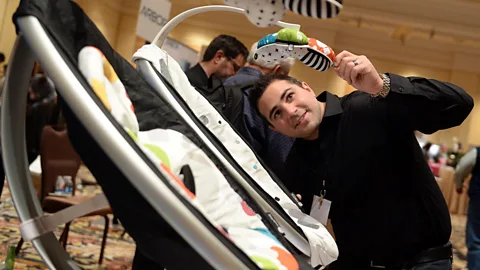
AlamyFor example, an ‘intelligent baby feeding monitor’ attaches to the bottom of a standard bottle and provides data feedback to a smartphone via Bluetooth. Several aspects of mealtime that are usually intuited – how much a baby drinks, the temperature of the milk and even the angle of the bottle – are tracked via the accompanying app.
Elliott acknowledges smart baby gadgets aren’t necessities, but says her generation is excited to adopt these new technologies to make parenting easier. “I talk to some older parents who didn’t have this technology. They say, ‘Oh, well, back in my day, we just checked that they were breathing.’ And I say, ‘Well, things are evolving.’”
Birth of a new market
In 2016, the Consumer Electronics Show, the world’s largest consumer technology tradeshow held annually in the US, launched a dedicated offshoot: the BabyTech Summit.
Summit producer Jill Gilbert explains that the event was initially popular among start-ups creating single-solution, standalone products for babies. The first wave of products included a car seat with sensors to ensure a child was secure and a changing pad which could track a baby’s growth with each nappy change.
Over the years, these baby products have evolved to become more complex, integrating more sensors, diversifying data inputs and providing comprehensive digital platforms. Now larger, more globally recognised brands are entering the flourishing market. Motorola sells a suite of nursery products, while Philips designed an app platform which combines data from a baby monitor, trends recorded by parents and online video consultations with doctors.
Although the baby tech sector specifically is relatively young and unstudied, researchers from market research firm Hexa say the baby-monitoring submarket alone is projected to grow from $929m in 2016 to $1.63bn by 2025. With China leading the way, Hexa predicts the Asia Pacific region will also gain a substantial global marketshare in that time.
As more millennial parents in the US, Germany, France and China decide to leave home to work, forecasters expect them to rely on digital baby monitors to stay connected to their newborns. The next to connect could be parents in emerging markets including India, Brazil, South Africa and Thailand.
Data knows best
Constantly stressing over a child’s wellbeing is not the best way to develop parenting abilities, says Dohyeong Park. “If you want to make your baby happy, you should be happy first. It will maximise the quality of care.”
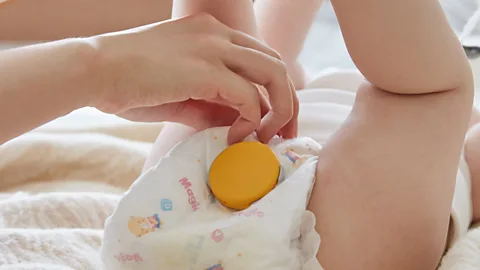
As CEO of smart nappy monitor company Monit in South Korea, he is building technology that he believes can address exactly this. Monit alerts parents to bowel movements, helping them change babies faster with the intention to prevent nappy rash and urinary tract infections. Dohyeong hopes that the data from Monit will free parents to leave their baby in another room, or spare them the worry of misinterpreting cries.
 Monit Corp
Rather than rely on intuition to care for infants, those in the baby tech industry would rather millennial parents use data. In a connected nursery, a newborn’s unwillingness to sleep through the night turns from an unavoidable drain on a parent’s sleep to a trackable habit to be corrected by data insights. A new parent’s separation anxiety turns from a weakness she must battle internally to a mere inconvenience to be tempered by smartphone updates. Stress over a baby’s health turns from a distraction to a fleeting thought.
“Millennials just expect that [technology] will be part of life,” says BabyTech Summit’s Gilbert. “[Older generations] expect TVs in our house. They expect smart monitors, connected platforms.”
‘A false sense of control’
The medical, emotional and psychological effects of baby technology have yet to be studied thoroughly – and there is not a consensus among childcare experts about its impact or necessity.
Rebecca Parlakian, senior director of programs at not-for-profit child development research group Zero to Three, is concerned that monitoring devices can “disconnect parents from understanding the particular needs of their babies”. Innately, babies learn how to manage their emotions through a process of “co-regulation,” she says, taking cues from their parents as they are held and comforted; in the instance of a mechanised cot, for example, parents could miss whether infants “prefer rocking, white noise or some other form of soothing”.
Parlakian also says the questionable impact of these health monitors can extend to parents. “If you have an anxious parent already, having that constant data might create more anxiety for them and more worry.”
Kurt Workman, CEO of Owlet, the company that manufactures Hazel Elliott’s $300 smart sock, disagrees. He points to a study the company completed in collaboration with the journal Global Pediatric Health, in which 96% of nearly 50,000 Owlet users reported a reduction in stress after using the smart sock.
But stress may actually be an integral part of becoming a competent, healthy parent, says Jenny Radesky, assistant professor of developmental behavioral paediatrics at the University of Michigan Medical School. She worries that health monitoring tools “may give parents a false sense of control, when actually a major step of becoming a parent is being able to tolerate the distress and feelings of lack of control that come with caring for another, tiny human.”
Growing up
All of this technology is, as consumers might expect, expensive. And despite their position as the most technologically savvy generation, millennials also find themselves as the most financially disadvantaged from their predecessors, too.
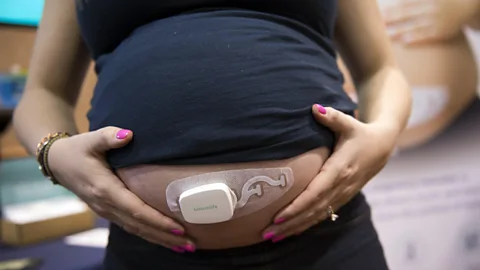
For instance, the Snoo, a popular smart cot that automatically rocks upset infants back to sleep, costs $1,160. Michelle Dowdy, a 29-year-old photographer and mother of three in Nashville, Tennessee in the US, owns the Snoo. “If [my baby] won’t sleep then it’s worth the investment,” she says. For Dowdy, the Snoo is no different than an “expensive sleep coach”. (Maternity nurses typically charge about $200 per night in both the UK and US – which means the Snoo would ‘pay for itself’ in less than a week.)
 Alamy
AlamyFor those with hundreds to spend on a sleep coach, spending more than $1,000 on a cot might not seem a stretch. But as many parents around the world struggle with providing basic necessities, baby technology is not only out of reach, it is a luxury. “Having a child can be quite expensive already, even just for the basics like a crib, food, diapers, etc,” says Todd Kunsman, founder of personal finance advice website Invested Wallet. “While these smart products may be ‘nice-to-haves,’ they are not necessary items.”
Elisabeth Gugl, an associate professor of economics at the University of Victoria who researches family economics, worries that, until this new industry can gather evidence to back up its economic and medical claims, parents won’t be able to separate fact from fiction, and companies can target anxious parents with false information to make a sale.
Still, many who use these monitors are strong proponents. “I have recommended Owlet to every single person I’ve met since getting pregnant,” Elliott says. (Dowdy says the same of her Snoo cot.) Elliott is even saving her Owlet sock for her next child.
A generation of data-driven parenting is, in other words, coming. As Dohyeong puts it, “It’s not a matter of choice. It’s a matter of time.”
If you liked this story, sign up for the weekly bbc.com features newsletter called "If You Only Read 6 Things This Week". A handpicked selection of stories from BBC Future, Culture, Capital and Travel, delivered to your inbox every Friday.
