Irish passengers from virus-hit ship land in Dublin

 Reuters
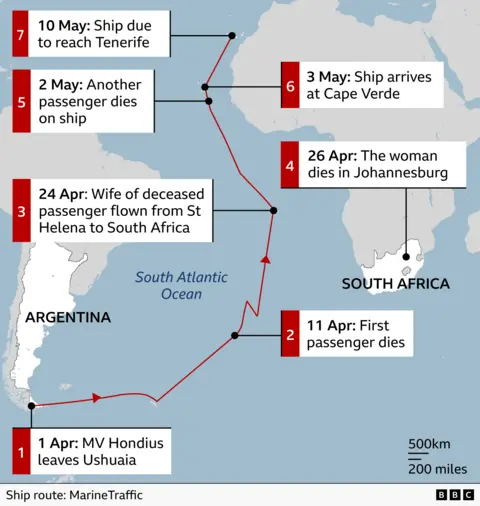
The two Irish women who were on board MV Hondius, the cruise ship which was struck by an outbreak of hantavirus, have arrived home.
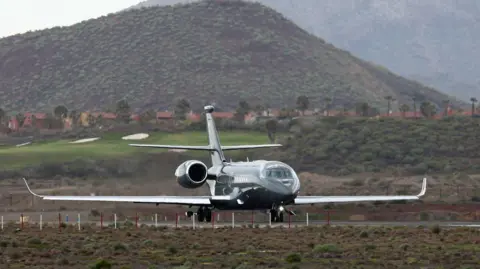
The ship docked in Tenerife on Sunday morning and the pair boarded an Air Corps aircraft accompanied by two Health Service Executive (HSE) medics and flew to Casement Aerodrome at Baldonnell.
The plane arrived just after 21:00 local time.
The Irish Department of Health said the passengers would now isolate for a period of time in a HSE facility in line with European Centre for Disease Prevention and Control and the World Health Organization (WHO) guidance
The WHO has recommended a 42-day quarantine period for the cruise passengers from their last exposure.
A plane carrying 20 Britons who were also evacuated from the cruise ship has arrived in the UK.
The Irish interim chief medical officer Professor Mary Horgan told Irish broadcaster RTÉ that both women were in "good spirits" and in "good health", adding that neither had shown any symptoms.
She said both women were being cared for at a Health Service Executive (HSE) facility where they will be tested and monitored for signs of infection and given psychological support.
Horgan added that she had no doubt the women were "very glad to be back in Ireland".
Hospital staff are ready in case either woman develops any signs of infection, but Horgan said she was hopeful this would not be needed.
 Reuters
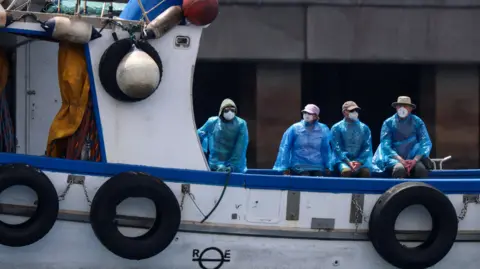
Speaking on Sunday, Spanish authorities confirmed the assessment of the current health status of passengers and disembarkation process was proceeding well.
Ireland's Department of Health said the return of the passengers had been "carefully planned and guided by public health authorities to ensure safety for everyone-these measures protect communities while respecting the dignity and well being of those returning home".
Passengers from Spain and France were returned by flight to their home countries where they are being quarantined.
Other passengers from Belgium, Greece, Germany, Guatemala, Argentina and Turkey are also being flown home.
Three people have died in the outbreak on the Dutch vessel, including two who were confirmed to have had hantavirus.
The cruise passengers face having to self-isolate after leaving Tenerife, a gruelling prospect as the virus has an incubation period of up to nine weeks.
Earlier, British Army medics parachuted on to the remote Atlantic island of Tristan da Cunha to help a British national with suspected hantavirus.
The man left MV Hondius in mid-April at Britain's most remote inhabited overseas territory, where he lives.
He first reported symptoms two weeks after leaving the vessel and is said be in a stable condition while isolating.
Oxygen was also dropped from an RAF A400M on Saturday, with supplies at a "critical level" on the island, the Ministry of Defence said.