Heatwave caution urged as London pavements hit 57C

 Greenpeace / TI Thermal Imaging
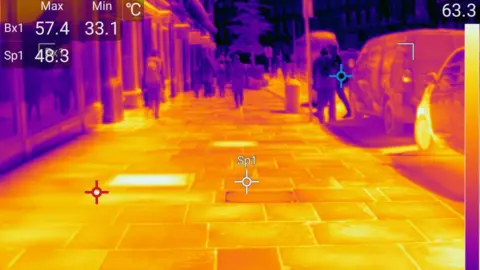
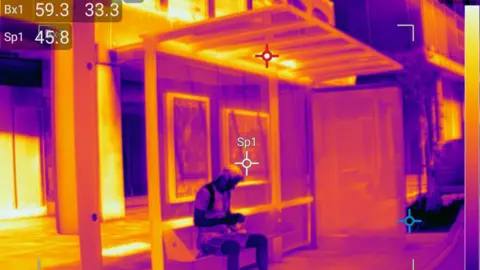
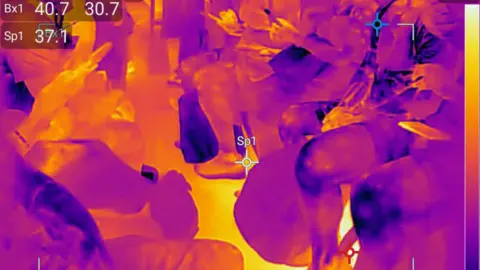
Londoners, especially those looking after children and pets, have been urged to be cautious when outside after thermal imaging technology recorded temperatures of 57C (135F) along the city's pavements and playgrounds.
The images, which record surface temperatures rather than air temperatures, were captured by thermal imaging engineers on Wednesday between 14:00 and 17:00 BST, when temperatures in London were around 35C (95F).
Experts speaking to the BBC, including animal welfare organisations, urged people to consider using public spaces at cooler times, or not at all.
City Hall said as part of its Heat Ready London action plan, it was committed to increasing urban greening and shade.
 Greenpeace / TI Thermal Imaging
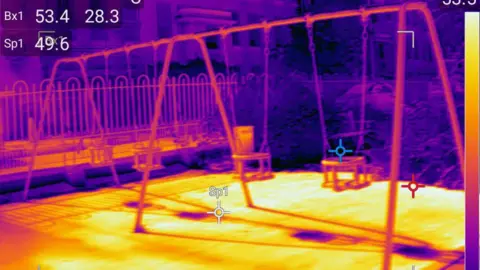
Greenpeace - which commissioned the imaging - said the black rubber floor at a children's playground in Islington, north London, recorded a temperature of 53C (127F) at 17:00, while the tarmac at roadworks in Holborn, central London, registered 65C (149F).
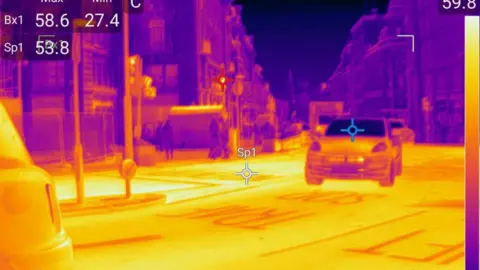
In Piccadilly Circus, ground surfaces were showing as 56C (133F), the environmental campaign group added.
 Greenpeace / TI Thermal Imaging
Anna Mavrogianni, professor of sustainable, healthy and equitable built environment at the University College London (UCL), said the images "help us think about heat risks differently".
Speaking to the BBC, Mavrogianni warned of the dangers of being around such hot surfaces and said it was "important to assess the levels of heat exposure in playgrounds and other public spaces before spending time there with children or pets."
The professor added the images highlighted the importance of "embedding climate resilience in urban design", essentially heat-proofing London for the future in the way it is built.
"Overheating is a public health and social justice issue," Mavrogianni added.
"A lot of solutions already exist: incorporating greenery and water features, using innovative reflective materials and providing shading are key priorities.
"These need to be applied in an inclusive manner to ensure they are appropriate for the most heat vulnerable groups."
"It is encouraging that there are now significant efforts to improve heat resilience across London, and public awareness around heat risks is increasing," she added.
 Greenpeace / TI Thermal Imaging
This week, Mayor of London Sir Sadiq Khan set out an action plan to prepare London for future extreme heat, including plans to increase greenery.
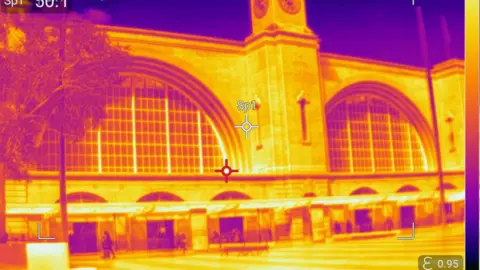
His spokesperson said: "In extreme temperatures like we've seen this week, pavements and buildings can become very hot as they absorb heat.
"Trees and canopy cover make a huge difference in providing shade and keeping our surroundings cool as well as providing essential green spaces for Londoners, which is why we have planted over 640,000 trees since Sadiq took office."
The mayor's website also provides a map of cool spaces around London where people can find a break from the sun.
 Greenpeace / TI Thermal Imaging
Many local authorities across the capital have issued advice to local residents during the heatwave, including Barking and Dagenham Council, which urged those going to a park or playground to check play equipment was not too hot before using them.
"Metal slides and other equipment can get really hot in this weather," they added.
In its latest guidance, published during the heatwave, the British Veterinary Association (BVA) said it was best for dogs to go on walks early in the morning or late evening when temperatures were lower or to skip them altogether because they were particularly vulnerable as they cannot cool themselves efficiently through sweating.
"Even a short walk during the hottest part of the day or being left in a vehicle for a few minutes can have devastating consequences," it said.
"Take the five-second tarmac test before taking your dog outside: place the palm of your hand on the pavement for five seconds. If it is too hot for you, it is too hot for your dog's paws."
 Greenpeace / TI Thermal Imaging
Commenting on the findings, Greenpeace UK's head of climate, Mel Evans, said: "This isn't just weather – it's a public health emergency driven by fossil fuel giants and their planet-heating emissions.
"These abnormal temperatures are stretching homes, schools, transport and our own health to breaking point."
Evans said adapting public spaces was not enough though and said political leaders "must also stop fossil fuel companies from turning up the heat on our planet – and make them pay their fair share to fix the problem they've caused."
Listen to the best of BBC Radio London on Sounds and follow BBC London on Facebook, X and Instagram. Send your story ideas to hello.bbclondon@bbc.co.uk
