Centuries-old lost gardens revealed by heatwave

 Bishop's Palace
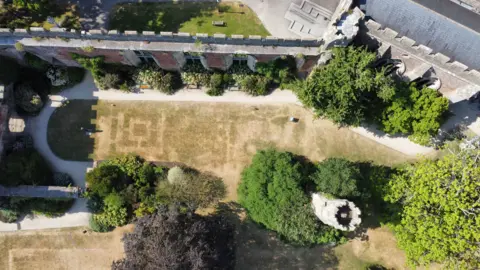
Traces of centuries-old gardens and buildings have been revealed by months of hot, dry weather.
Staff at the Bishop's Palace in Wells, Somerset, said visitors had been "fascinated" to see signs of garden designs from the 18th Century, while relics of old structures at Glastonbury Abbey and Longleat House have also been exposed by the conditions.
The phenomenon occurs when grass laid over old flowerbeds or stone has shorter roots so burns more quickly, creating a contrast with the more bedded-in lawn around it.
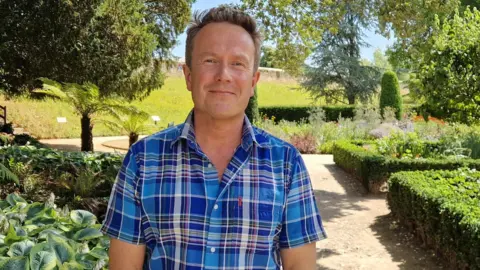
James Cross, the head gardener at the Bishop's Palace, said some remnants of gardens past had appeared in spots they had never noticed before.
 Bishop's Palace
"They're showing up almost certainly Dutch-style gardens that were popular here, or at least laid out here, probably [in] the middle of the 1700s," he said.
The old garden, he explained, featured gravel pathways and hedging in a formal and "very symmetrical" style, with recent drone footage showing elements that had never been uncovered before.
"It has been fascinating to find those Dutch-style gardens showing up in a spot that we didn't think there was actually anything," he said.
Historical drainage systems have reappeared in Stoke Park in Bristol, too, following months of prolonged heat and dry weather.
Steve England, an outdoor educator, horticulturist and historian, said the lines that stretch across the field date back to medieval times when monks used to farm the land.
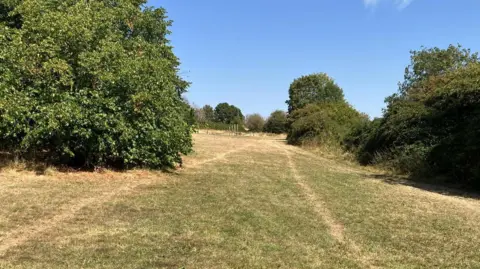
"They dug a trench, and they lined it about a foot deep with crushed limestone stones, basically gravel," he said.
"When it rains, all the rain is going to go into the little trenches and be filtered off somewhere, so it was drying up the land."
According to England, the lines had become visible because the stones underneath had heated up and killed the grass roots.
"This is what makes Stoke Park one of the more special places in Bristol - it's the fact that there's layer upon layer upon layer of history," he added.
 Glastonbury Abbey
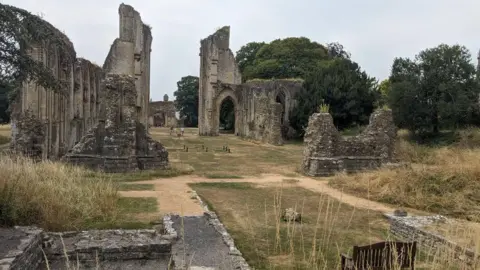
Lucy Newman, the collections manager at Glastonbury Abbey, told the BBC the parched conditions had uncovered traces of foundations, stone columns and earlier excavation work.
"This year in particular, they've been really sharp and really clear," she said.
"So it helps our visitors get an understanding of which bits of the Abbey [remain]... we've got a few bits and pieces where we've still got tall walls, but not very many, [so] it just gives that little bit of extra information on the ground."
The same phenomenon has been reported at venues across the country, including at the Chatsworth Estate in Derbyshire, Blenheim Palace in Oxfordshire and Longleat House in Wiltshire.
 Tom Anders/Longleat House
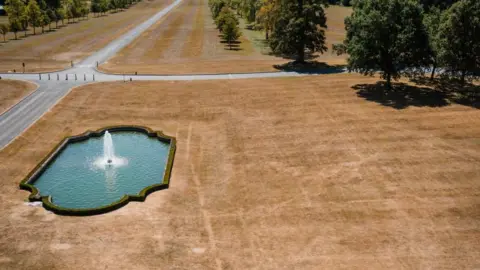
At Longleat a 'leat' - a West Country term for a man-made stream feeding a watermill - has been revealed, as well as the possible location of the watermill itself. The leat is thought to have given the historic estate its name.
Drone footage has also revealed "the clearest evidence in memory" of long-lost formal gardens, Longleat curator Dr James Ford said, including previously unrecorded features dating back to the 17th Century.
"Altogether, these marks offer a rare glimpse of earlier phases of Longleat's landscape, from its medieval priory origins to its later formal gardens and 18th-century redesign," said Ford.
Follow BBC Somerset on Facebook and X. Send your story ideas to us on email or via WhatsApp on 0800 313 4630.
