Scientist who cleaned space toilet on work experience now leading Mars exploration teams

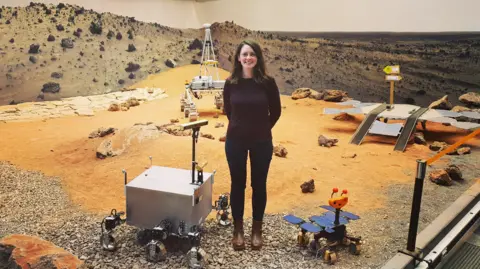 Claire Parfitt
Cleaning a space toilet while on work experience was Claire Parfitt's first introduction to a career away from Earth's orbit.
But she never imagined her time at the National Space Centre in Leicester, when she was 14, would one day see her lead a team exploring future Mars missions.
Parfitt, originally from Nottingham, now works for the European Space Agency's European Space Research and Technology Centre in the Netherlands.
The 42-year-old joined the space industry after securing a physics degree and a PhD in spacecraft power systems engineering.
She has since worked on missions such as the ExoMars Rosalind Franklin rover, which will explore the surface of Mars.
She has also worked on the SMILE mission - officially known as the Solar wind, Magnetospheric, Ionic Link Explorer mission - which uses four science instruments to study how Earth responds to the solar wind from the Sun.
But Parfitt still recalls how support in her early years, including from her science teachers at Fernwood School in Wollaton, helped pave the way for her career.
She had initially applied for work experience at Nasa, which was turned down, but she was eventually able to secure a placement at the National Space Science Centre.
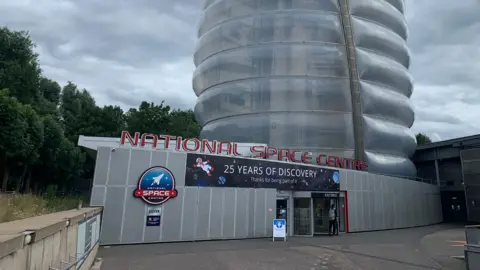
During her time there, staff were planning and collecting artefacts for the opening of the country's flagship space science attraction - the National Space Centre.
"I just knew that's always what I wanted to do," she said.
"The director of the Space Centre in those days was a lady called Alex Hall.
"To see someone in that position, I think it really helped me to envisage my own career in the space industry."
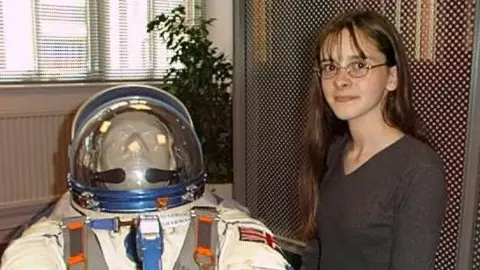 Claire Parfitt
Parfitt recalled exhibits being delivered to the offices ahead of the opening of the Space Centre in June 2001.
"One of those was a space toilet, which I had never seen before and I helped to unpack it," she said.
"There was obviously some preservation that had to happen, some cleaning.
"It was just an unusual piece of technology that is used for space missions, so it was really interesting to see."
She helped to unpack a space suit worn by Helen Sharman, who became the first British person to travel into space.
Since it opened 25 years ago, the National Space Centre has welcomed almost six million visitors.
Parfitt described the attraction as incredible, and added: "The Space Centre is such an inspirational place for people to go. I know I was involved from a very, very early age.
"I'm pretty sure it put me on the track that I'm on now for my space career."
Following a period in the UK space industry, Parfitt moved to the European Space Agency's European Space Research and Technology Centre in the Netherlands in 2019.
Parfitt, who described her career as a "dream come true", now leads a team planning for the future human and robotic exploration of Mars at the European Space Agency.
She is also chair of the International Mars Exploration Working Group.
Parfitt said Mars was a "really scientifically important place to study and explore".
She added: "When Rosalind Franklin launches in 2028 that will be extremely exciting.
"For future Mars missions afterwards, there's a lot to do to prepare for human exploration.
"We have to plan the next decades carefully to make sure that we preserve Mars and get the best science data that we can back for Europe."
Listen to BBC Radio Leicester on Sounds and follow BBC Leicester on Facebook, on X, or on Instagram. Send your story ideas to eastmidsnews@bbc.co.uk or via WhatsApp on 0808 100 2210.
