'It's 50C in the polytunnel' - workers tackle the heat

 BBC
BBCWorkers in kitchens, farms and other hot environments across the Channel Islands and South West have adapted their routines during a period of record-breaking temperatures.
Guernsey had its warmest June since records began in 1843, according to Guernsey Met, with 25 June becoming the island's hottest day on record at 36.4C (97.5F).
Plymouth in Devon recorded its fifth hottest day in a century at 31.5C (88.7F) during this week's heatwave and Bude in Cornwall saw a high of 31C (87.8) .
There is no legal maximum working temperature in the UK, Guernsey or Jersey, although guidance says employers should manage risks and improve comfort where possible, with ventilation, cold drinks and breaks.

Excavation operator Adrian Riley from Guernsey Electricity works outside operating diggers fixing network services.
"You just have to get on with it as if it is any other day," he said.
"We look after each other a lot out here, water and hydration but sometimes it's too hot," Riley added.
"Nobody is a hero in this heat."
Guernsey Electricity's health and safety lead, John Tostevin, said: "People pay money to go to a sauna but these are the temperatures we're dealing with here when working with the engines, and the worst thing for us is we have to wear black overalls to protect ourselves.
"We have to manage the heat, even if it's really hot, taking half a day off work because the sun is out just isn't an option for us.
"If there's a power cut our employees have to work."
Tostevin said they give employees extra rest and have lots of water on site.
"We are now coming up with new ideas to allow us to work safely that we haven't had to think about before because we cannot work in the sun."
'50C in the polytunnel'
In Jersey, Ollie Griggs, from Lomah Farm where they grow vegetables and flowers, said the lack of rain between heatwaves had made conditions harder for crops and staff working in polytunnels.
"At the moment it's 42C (107.6F). We did hit the maximum in the last heatwave, which was 50C (122.0F)," he said.
Griggs said the farm had been starting earlier and finishing earlier on the hottest days, while chickens were being given shade and cool water every two to four hours.
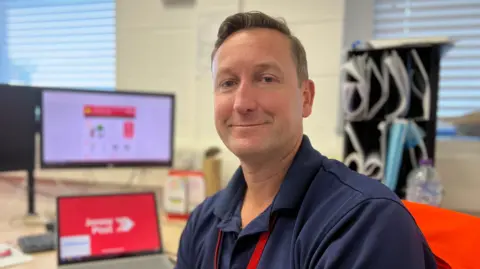
Paul Belhomme has been at Jersey Post for more than 30 years starting as a postman and working his way up to director of operations.
"In all the years I have been here, I would say that I have not had hot conditions for as long a period as what we're seeing now," he said.
"Records have been broken, so it's definitely climate change we're seeing and we're actually predicting this to happen more and more, which is why we've got to be prepared for this."
Belhomme added postal workers are beginning to move their start times earlier, "which has made the staff happy and it means we can keep them out of extreme hot conditions later in the afternoon or from lunchtime".
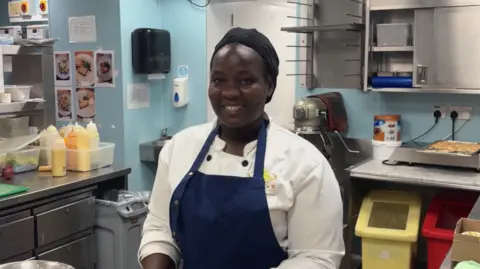
At the Rocquettes Hotel in Guernsey, pastry chef Lornah Ongechi said staff were able to keep working because management provided drinks and the kitchen doors were kept open.
"We are really hydrated in terms of water," she said.
Ongechi said chefs still had to adapt in the heat, adding: "If you were used to wearing a heavy jacket, like me, today I'm wearing a long jacket but it's still hot."
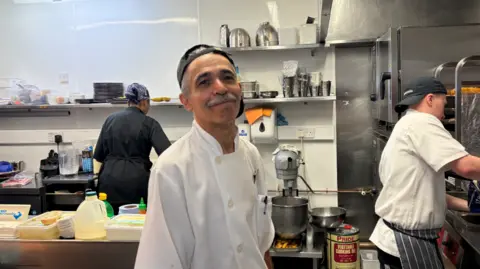
At Anni's Hideaway, Moores Hotel in Guernsey, chef Freddie Pereira, said working over hot pans in summer was "part of the job but can still be difficult".
"I just have water with ice and some juice, take some fresh air," he said, when asked how he cooled down.
"Sometimes it's too much, but we still have to do it," he added.
In Jersey, A&A Scaffolding Solutions Ltd managing director Alex Wareham said it was hard managing a busy schedule and heavy deadlines during the heatwave, but they have no choice but to carry on.
Mr Wareham said: "We have set a few rules, allowing staff too start early and then finish early if they want to.
"As much as we'd like to say to our workers, 'let's go home for a week', we just can't afford to do that."
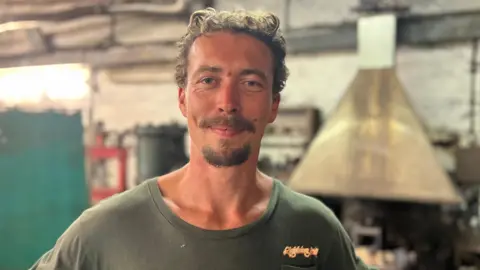
Architectural Ironworks' blacksmith and fabricator in Jersey, Joseph Evans spends his job welding, forging and making gates and railings.
Evans said during a heatwave "its like being in a sauna most of the time, it gets pretty warm".
"We have one fan at the moment, we just sweat it out and wait till the end of the day, or have a few minutes break and carry on."
'Hiding water on set'
Cornish theatre company Ha Hum Ha are touring their period drama the Scarlet Pimpernel which sees the cast donning wigs, heavy skirts and frock coats.
Producer and actor Ben Kernow who plays multiple roles in the show said: "We can't do much to the costumes, without going on naked, essentially.
"We're taking things a little bit slower (with fight sequences) at half speed if it's a very hot evening."
He added: "We hide water around the sets in places where people might not spot it."
 Chris Kelly
"The main thing is keeping hydrated so that we keep our energy levels up, and we're not kind of running into a burnout zone."
He said most of the costumes are "quite breathable" as they are made from cotton and linen, apart from the heavier coats.
"The show is naturally fast-paced and multi-role so we're changing out of costumes fairly quickly anyway, so we get moments of respite through that."
Kernow said costume changes are challenging in the heat "because you might be a bit sweaty and a little bit bigger than you would be usually."
 Shem/Amary Farm
The team at Amary Farm at Lincombe near Lee Bay in north Devon were also working round the weather and said temperatures peaked at 52C (125F) in the polytunnel.
Will Davis said: "We're having to shift the work from being able to do it in the day to early mornings and late evenings."
He said they are picking produce at 05:00 and keeping it in fridges, "packing it later in the day" ready for the veg boxes they deliver each week.
He said he was picking basil at 08:00 and "it's wilting as you're going".
"So you're really having to change the day and how you approach the day to be able to deal with the heat."
