Irish PM announces €505m in fuel-cost measures after days of protests

 PA Media
The Irish government has announced a package worth €505m (£440m) to support those "most impacted" by rising fuel costs.
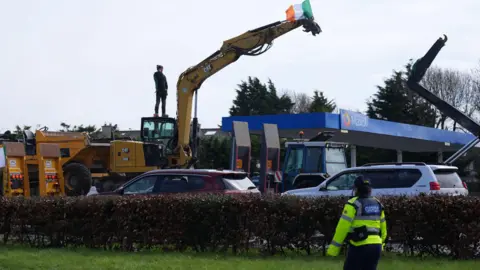
Fuel costs have soared globally as a result of the US-Israel war with Iran and demonstrators in the Republic of Ireland have been blocking fuel distribution sites and many major motorways and roads in protest.
Taoiseach (Irish PM) Micheál Martin said on Sunday that his government are extending temporary measures to reduce excise duty on petrol, diesel and marked gas oil.
They will also be postponing an increase on carbon tax and will be announcing a fuel subsidy scheme for farmers and fisheries.
Martin said groups "with a self-declared" mandate have imposed blockades.
"They have explicitly rejected the right of democratic representative groups to speak for them and have gone well beyond simply expressing their point," he said.
"Nobody has a right to blockade our country," he added.
What is in the support package?
The support package will see the reduction on excises duty extended from the end of May to the end of July.
There will be a 10 cent reduction per litre on both diesel and petrol.
And a 2.4 cent reduction per litre on marked gas/oil.
Reductions in fuel will come into effect from midnight on Tuesday subject to Oireachtas (Irish parliament) approval.
The increase on carbon tax will be postponed from May until the budget in October.
 RTÉ
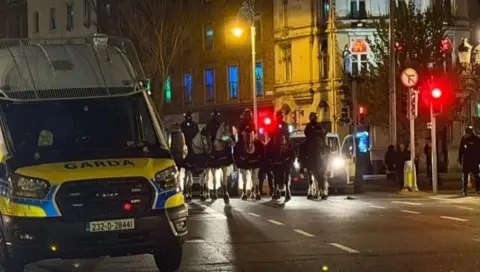
RTÉFuel protesters have been removed from a number of sites by police.
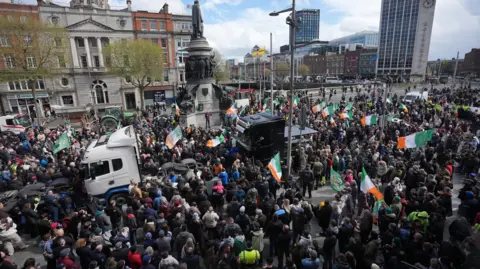
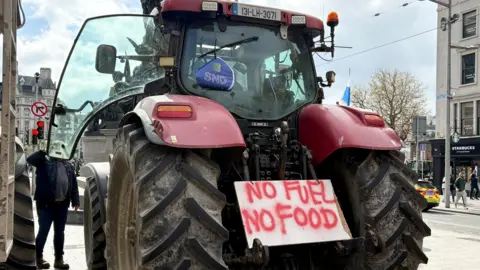
Protesters were moved in an operation by gardaí (Irish police) from O'Connell Street in Dublin, the M50 motorway near the city and from Galway port.
A protest is still blocking the N1 southbound near Dundalk - part of the main route between Dublin and Northern Ireland - as well as other roads including the M7.
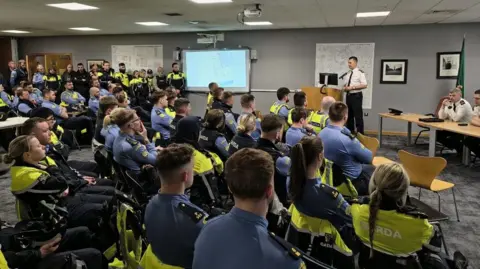
Shortly after 03:30 local time gardaí asked people inside tractors and trailers in O'Connell Street to leave the area, all of whom did so peacefully.
About 200 uniformed gardaí, the public order unit and mounted unit surrounded O'Connell Street, while its water unit patrolled the River Liffey below and a Garda helicopter flew overhead.
A number of trucks and tractors left the area before the operation began, while several others later returned to their vehicles and then drove away under Garda escort.
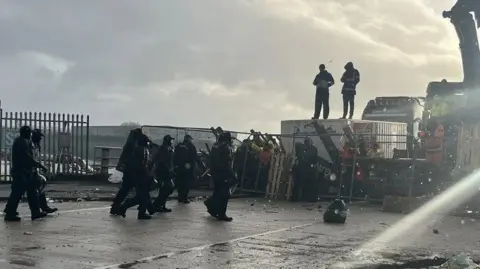
An operation to end a blockade of Galway docks began later in the morning.
Gardaí said it was "to ensure critical supplies of fuel to maintain critical emergency public services, including ambulance and fire services".
Demonstrators had formed a barricade on the bridge leading to the port terminal.
It was dismantled and protesters were directed to leave.
Most did so peacefully, although some were resistant.
On Sunday, Fuels for Ireland said an oil tanker carrying six million litres of fuel was able to dock at the port after the blockade was lifted.
Fuel shortages
 PA Media
The blockade of an oil terminal at Foynes, County Limerick, has now ended.
RTÉ reported that protesters in a motorcade of trucks and tractors were led by a group of motorcyclists from the entrance to the port at lunchtime on Sunday.
The protest near Rosslare Europort in County Wexford has been stood down and the vehicles blocking the village of Kilrane have been moved away.
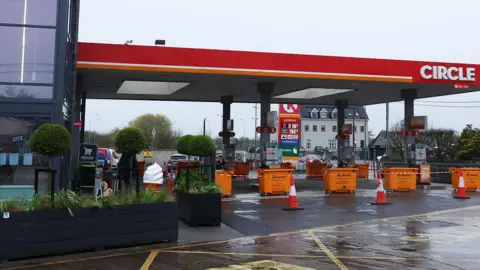
Hundreds of petrol stations in the Republic of Ireland have run out of fuel as the protests and blockades - involving slow-moving convoys made up of vehicles including tractors - are now in a sixth day.
On Saturday, fuel trucks regained access to an oil refinery in County Cork that had been subjected to a days-long blockade.
Protesters who had been blocking trucks leaving the Whitegate Refinery were pushed back by gardaí using pepper spray, in an operation supported by the Irish Defence Forces.
The Garda commissioner said a number of arrests were made during the operation.
He added that blockades were illegal and "not a legitimate form of protest".
"We gave these blockaders fair warning that we were moving to an enforcement phase and they chose to ignore that and continue to hold the country to ransom," Justin Kelly said.
 RTE
RTESinn Féin is to table a motion of no confidence in the Irish government in the Dáil (lower house of Irish parliament), where it is the largest opposition party.
Sinn Féin leader Mary Lou McDonald said the actions of the government parties had been "disastrous".
"They have lost the confidence of the public," she said.
Independent Ireland, Aontú, People before Profit and the Social Democrats have said they will support the motion.
 An Garda Síochána
Bus Éireann, Ireland's national bus service, has confirmed that school transport services are to resume on Monday.
 Reuters
The National Emergency Coordination Group, which brings together government departments and state agencies to coordinate emergency response, said fuel supplies for emergency response vehicles, including the ambulance service and fire service, are under "increasing pressure".
The Taoiseach previously said blockades meant the country was "on the precipice of turning oil away from the country" during a global oil supply crisis.
 PA Media
Why are the protests taking place?
The conflict in the Middle East has caused rapid price rises for both petrol and diesel.
Some 20% of the world's oil trade, the raw ingredient for producing both petrol and diesel, has been halted by the closure of the Strait of Hormuz.
Diesel in the Republic of Ireland has risen from about €1.70 (£1.48) a litre to €2.17 (£1.89) on many forecourts in recent weeks and petrol is now up to 25 cents more per litre at many pumps.
The protests started on Tuesday morning.
