'As a child in Bradford, I thought being queer was a white thing'

 Sid Akbar/Bradford Arts Centre
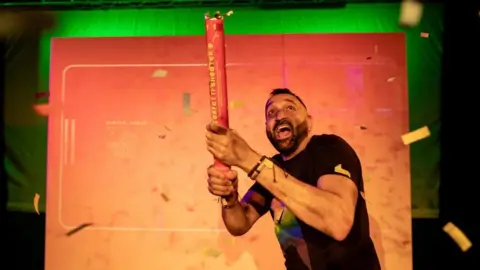
Playwright Sid Akbar is writing the stories he never saw growing up. As a queer man from a Pakistani family in Bradford, he felt isolated and never saw himself reflected on TV, in theatre or society.
"I just thought being queer was a white thing," says Akbar.
He says growing up queer and a person of colour in Bradford was hard "because of the complexity within the community and things that are not spoken about".
"There was a lot of love in my family but also there was a lot of expectation about what my life should look like and what I should be doing to be hitting those milestones," he says.
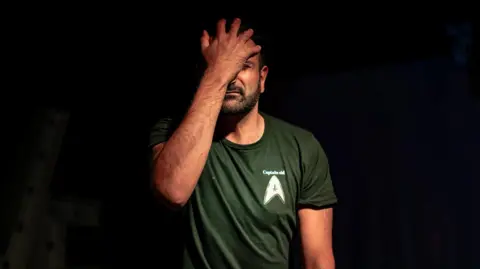
"A lot of it was me battling with my own internal monologue and trying to understand myself while not disrupting what's around me - so going to mosque, listen to my dad, going to those religious gatherings, going to weddings and my auntie's house and speaking about marriage and what the future looked like."
 Sid Akbar/Bradford Arts Centre
His company Dhamaka Arts is about celebrating "the lives of queer people of colour and intersectionality in the UK" through stories.
And he is now making his second autobiographical show, Khandan (Family) – The Shame Generation, which is at Bradford Arts Centre from 11-13 June.
His first show Besharam, which means shameless in Hindi and Urdu, premiered in 2023 and was his coming out story. With Khandan, he is now looking at family duty and shame.
"Shame has been the biggest force shaping my life and it wasn't something that was said out loud, it was just something I really wanted to unpack because it came to the point where I ended up being two different people or three different people," he says.
Akbar began to question where that shame was coming from and who it really belonged to.
"It's passed on from generational trauma, from our parents, from wider society, from religion to culture, from pop culture and I think I wanted to share it in a communal space with the audience so we could laugh at it, challenge it and just let it go together," he says.
The playwright and actor now lives with his partner in Manchester, but he says coming back to Bradford brings up mixed emotions.
"My family still lives here, I just can never leave Bradford, it's the place where I'm always coming back to.
"I did a lot of exploring in my first show, and I think it was more about forgiving the city," he says, "and the way to do that is coming back to Bradford. It's owning the space."
Fortunately, he says, things have changed for young queer people in the city.
"A lot of young people have a language for it now," he says.
"It's like being invited to the party but not being asked to dance. And I think that is shifting."
 Sid Akbar/Bradford Arts Centre
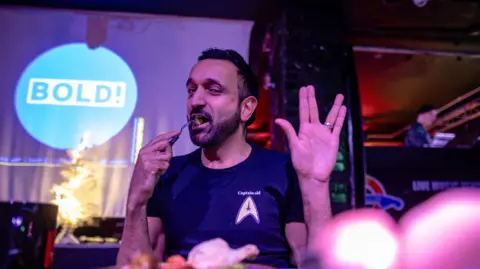
The heavy themes of the show are balanced with humour and, along with the help of co-creator Jenn Wilson, Akbar's story is told through the medium of sci-fi and Star Trek.
"We go further into queer space and really untangling shame, the final frontier.
"So sci-fi is a massive kind of framework in which me and Jenn play to really pull out the stories," he says.
"We both love Star Trek and using that metaphor from Star Trek was a way that we could communicate about tricky things in a shorthand," says Wilson.
"I'd even said to Sid, I want you to try and talk about this show as if it's the opening titles of Star Trek.
"That was where the humour was and that's where possibilities opened up and there was loads of playfulness."
Akbar says sci-fi is also a "very queer" genre, which allows him to imagine new possibilities for his life and for others.
"I think growing up with Star Trek it always had that positive future and the endless possibilities out there in the universe and also it's camp and playful, so why not?
Listen to highlights from West Yorkshire on BBC Sounds, catch up with the latest episode of Look North.
