'Amazing' toy scanner eases children's MRI anxiety
A new miniature replica of an MRI machine which helps to ease children's anxiety ahead of scans by testing it on different toys is "amazing", a mum has said.
Macie was diagnosed with Pfeiffer Syndrome when she was seven months old, and has to have regular MRI scans at Oxford's John Radcliffe Hospital to monitor her condition.
To undergo the scans, the 6-year-old previously had to be placed under general anaesthetic - but thanks to a new tool, she can now do it without having to go under.
But her mum Ashley said the new kitten scanner had "eased" her daughter's anxiety and "gave her a lot of confidence" over having a scan herself.
"Macy had a lot of anxiety having the scan, but we were going to try and get her to do it awake and she thought she could be brave and do that," Ashley, from Swindon, explained.
"She played with the kitten scanner and then she went into the actual MRI and she sat there, laid there beautifully, an stayed still for half an hour."
"I thought it was amazing."

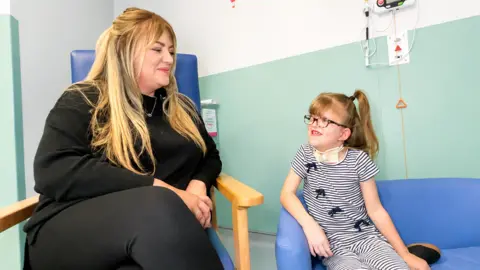
Ashley said using the scanner "really helped" because the lack of general anesthetic meant the family did not have to stay in hospital "even longer".
"Just coming in and doing the scan awake really helped us to be able to go home a lot faster," she said.
"I thought it was amazing."
"She [Macie] went home and she told all of our friends and family about playing with the kitten scanner," Ashley added.
The toy scanner, which is one of the first of its kind in use in an English hospital, was funded by the Oxford Hospitals Charity.
It lets children put three different animal toys through the mini-scanner, which plays a video explaining what is going on and providing coping mechanisms to deal with any anxiety they may experience.
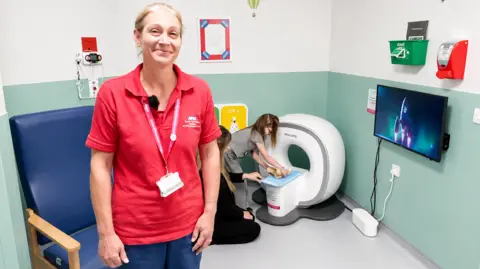
Sonia Dugmore, who is a senior health play specialist at the John Radcliffe, described the equipment as a "fun, interactive and innovative tool" which enabled children to "play through the MRI experience".
"We'll bring them [children] in to learn about what it is to have an MRI through this fun interactive tool and it helps to reduce fear and anxiety," she said.
"It helps them to learn about the experience, understand what it is we want them to do and it's helped us to get many more children through awake - so not needing to have the general anaesthetic for their scan."
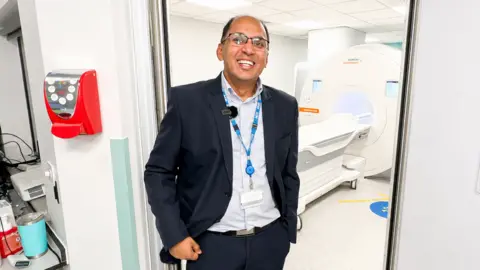
Robin Joseph, neuroradiology consultant at the John Radcliffe Hospital, said the scanner "makes a real difference for us as a hospital".
"If patients aren't able to do the scans awake, we have to put the patients to sleep, so we use a general anaesthetic," he explained.
"We sedate them and this is a big thing to do - it takes much, much longer, so in an afternoon, we may only do two or three patients with the general anaesthetic."
"Whereas with the kitten scanner, we can do four or five patients in the same time - so it makes a real difference in the kind of number of patients we can do."
He added that it also meant general anesthetic could be "reserved... for those patients" who could not use the kitten scanner.
