Volunteers rehearse life-saving disaster response

 SARAID
A humanitarian rescue charity has undertaken a high-intensity simulation to prepare volunteers for life-saving operations during major disasters.
Search and Rescue Assistance in Disasters (SARAID) is a UK-based charity that deploys trained search and rescue personnel to large-scale disasters worldwide.
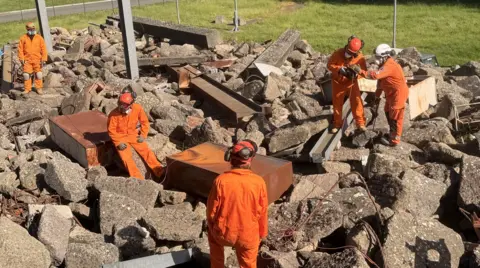
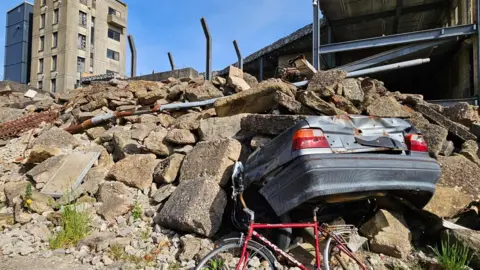
The Operation Menthon training was held in Moreton-in-Marsh, in Gloucestershire, on Saturday and involved the simulated collapse of a concrete multi-storey car park.
Technician and engineer Jen Durie said the drills were designed to keep skills up to date and build trust between people they may rely on in an emergency.
Rescue teams are often deployed to calamities where people may be trapped or injured, such as tsunamis, earthquakes, floods and landslides.
The mock building collapse was designed to replicate these conditions, where time-critical decisions, staying calm, and technical expertise are essential to saving lives.
Volunteers breached two concrete floors and cut through the roof of a crushed car, before breaching back out through the side of the car to rescue a 'casualty' inside.
 SARAID
"Essentially what it allows us to do is put our skills together and teach them the different things that could happen, so they can learn to adapt," Durie said.
"But more than anything, it's about building that team bond.
"Ultimately, we are responsible for ourselves and each other in dangerous situations, so building that trust and those relationships is really important."
SARAID is the UK's only completely voluntary team to be classified by the United Nations as a fully qualified Light Urban Search And Rescue (USAR) squad.
Their work often takes them to disaster zones across the globe, such as India, Nepal, Mexico, Palestine, Sri Lanka, Pakistan, Algeria and Haiti.
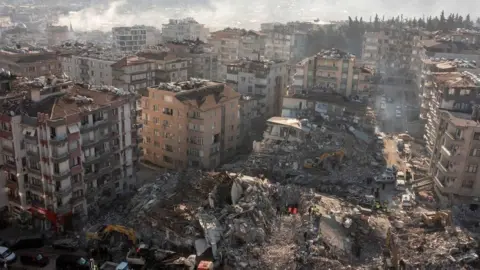
The last overseas deployment was to southern Turkey following the devastating earthquakes in 2023, which claimed the lives of more than 50,000 people.
 Reuters
The charity said complex operations often involve structural engineers, paramedics, and specialists in rope rescue, breaching and breaking, and hazardous materials.
National director Gary Francis said although the training exercises were designed to prepare for these circumstances, "really, there is no comparison".
"When you deploy to an active disaster, it's the sights, the sounds, the smell. It overloads your senses," he said.
"For a lot of our members, it's quite a shock to them.
"I wouldn't say over the years you get used to it - you're dealing with human tragedy at the end of the day - but you're able to deal with it slightly better."
Follow BBC Gloucestershire on Facebook, X and Instagram. Send your story ideas to us on email or via WhatsApp on 0800 313 4630.
