He told us we were slaves - The fight for justice on a Scottish fishing trawler

 BBC
BBCJoshua Amissah got up from his seat in the witness box and stepped away from the interpreter by his side.
The end was drawing near in a nine-year fight for justice, in a case of modern slavery on a Scottish fishing trawler.
The 40-year-old Ghanaian walked a few steps to the corner of the silent court room, crouched and covered his face. He was composing himself.
"He told us we were slaves," Amissah said.
"He said that his father had told him that any black person he worked with, he must treat that person as a slave."
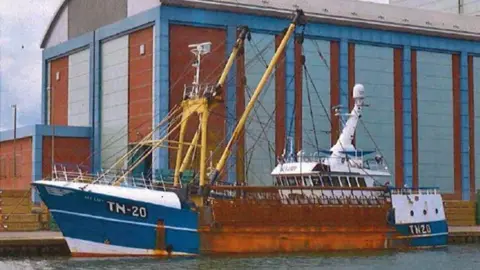
Amissah had been employed aboard the Sea Lady - a vessel owned and operated by the Annan-based TN Trawlers.
He told the jury at Hamilton Sheriff Court of the time he had confronted his skipper over his poor treatment.
The company owner was Thomas Nicholson. The skipper in the dock was his son, Tom Jr.
On Monday, Nicholson admitted breaching a human trafficking court order in a Scottish legal first.
Just days earlier, his son Tom Jr admitted failing to provide adequate food and rest to five Ghanaian fishermen while he was a skipper at TN Trawlers.
It comes after a three-year investigation by the BBC into claims of mistreatment of migrant fishermen by the firm over a decade.
 COPFS
COPFSOn board the Sea Lady the work was continuous. Amissah and his Ghanaian crewmates had devised a secret rota to get some sleep.
Such was the lack of food, another crewmate told the court that they had resorted to eating fish and octopus caught by the dredges to survive.
There was no induction, no training, the court heard.
"As soon as we got there, he said we should just get to work," Amissah said.
"[Tom Jr] said there was no time and that we needed to go hunt for scallops."
"There was no rest during the trip."
Then, after three days of evidence, the case suddenly ended.
After some amendments to the charge, Tom Jr had changed his plea to guilty.
He admitted failing to provide adequate food, rest or training to his Ghanaian crew as he skippered the vessel in the English Channel over months in 2017.
'It pains us, it cost us a lot'
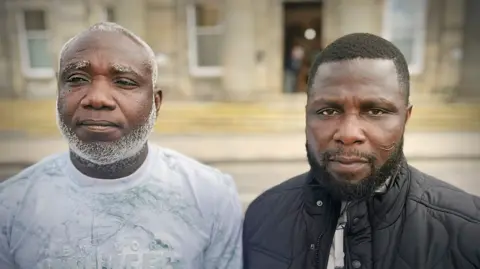
Amissah, who is still a fisherman, spoke to BBC Scotland News outside Hamilton Sheriff Court alongside his fellow crew member, Kow Mensah.
"What we experienced nine years ago, that was tough," he said.
"People don't understand because they weren't with us at the fishing grounds.
"You don't have any choice to say anything, or speak out or challenge. You don't want to say anything that will cause you harm, or your family.
"It pains us. It has cost us a lot.
"We want the whole world and other fishermen or other skippers to know that this is not the right way to treat the crew."
 Gavin Hopkins
Because of Tom Jr's sudden guilty plea, Kow Mensah and two other Ghanian men – Gershon Norvivor and Kojo Attah – did not get the opportunity to testify.
But the court did hear how an injury to another crew mate, Augustus Mensah, helped the men escape their ordeal on the Sea Lady.
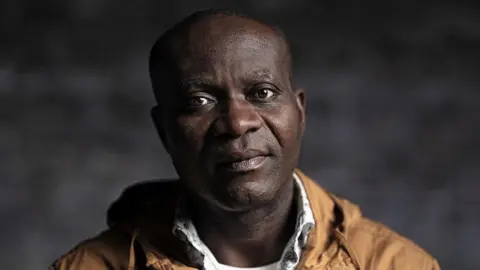
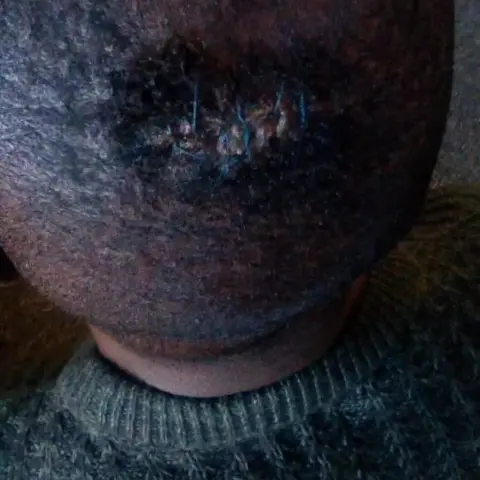
During rough weather in the English Channel in December 2017, Augustus Mensah, 55, fell and struck his head on the deck.
They eventually found a first aid kit to treat his open wound, but there was only a single bandage.
After the vessel travelled to Portsmouth for medical treatment, the police became involved.
Augustus Mensah's story featured prominently in the BBC's 2024 Disclosure documentary "Slavery At Sea" and File on 4's "Invisible Souls".
He spoke to the BBC again last week. He said he waited "nine good years" to tell his story to a court.
He said: "I was grateful to give evidence because they tried to deceive the public.
"It wasn't easy for me, but I am very happy that at long last we got our justice."
Tom Nicholson Jr will return to court to be sentenced next month.
While his case was prosecuted under maritime health and safety laws, it started life as an investigation into human trafficking.
Dubbed "Operation Feature", the probe began when members of the Sea Lady and another boat, the Noordzee, were taken in by police at Portsmouth after Augustus Mensah's head injury.
The men from Ghana and India were later recognised by the UK Home Office as victims of modern slavery.
However, in late 2022, the Crown Office dropped the trafficking case
The Crown said: "There is no longer enough evidence to allow this case to carry on."
But after Augustus Mensah and others applied for a "right to review", the case was eventually resurrected under the Merchant Shipping and Fishing Vessels (Health and Safety at Work) Act.
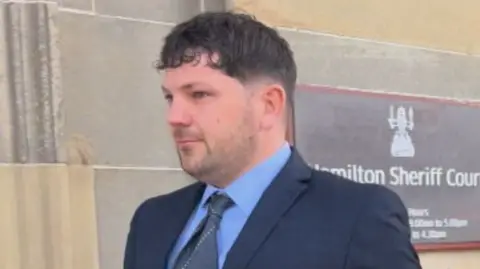
The case was the second time a member of the Nicholson family appeared at Hamilton Sheriff Court to face charges of breaching health and safety at sea.
In November 2022, Tom Nicholson Jnr's father Thomas Nicholson – who led TN Trawlers – admitted failing to get adequate care for a Filipino crewman, Joel Quince.
He was fined £13,500 and ordered to pay Quince £3,000 in compensation.
That case stemmed from a 2012 police investigation – "Operation Alto" – in which 18 crew from the Philippines were recognised as victims of modern slavery.
This week Nicholson, 63, was also fined £2,700 after breaching a human trafficking court order.
He is understood to be the first person in Scotland to receive and breach a Trafficking and Exploitation Risk Order (TERO).
'Concerning case'
Nicholson - who remains under investigation for trafficking - was given the order by Dumfries Sheriff Court to prevent him moving vessels without providing non-European crew details.
He breached an interim version of the order when he moved his vessel Olivia Jean from the Netherlands to Scotland without providing documents to the Maritime and Coastguard Agency (MCA).
His defence said this was a "genuine mistake" and no foreign crew were aboard.
Phil Taylor, director of the charity Open Seas, described the fine as "paltry".
He also highlighted the awarding of more than £250,000 of public funding to TN Trawlers while human trafficking investigations were ongoing.
"This is a really concerning case, and it's hard to understand how this firm was provided with public funding," he said.
"It shouldn't be possible for ministers to hand out tens of thousands of pounds to a business under investigation for human trafficking.
"This case shows how important it is for government to scrutinise the work of firms it is supporting with public money, and to publish details of historical convictions and ongoing investigations on the UK fishing vessel register, to ensure those who break the rules are held accountable."
Det Ch Insp Paul McNamara, of Police Scotland, said: "This investigation was a long running, joint operation between the Home Office, Border Force, Maritime and Coastguard Agency, and Police Scotland.
"As part of this, a Trafficking and Exploitation Risk Order (TERO) was in place.
"Breaches of the conditions imposed were identified through intelligence and Thomas Nicholson was reported in connection."
He said TEROs served a critical role in protecting those at risk of trafficking and exploitation.
McNamara added: "They allow police to step in at an early stage to prevent harm and disrupt organisations while we investigate.
"Partnership working is essential as we share knowledge and skills to target those who make money by exploiting others.
"We want to make Scotland a hostile environment for organisations involved in slavery and exploitation, to protect potential victims and keep our communities safe."
Chris Williams, fisheries section co-ordinator at the International Transport Workers Federation, said there was a "structural, systemic problem" in migrant worker recruitment in the fishing industry.
He said: "What we need is a solution that enables workers from the Philippines, Ghana, Sri Lanka and India to come into the UK fishing industry with employment rights, minimum wage protections, and their hours of work and rest being recorded.
He said the UK should not allow a "race to the bottom" where workers can be exploited and abused.
Williams added: "We should be paying people fairly and treating them fairly if we're so desperate to have them to keep this food-producing sector working."
In 2024, the BBC identified 35 men who worked for TN Trawlers and were later identified by the Home Office as victims of modern slavery.
The Disclosure and File on 4 production featured contributions from former workers from the Philippines, Ghana and India who alleged they had been mistreated by the company.
In October 2024, another group of fishermen from Ghana were awarded £20,000 each in compensation by the UK government.
The crew were rescued in 2020 from the scallop-trawler Olivia Jean, also owned by TN Trawlers.
TN Trawlers denied any allegation of modern slavery or human trafficking and said its workers were well-treated and well-paid.
Additional reporting by Carla Basu, Jax Sinclair, Penny Macmillan and Paul Ward.
