Chefs and fishers learn to adapt to new species

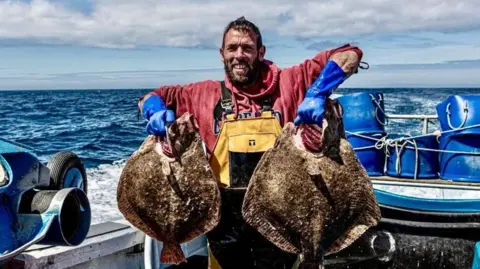 Buck Bennett
Chefs and fishers say they need to adapt as increasing numbers of once rare species of fish are being attracted to warming waters.
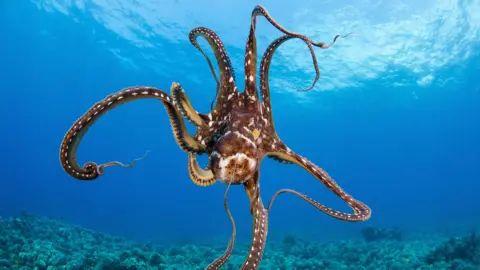
An ongoing octopus bloom, which the Marine Biological Association said had been attracted from the Mediterranean by increasingly warm waters in the South West, has severely hit shellfish.
Newquay crab and lobster fisher Buck Bennett said he had seen more red mullet and types of bream than ever before and believes fishermen will need to adapt.
He supplies Jamie Park, chef director for the Adam Handling Collection, who said he was "going to have to get the Mediterranean encyclopaedia of fish out to start understanding the new species".
 PA Media
Bennett said: "We've always caught red mullet but the numbers that have been poor over the last couple of years seems to be increasing massively.
"When you look into them they're a very Mediterranean fish, also black bream, gilt-head bream and couch's bream, yet again, something that we would catch but in very, very small numbers.
"So I think the industry over the next three, five, seven, 10 years, anybody's guess, we could be fishing and having to change our fishing methods totally."
Bennett said fishers have always had to adapt, and this is the latest shift in the type of fish in our waters.
He said: "I'm a big believer that all this fish is moving north - the cod that's disappeared, the mackerel - bearing in mind the South West was sort of like the pinnacle of a mackerel fishery from back in the 70s - nobody can catch a mackerel anymore."
He said some fellow fishermen had turned to catching yellow fin tuna, with one recently landing a 130kg (20 stone) fish.
"I can see everybody in the UK fishing fleet being [given quotas] on tuna, I can see tuna becoming something that is is plentiful in our waters."
 Buck Bennett
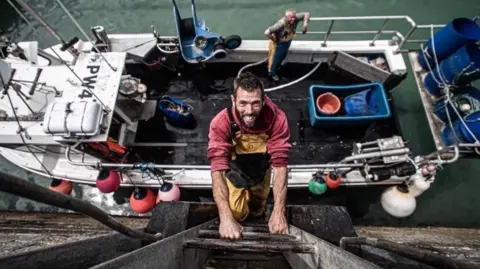
Bennett has wondered whether a different type of crab that prefers warmer water may arrive on the South West's shores and whether the existing traditional crab pots would be suitable to catch them.
"Where I've got 600 or 700 pots that are suitable for catching the crabs that we catch at the moment, you might find you have to either adapt that gear or you have to sell it.
"You know for me to change my crab fishing methods with the same amount of gear to a new set again you're probably talking in excess of £100,000.
"I think every which way you look it's going to put strain on the industry, especially the industry here.
"We're all really in a sort of unknown, nobody's been in this position before so nobody knows what's going to happen next week, or next month, or in six months time.
"That's why it's so worrying, because you don't know if you can adapt or not, because you don't know what it is you've got to adapt to at the moment.
"All we can see is a lack, we can't see a gain, we can only see a lack."
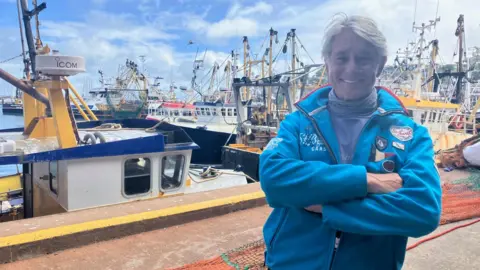
Brixham fish merchant Ian Perkes said he had seen a difference in what is being landed and said it was because octopus eat between 6% to 8% of their body weight each day.
He said: "We're talking of an estimate of 10,000 kgs (1,575 stone) of shellfish per day are being eaten by these octopus and now they've started eating the cuttlefish.
"These fish lay 180,000 eggs, they only live to maybe two years old but you only need one per cent of those eggs to succeed.
"We're seeing not so many cuttlefish now, we're seeing no mackerel, no cod, no pollock, no squid - these are all species that we'd be looking to buy this time of the year but we're not seeing them."
 John Hersey
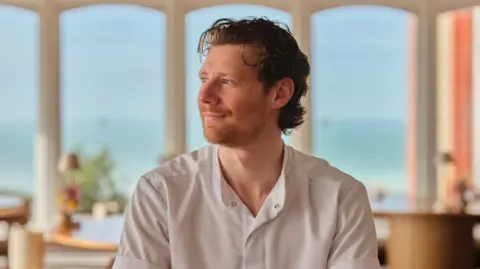
Chef director Jamie Park said his menus would have to adapt to the lack of some species and proliferation of others.
He said: "The crab that we're going to probably see in the future won't be Cornish crab, it will be from further north, so you're talking sort of around the top of the north coast of Wales, around Irish waters and the North Atlantic.
"Things like red mullet and other Mediterranean species, there'll be loads of those in the water here."
He said the octopus were eating everything in their path, including scallops, cockles and whelks, which would effect other fish which fed on the shellfish.
Park has recently added octopus to the menu at the Tartan Fox near Newquay.
He said: "I chose to feature octopus because of what's happening with the industry at the moment - it's here, it's in our waters and the fishermen are catching it.
"We've told customers they're an invasive species at the moment, they've sort of taken over the waters, they're eating all of the native species and they're disruptive for our local fishermen and it's causing problems.
"We almost make the guests a part of a solution, we say 'come eat more octopus, you're doing everyone a favour at the end of the day'."
Looking to the future the chef said: "I'll have to get the Mediterranean encyclopaedia of fish out to start understanding the newer species.
"For as long as I can get these ingredients that we love in a responsible way, and in a sustainable way, through small, independent fishermen, then will continue to serve it, but if Buck calls me tomorrow and says we can't do it anymore because of X-reason, then we'll adapt and we'll move with the times."
