WW2 soldier's cigarette case returned to daughter he never met, 80 years after he died

 BBC Wales
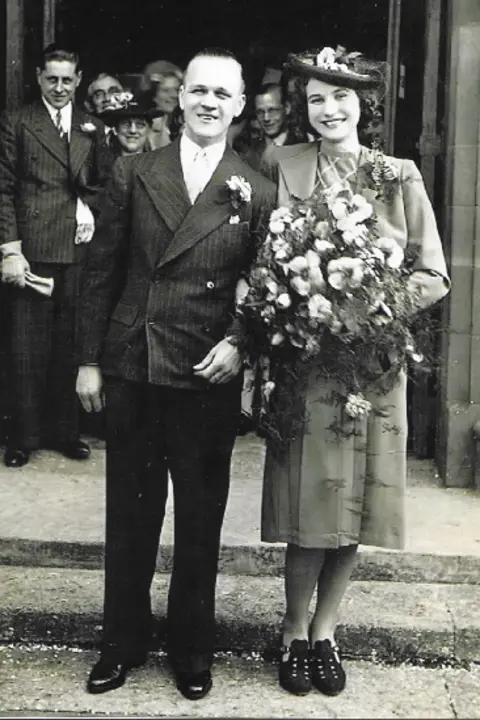
A silver cigarette case belonging to a World War Two soldier that was found 82 years after he died has been returned to the daughter he never knew he had.
Dutch metal detectorist Filip Krapels unearthed Stan Drew's bullet-damaged case in a field near his home in Bergeijk, close to the Belgian border, on 2 April.
Official war records show that Stan died during intense fighting for Normandy on 21 July 1944 at Falaise Gap, in France, 370 miles from where his cigarette case was eventually unearthed.
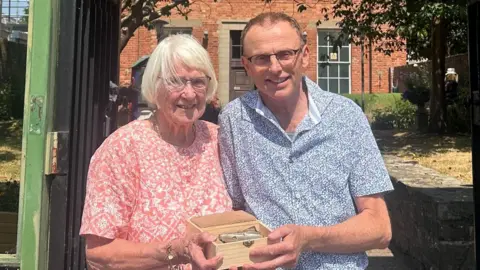
Moved to tears at the presentation at the Royal Welsh Regimental Museum in Brecon, Stan's daughter Diane Owen said: "I'm shocked... really shocked. I knew he was a brave soldier, but knowing what an ordinary boy he was just makes his life, and Filip's discovery, all the more real for me.
"I just wish I could have spoken to him. Thank you Filip, for bringing a little piece of his memory home."
 Drew family photograph
Filip told Diane: "I've had many turbulent – I think you'd say in English - sleepless nights since digging this up.
"I knew I had to bring it home and seeing Diane today has made me even more certain that I was correct in that thought.
"A mission I was given has been completed."
The case has been loaned to the museum for the foreseeable future and will go on display in a padded glass case alongside interpretive material.
 Filip Krapels
After BBC Wales ran a story about Filip's discovery in May, Stan's great niece Sally Docherty read it and thought "hang on, that's our Stan isn't it?"
"So I got on to my mum Sheila and her cousin Diane and that's how we're all here today."
Filip's research also tracked down Diane, who said: "I was born on 1 August 1944, so 11 days after my dad died, but my mother knew nothing until September.
"We didn't talk much about him when I was growing up, but my mum and step-father did tell me that Stan was a very caring man and that he would have been a brilliant father to far more children, had he had the chance."
 Drew family photograph
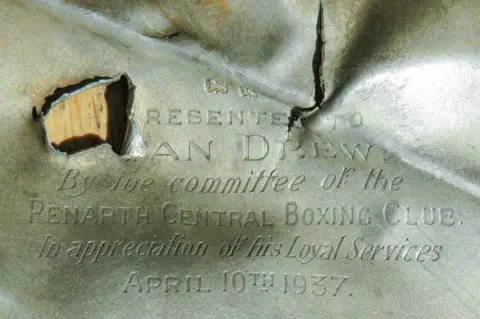
A bullet had obliterated the capital S of Stan's name, leading Filip to search for an Ian Drew after discovering the case.
Realising no such soldier existed, his hunt led him to anyone with a name resembling the letters on the case with a boxing record in Wales as the inscription was from Penarth Central Boxing Club and dated 10 April 1937.
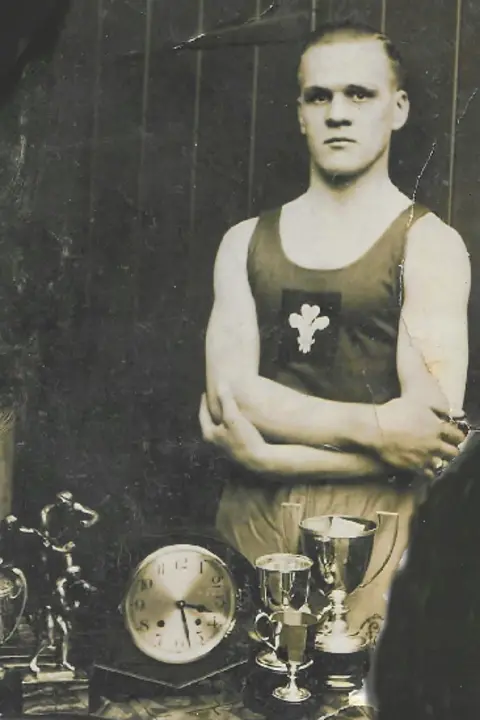
Filip said Stan had "a very successful amateur boxing career, and many of his fight reports are recorded in the Western Mail archives".
He added: "I've been metal detectoring in my neighbourhood for many decades but until this find I'd never discovered anything of such significance, or something which could still have such meaning to a living family member.
"Despite my inexperience, that part of the quest was reasonably straightforward, thanks to the internet."
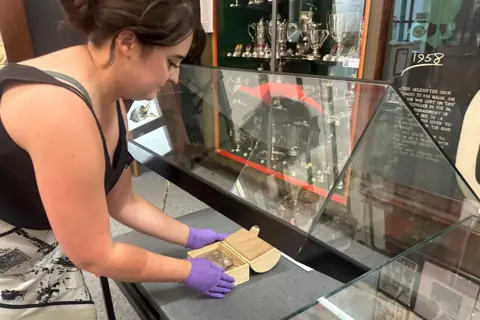 BBC Wales
It is thought Stan's cigarette case was picked up by a fellow soldier and carried from Normandy before being lost in battle as the Allies pushed into Belgium and the Netherlands in September and October 1944.
Royal Welsh Regimental Museum curator Amanda Rosewarne was able to provide Diane with a booklet of all the records held on Stan by the Army.
Amanda said: "Sadly, Stan was just one of 118 men to go missing that day - many of whose bodies would never be recovered.
"Although we've been able to document almost all names on war memorials, the level of detail which this inquiry has given us has allowed us to delve far deeper into the life of one particular soldier.
"Stan's life was unique, but the story his cigarette lid has uncovered speaks for so many thousands like him."
At the ceremony to reunite the family with Stan's case, Col Robert Dickinson of the Royal Welsh Regiment concluded: "Stan's story tells us in such vivid terms, that our servicemen and women aren't heroes in the comic book sense, but just ordinary men and women who – when put to the test – give everything in their soul to defend their family and their country."
