Anita Manning's auction house criticised for offering human remains

 Great Western Auction
A Glasgow auction house founded by TV presenter Anita Manning has been criticised for offering human remains for sale.
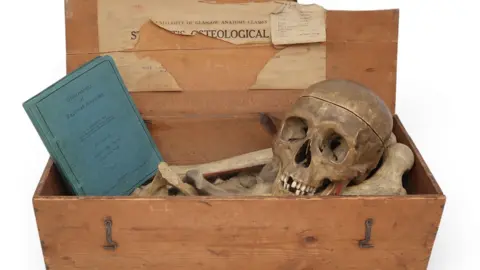
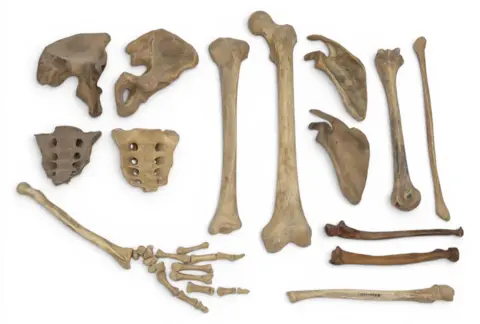
Human bones, including a skull, were due to go under the hammer on Friday, but Great Western Auctions withdrew the item for sale after being contacted by BBC Scotland News.
The auction was described by experts as being "unethical and unacceptable in any form", with the body parts likely to have originated in India or China and then sold overseas to be used in universities for study.
The lot was valued at between £500-£800 and came in a box marked as belonging to an anatomy class at the University of Glasgow.
It is not illegal in the UK to sell or auction off human remains, as long as they were not acquired illegally and are not being used them for transplant.
However, the fact that many of the remains used in medical classes came from other countries and were likely not to have the consent of the deceased has prompted concerns.
Dr Lauren McIntyre, of the British Association for Biological Anthropology and Osteoarchaeology, said auction sales such as the one that had been planned for Glasgow were unacceptable.
She told BBC Scotland News: "The buying and selling of human remains for commercial gain robs the deceased of their dignity, and is both unethical and unacceptable in any form.
"Most medical and anatomical remains like the ones that were to go to auction in Glasgow are the product of 20th Century mass export from countries like India and China, rather than being from consenting donors.
"The export of human skeletons from India was only banned in 1985 amid government fears of grave robbing and murder, although there is evidence that the trade continues.
"The export of human skeletons from China was only banned in 2008. Therefore, many of the examples seen for sale may actually be of very recent date."
 Great Western Auctions
Prof Gordon Findlater is HM's Inspector of Anatomy - meaning he oversees the licensing and regulation of anatomical services in the UK.
He told BBC Scotland News there were several possibilities for how the bones came up for auction.
These ranged from a student borrowing the remains for study - which used to be allowed many years ago at the university - and not returning them, to them being a donation from the family of a doctor who had owned the bones for work purposes.
"Without knowing who is selling these bones, it is impossible to know how the seller came across them," he said.
"If the bones came from a donated body at some point in the past, then it is in breach of the current Code of Practice for Anatomical Examination in Scotland 'for any individual or organisation to make financial profit from bodies donated to medical science'."
 Great Western Auctions
Journalist Patrick Pester has written about the topic extensively, and described auctions featuring body parts as "the tip of a grisly iceberg".
He told BBC Scotland News: "I think we need to have a national conversation about the sale of human remains.
"Most people have no idea that you can buy the dead at auction and on social media.
"There are usually a few auction houses listing human remains for sale at any given time, but the vast majority of the trade goes through social media."
Pester added that people who purchased the items did so for various reasons.
He said: "There are a lot of people interested in the macabre and want them for a Gothic aesthetic, there are people interested in medical history and evolution, there are witches wanting them for rituals - there is no one size fits all type.
"It's not about demonising collectors at all, but something has to change as regulations are currently like the Wild West."
Responding to the BBC's request for comment, Great Western Auctions said: "The lot has been withdrawn."
The company, based on Dumbarton Road, was founded by Manning and her daughter Larissa in 1989.
It marked Manning as one of Scotland's first female auctioneers, and she has since enjoyed a prolific TV career on programmes such as Bargain Hunt and Flog It!.
In 2024, Labour's Bell Ribeiro-Addy called for an end to the sale of human remains in auction houses and on social media.
The Human Tissue Act only bans "commercial dealings" of human tissue in the context of medical transplantation, rather than sale as objects.
In addition, it only covers remains under 100 years old, meaning many historic remains would not be in scope.
