Mass stranding offers rare insight into lives of pilot whales

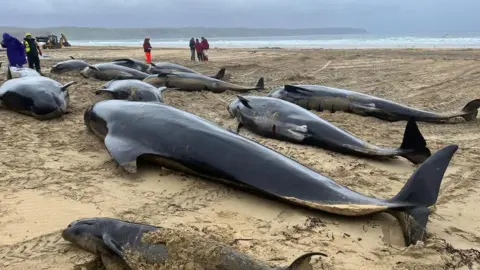 Christina McAvoy/BDMLR/PA Media
Scientists say they have discovered rare insights into the feeding habits of long-finned pilot whales after a mass stranding in the Western Isles.
The pod of 55 whales died after getting into difficulty in Tolsta Bay, Lewis, in July 2023.
Research published last month suggested the stranding was triggered by a female experiencing a difficult birth.
Scientists said the new study had found evidence about their seasonal feeding grounds and how they place the elusive animals at risk of stranding.
The study, led by the Scottish Marine Animal Stranding Scheme (SMASS) based at the University of Glasgow, has been published in the scientific journal PLOS One.
By analysing skin tissue, scientists have identified "chemical signatures" that show the whales were healthy and had likely hunted fish and squid near deep waters of the continental shelf, an area of seabed that surrounds the UK.
The researchers said long-finned pilot whales were a deep water species and "notoriously difficult" to study in the wild.
It was possible to take tissue samples from stranded animals, and stable isotope analysis was used to reconstruct their feeding history.
The data indicated that the pod had been feeding primarily along the edge of the continental shelf and a slope down into deeper offshore waters.
The area is believed to support substantial fish and squid populations during spring and early summer.
The scientists said the animals were in good nutritional condition at the time of death, but their stomachs were empty.
This raised questions about their foraging activity in the immediate period before stranding, the team said.
They added that the study was the first direct evidence long-finned pilot whales use shelf-slope habitats as important seasonal feeding grounds, and how that places them at risk of stranding in shallower waters.
The continental slope is a geological feature where the seabed slopes down from shallower seas nearer the coast to the deep ocean.
In some places the slope is a long, gentle gradient but in others it is steep.
Different water currents mix there and nutrients they churn up create a habitat that attracts plankton, fish and larger animals such as whales.
Anna Kebke, PhD researcher at the University of Glasgow and lead author of the study, said: "Understanding the feeding habits of large marine predators such as long-finned pilot whales is critical for the development of conservation strategies.
"However, dietary data are often lacking."
She added: "Our findings demonstrate the importance of deep water food sources to long-finned pilot whales, providing valuable insights into their early spring-summer feeding habits."
SMASS director Dr Andrew Brownlow said the analysis added further information to what had already been gleaned from a post-mortem examination of the whales.
"Together, they allow us to move from asking what happened at the moment of stranding to asking what set these animals on a course towards it."
The team said two further mass strandings involving long-finned pilot whales occurred in Scotland in 2024 and 2025, highlighting the urgency for further research.
'Distressed individual'
Members of British Divers Marine Life Rescue and other volunteers attempted to save some of the pilot whales in the 2023 incident.
In its report last month, SMASS said it found that a mature female had experienced a difficult birth.
The scientists said this suggested a "possible social trigger for the stranding".
They added: "Strong social cohesion may have then led the entire group to follow the distressed individual into shallow waters.
"Once stranded, the animals were unable to refloat themselves due to a combination of surf generated by onshore winds and the soft sand substrate on the beach."
Long-finned pilot whales are large dolphins and described by Whale and Dolphin Conservation as having "incredibly strong bonds".
