Care failures contributed to teen's death - expert

 Family handout
This article contains details of suicide and self-harm
Failures in the way a mentally unwell teenager was treated contributed to her death, an expert has told her inquest.
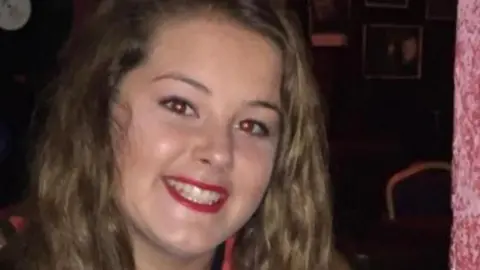
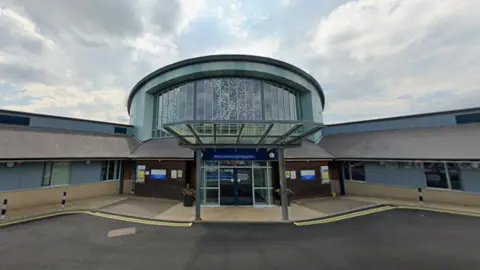
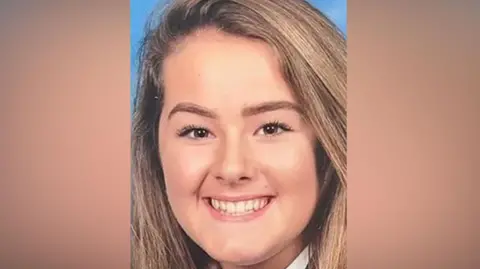
Emily Moore, from Shildon, died in February 2020 while a patient at Tees, Esk and Wear Valleys NHS Foundation Trust's (TEWV) Lanchester Road Hospital in Durham.
After reviewing the 18-year-old's records, psychiatrist Dr Francesca Denman said there were multiple factors which had increased the already high risk Emily posed to herself.
They included Emily's traumatic experiences at another TEWV hospital and staff not following her care plan in the hours before she fatally injured herself, the jury heard.
The inquest in Crook has heard Emily began experiencing mental health problems in 2017 when she was 15, resulting in her being sectioned in March 2019 and diagnosed with emerging emotionally unstable personality disorder (EUPD).
After spells in TEWV's West Lane Hospital in Middlesbrough, which her father described as a "hell-hole", and Ferndene in Prudhoe, run by Cumbria, Northumberland, Tyne and Wear NHS Foundation Trust (CNTW), she was moved to Lanchester Road on 6 February two days after turning 18.
 Google
Emily was initially on enhanced observation on the 20-bed Tunstall ward, meaning staff always had to have sight of her, but after several incident-free days that was downgraded to regular check ins, the jury heard.
On 12 February, doctors agreed a care plan which said Emily should be in communal areas during the day, apart from when she was getting dressed in the morning and for an hour after lunch.
The inquest previously heard Emily benefited from engaging in activities and being distracted from her thoughts.
But staff on duty on 13 February allowed her to spend most of the morning and early afternoon alone in her room with a check on her made every 15 minutes.
 Family handout
Healthcare assistant Michelle Hutchinson, who monitored Emily throughout the day, said she had not been aware of the care plan and only found out about it at the inquest.
Had she known, she would have encouraged Emily to leave her room and be in the communal areas, she told jurors.
She said she last spoke to Emily in her room at about 14:10 GMT, with the teenager appearing "bright" and there being "no indication of any distress".
Ten minutes later she looked through the window of Emily's bedroom door but could not see her, the jury heard.
She went to see if Emily was in any of the communal areas before returning to the bedroom and finding the teenager unconscious in the small en suite bathroom, the jury heard.
Anna Morris KC, representing Emily's family, asked why Hutchinson did not go into the bedroom the first time she could not see her.
"Because I had no concerns about her at that point," Hutchinson replied, adding she thought Emily had gone to the activities room.
 Supplied
Denman said she identified several factors contributing to Emily's death, including
- Emily's "extremely unpleasant" and severe mental illness characterised by impulsive self harm at unpredictable times
- the availability in her room of a method to harm herself
- her care plan not being followed in the lead-up to her fatally injuring herself
- Emily being allowed to spend too much time on her own resulting in her "ruminating" on self-harm and suicide
- her "risky" move to the adult ward being based purely on her age and not the "right time" clinically
- her treatment at West Lane if it was as Emily, her father and other patients described
- the impact of the death of a friend and fellow patient at West Lane
Denman said Emily would have been "sensitive" to her care plan not being carried out as she expected which, due to her illness, might have symbolised to her that people "did "not care" about her, a known trigger for her self-harm.
The inquest has heard Emily may also have been further upset that day as it should have been the 18th birthday of a friend who died when the pair were patients together at West Lane, which her father David had warned staff about that morning and Emily had previously said was "in her mind daily".
Jurors have heard Emily complained of being treated "like dirt" at the Middlesbrough hospital, which other patients described as "awful" and was subsequently closed by the Care Quality Commission.
Denman said sectioning a child in hospital was always a "desperate measure of last resort" which was "necessary" but also "harmful" by virtue of the child being away from home and exposed to restrictions and other mentally unwell patients.
She said because of Emily's condition, she would probably have "taken her life when she did and the way she did" even if her care at West Lane had been "optimal".
But if Emily's care at West Lane was "as described", it would have been "positively harmful" and "deteriorated her condition more than just an admission to hospital would", increasing even further her already high risk of self-harm or suicide, Denman said.
"It's reasonable to say it made things worse," Denman said, although "things were already very bad even under optimal care".
The inquest continues.
- If you are affected by any issues raised in this article, support can be found at BBC Action Line
