Metro memories as old trains begin last week in service

 BBC
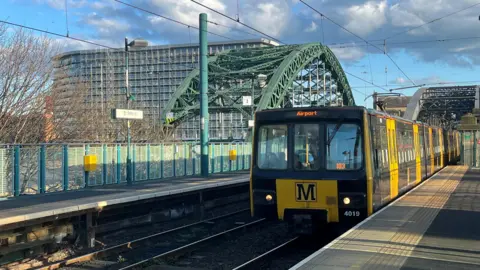
BBCAs the old fleet of trains from the Tyne and Wear Metro enter their final week of service, people share their memories of when they first pulled up at platforms.
Rob Tickell was one of the first to travel on the Metro service as a child in the 1980s and says he will not "forget them in a hurry".
He has been able to see the trains from his Benton home his entire life and says spotting one of the new ones coming past for the first time gives him a "buzz of nostalgia".
"You think 'oh, I remember what it was like seeing the first one coming past,'" he says.
For Paula Mitchinson in Sunderland, who moved near a station soon after the network reached the city, travelling on the carriages was a chance to feel like a child again and pretend to "drive the train" from the front seat.
The ageing fleet is being replaced by 46 Stadler trains at a cost of £362m.
North East Mayor Kim McGuinness has also announced services will increase from December - a train will run every 10 minutes on each line during the week.
 Michael Matthews
The UK's first urban light rail network began operating in August 1980 and was officially opened by Queen Elizabeth II the following year.
Since then, the original trains have made 1.7 billion customer journeys, clocking up half a billion kilometres, operator Nexus says.
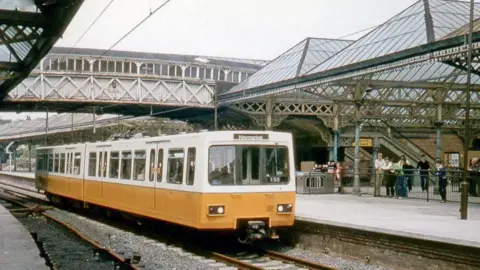
The carriages were originally white and yellow, but were refurbished between 2010 and 2015, changing to a light metallic grey and black exterior finish alongside the signature bright yellow branding.
 Walter Dendry/Geograph
When he was about 12, Tickell travelled on a test train ahead of the system's official opening.
He says at the time the carriages felt futuristic, airy and bright.
"We got to travel down the line and went into the underground section for the first time," the 57-year-old recalls.
"There was a thrill to seeing those trains arriving in a roar of air along the tunnels, which was really quite novel to anyone in Newcastle at the time."
'Driving the train'
Initially the network only ran between Newcastle's Haymarket and Tynemouth in North Tyneside.
It was later extended around the coastal loop, before Newcastle Airport was added in 1991 and Sunderland in 2002.
Paula Mitchinson moved near the Stadium of Light station shortly after it opened in 2002.
The Sunderland fan says naming the station after the Black Cats' home ground "sealed it completely".
"I love the old Metro trains. They were perfect trains," the retired teacher says.
"And what's even more wonderful, and I know a lot of people feel the same way, if I was really lucky or it was early in the morning, I might be able to get the very front seat or the very back seat.
"And I'm a big kid at heart, so I could pretend I was a train driver, which was great."
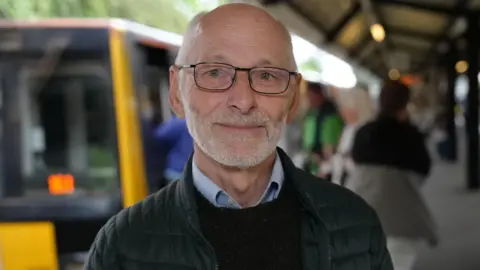
Bill Dodds worked as a driver for 34 years, starting in 1980 when the system first opened.
He was only 24 at the time and said a lot of his colleagues were in their 50s and 60s and had been driving steam trains.
He said the old trains had "done fantastically well."
"They were only designed for a lifespan of 30 years and they've been running for 46 years, 20 hours a day.
"They've really worked hard for those years and I think it's a tribute to the staff who've kept them running for that long as well, way beyond their lifetime."
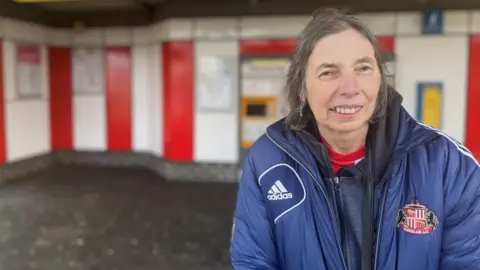
Mitchinson hopes to catch one of the old metros for the last time this week.
"Even though they're not new trains, they were there and they were there all the time," she says.
"And I know sometimes it could be late, but it was still a lot quicker to use the metro to go anywhere around the system."
Travelling on an old train for potentially the last time, Cameron Johnston, from Wallsend, said he had been making the most of their final runs.
"It's sad they're going to be gone but I at least want to say a fair goodbye to them," he said.
"I'm definitely going to miss them, I've spent the past couple of years riding them as often as I can, making the most of them while they're still here."
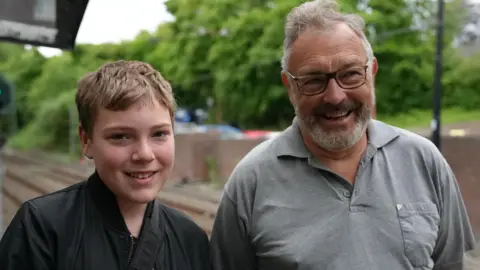
Dave Victor and his son Henry travelled up from Colchester to travel one last time on the old trains.
Henry said he would miss the old ones but the new ones were "necessary" because they were more accessible.
While Tickell is not sure if he will get to travel on an old train one last time, he hopes to at least "catch sight of one".
"I'm quite lucky because I've had such a long time with them in my life effectively that I've got a lot of memory stored up, so I don't think I'm going to forget them in a hurry."
