From blast off to splashdown: My days following Nasa's historic mission to the Moon

 BBC/Kevin Church
For the last 10 days, four astronauts have been making history, travelling further into space than humans have been before as they voyaged to the Moon and back.
I've been following every moment of the Artemis II mission: from lift off, to their lunar close encounter and a nerve-shredding landing.
Before they blasted off into space, the crew told us that on launch day astronauts are the calmest people around.
Me - not so much.
The force of the blast passes right through you
My excitement was impossible to contain and as the rocket fired its huge boosters and engines and headed skywards, my reaction went viral.
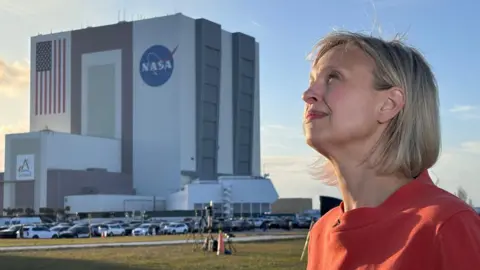
Standing by the countdown clock at the Kennedy Space Center in Florida, alongside my BBC News science team Alison Francis and Kevin Church, was a truly visceral experience.
The burning white brightness you just can't take your eyes off, the deafening roar that takes seconds to hit you, and the force of the blast that passes right through you.
Most of all though, I just couldn't quite grasp that there were four human beings strapped into their seats at the top of a 98m-tall rocket on their way to the Moon.
As Reid Wiseman, Victor Glover, Christina Koch and Jeremy Hansen got their first look at home from far above, Glover told the world: "Planet Earth, you look beautiful."
Then with a burn of their spacecraft's main engine, they said goodbye and began their quarter of a million mile journey to the Moon.
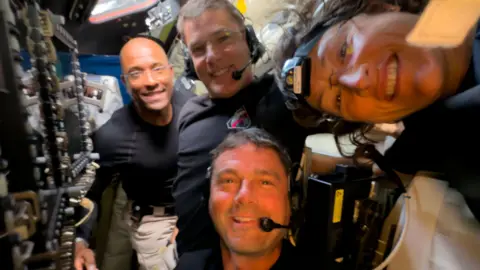
With the crew getting used to microgravity, live video was streamed back to Earth from inside their capsule.
And it was immediately clear how crammed together they were. They were living, working, eating and sleeping in a space about the same size as a minibus.
There was no privacy from each other, or from the millions of people around the world following every twist and turn.
 NASA
NASAParticular attention was paid to their Universal Waste Management System, otherwise known as the loo.
Their troublesome toilet, which cost $23m to design, had problems with its plumbing.
And we got to find out, in intimate detail, about the impact this was having on the astronauts, when questions were asked at a media briefing about the status of their "number ones and number twos".
And if you want to know - and, confession, I really did - it was "go" for "number twos" but for "number ones" collapsible contingency urine devices were deployed. Basically bags with funnels.
Inside Nasa's Mission Control
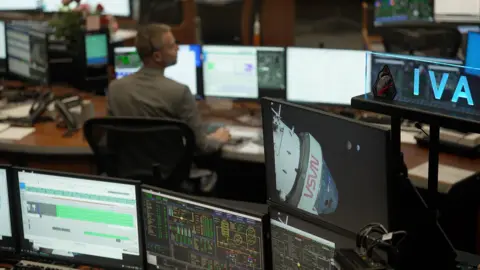
At the Johnson Space Center in Houston, we got to spend time in mission control - the nerve centre of the entire operation.
The team there, staring intently at their screens as data poured in, were monitoring all of the spacecraft's systems, from navigation to life support.
And this was vital. It's important not to forget that this was a test flight - the first time any humans had flown on both the rocket and the spacecraft.
And a test flight comes with real risks.
 BBC/Kevin Church
Speaking to Canadian astronaut Jeremy Hansen, for the 13 minutes presents: Artemis II podcast, while he was in quarantine before the launch really brought this home.
He told me he'd spoken to his wife and three children about the possibility that he might not come back.
Reid Wiseman also said he'd had very honest conversations with his two daughters about the dangers involved with this endeavour. He'd brought them up as a single dad after his wife died six years ago.
That loss led to one of the most poignant moments of the mission.
Crater called Carroll
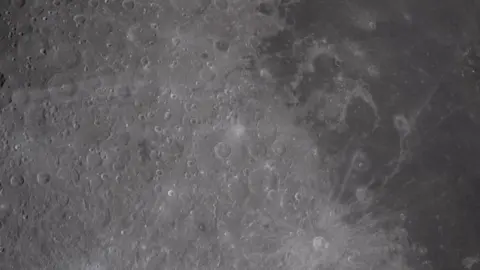
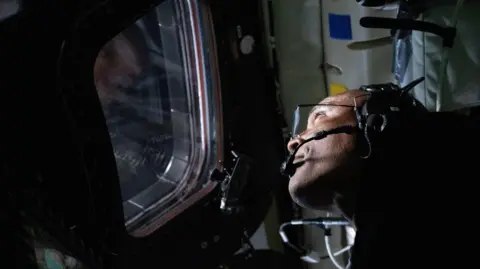
As the crew neared their destination, with the Moon growing ever larger in their spacecraft's window, new features became visible on the lunar surface.
They named a crater - a bright spot visible from Earth - after Reid's late wife Carroll.
The crew, all in tears, came together to hug their commander and friend. And back in Houston, there wasn't a dry eye at mission control - and that includes the BBC team.
 NASA
NASAEvery single person we've spoken to at Nasa - from its head Jared Isaacman, to their fellow astronauts, and the scientists and engineers - cares deeply about this quartet, and have been rooting with every fibre of their body for them to succeed.
And succeed they have.
After breaking Apollo 13's record for the furthest distance ever travelled into space, the Artemis astronauts just kept on going.
Taking thousands of images and recording audio descriptions of the bleakly beautiful the lunar surface as it passed beneath them, the crew eventually voyaged 252,756 miles from Earth.
 NASA
NASAThe legacy of Apollo runs deeply through the veins of this mission.
Messages from Apollo astronauts Charlie Duke and Jim Lovell - recorded before he died last year - were played to the astronauts during their flight.
But some have asked whether this was just a nostalgia trip. Why spend all this time, effort and money - an estimated $93bn - going back to the Moon when the US has been there already?
Nasa's administrator Isaacman told us he wants his space agency to build on Apollo, not just repeat it.
He has a raft of lunar exploration plans, from a landing planned for 2028 as well as a Moon base - and in the future he has his sights set on sending humans to Mars.
But there are also questions about whether astronauts really need to explore the Moon when orbiters, rovers and landers can do the job.
Isaac was adamant that humans must be in the mix, telling me that exploration was part of human DNA. But he also acknowledged that this came with risk.
And nowhere was this more apparent than the final challenge for the Artemis crew - their return to Earth.
Coming home
 NASA
NASAIt was the final challenge of their mission, and the biggest one too.
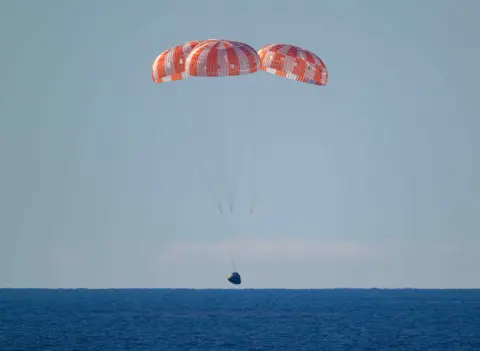
Victor Glover said re-entry was like riding a fireball through the atmosphere. And as the capsule hurtled back to Earth, it experienced temperatures half as hot as the surface of the Sun.
Watching this white-knuckle ride from mission control was an anxiety inducing experience. Especially when the communications dropped out for six very long minutes as the capsule closed in on Earth.
The relief here was palpable when a small dot of bright white light was spotted high above the ocean, and Wiseman's voice rang out at mission control, "Houston, We have you loud and clear."
With the capsule descending beneath huge parachutes to gently splashdown in the Pacific Ocean, the astronauts were back on Earth.
The focused and calm atmosphere in mission control was no more as the room erupted with celebrations. The Houston team - as well as the thousands of people who'd worked on the project - had safely brought their friends home.
The Artemis astronauts have had an extraordinary experience, which they've already acknowledged will take a long time to fully absorb.
And of course, they have an extraordinary connection with each other too.
 NASA
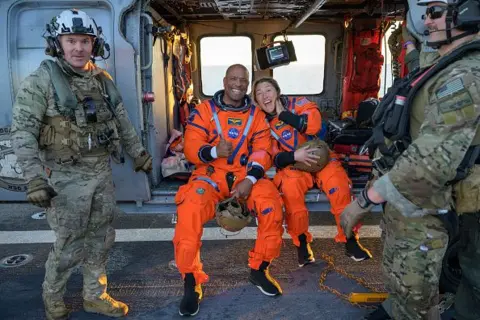
NASAI had the chance to speak to the crew in space as their voyage was nearing its end. I asked them what they'd miss most. Without hesitation, Christina Koch said she'd miss the camaraderie, that the crew were now like family.
They went up to space relatively unknown - now Reid Wiseman, Victor Glover, Christina Koch and Jeremy Hansen have returned household names.
It does feel like we have been in the front row as history is being made. Kevin, Ali and I have been taken aback by how much this mission has gripped so many people - as we've reported around the clock to keep up with everyone's insatiable appetite for the latest news from space.
For a few brief days, the astronauts have transported millions around the world away from planet Earth - and let us ride along with them.
And if Nasa achieves its ambitious exploration plans - and other countries follow too - we'll all be back for more.
