Europe's oldest science park could be redeveloped

 Allies and Morrison/Kin Creatives
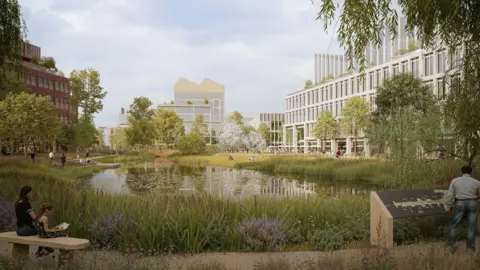
Cambridge Science Park said redevelopment plans could create 20,000 new jobs and facilities for the public.
More than 7,000 people currently work at the site on Milton Road - the oldest science park in Europe - developing technologies and medicines.
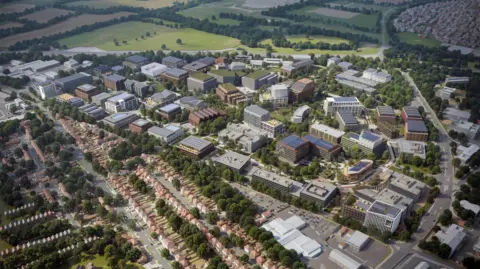
Under the submitted plans, new buildings and infrastructure would be built there, which was predicted to treble the park's economic output to £3bn a year.
Dame Sally Davies, Master of Trinity College Cambridge, which, along with leasehold partners, is funding the proposals, said a key aspect is "opening up the new Park of Science to the young people and families of Cambridge and the towns and villages around".
 Allies and Morrison/Kin Creatives
Founded in 1970 by Trinity College Cambridge, the park has been responsible for breakthroughs including cancer drugs, Bluetooth technology and mobile phone chips.
It has grown organically over the past 56 years, but it was hoped that the new plans would maximise the space.
In the proposals, the amount of built space would increase from 2.8 million to 8 million square feet. The college said it was determined to ensure that any growth "provides benefits and opportunities for everyone in Cambridge, Peterborough and surrounding towns and villages".
Aside from more jobs in areas such as construction, gardening, human resources and science, "benefits" would include "improved bus links, cycling routes, flood resilience, and biodiverse landscaping".
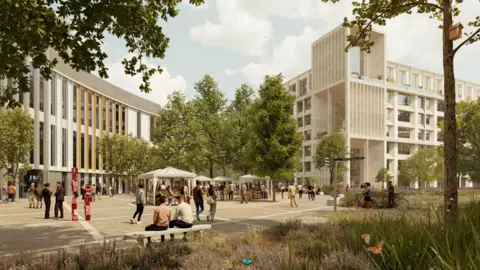
The site, which is already open to the public, would also feature outdoor exhibits, an open-air museum and strengthened links to the Cambridge Science Centre, which encourages participation in STEM subjects.
 Allies and Morrison/Kin Creatives
Rebecca Porter, CEO, Cambridge Science Centre, said: "We are incredibly excited by the opportunities that the continued growth of Cambridge Science Park presents.
"Since Trinity College supported our move to the park, we have transformed our scale, reaching over 30,000 people in 2025 alone - from our Cambridge centre to dedicated outreach with nearly 1,400 pupils in Wisbech.
"What makes this location so vital is its proximity to world-leading research, which cannot be replicated elsewhere. We aren't just interpreting science at a distance; we are translating real-time innovation into accessible experiences for families and schools."
The plan has been hailed as "a strong vote of confidence in the UK as a science and technology leader" by Roland Sinker, chair of innovation and growth at the University of Cambridge.
It will "create thousands of high-quality jobs, contribute billions to the national economy, and help ensure that the breakthroughs of the future are developed here in the UK," he added.
The application has been submitted to the Greater Cambridge Shared Planning Service. Its joint development management committee will consider the plans.
Do you have a story suggestion for Cambridgeshire? Contact us below.
Follow Cambridgeshire news on BBC Sounds, Facebook, Instagram and X.
