Swinney's 100-day push gives way to bigger battles ahead

 PA Media
There have been a flurry of announcements from John Swinney over the summer as he works to fulfill the pledges for the first 100 days of the SNP returning to power which he made ahead of the Holyrood election in May.
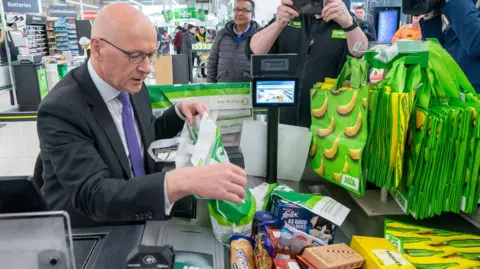
For example, last week the first minister formally opened the 11th GP walk-in centre and announced locations for an expanded network across Scotland.
That ticked off one of his 100-day commitments but it does not in itself end the early morning rush for GP appointments or the wider backlog in the NHS.
Ministers hope walk-in centres will make a worthwhile contribution but the Royal College of GPs and political rivals are sceptical after early statistics suggested underuse.
 PA Media
The whole point of the 100-days exercise is to give a sense that the government is energised and active albeit that the SNP is now in the party's fifth consecutive term in power.
Swinney, like the new UK prime minister Andy Burnham, has decided that the best way to counter public disillusion and disgust with politics is to demonstrate delivery.
Some promises are easier to honour than others.
For instance, formally requesting the transfer of energy powers from Westminster just required a letter to be sent.
That it has not yet received a reply does not prevent it from being counted among the pledges met.
Swinney's 100 days list does, however, contain some high profile commitments that are still to be honoured.
On Tuesday we expect news about the £2 bus fare cap being extended across west central Scotland.
That should also be the day when draft legislation aimed at ensuring affordable prices for food essentials in supermarkets is published.
That does not mean the law will ever be enacted but it should spark renewed debate about how best to cut the cost of living and who's doing what to help.
Critics argue that passing a food price law would backfire by pushing down what farmers and other producers are paid and pushing up the cost of other items to protect supermarket profits.
The proposal may well breach UK internal market rules but UK ministers have not said whether or not they would block the legislation.
The SNP is keen to provoke their response.
 PA Media
The way the Scottish government has chosen to count its 100 days has it ending on Tuesday - the same day John Swinney sets out his programme for government in a Holyrood statement.
Any outstanding issues could be dealt with there and, if not, opposition parties have the opportunity to hold the first minister to account.
The programme is bound to reference efforts to cut the cost of living and to reduce waiting times in the NHS - the two most talked-about issues in the election campaign.
It should also major on public service reform which the Scottish government has described as the "defining task" of this term at Holyrood. There is even a cabinet minister for that specific role.
 PA Media
It is often hard to pin down exactly what is meant by "reform" and I would expect the programme to offer a little more clarity.
My understanding is that after almost two decades in office, Swinney has concluded that to make government better, there needs to be less of it.
There are 134 public bodies under Scottish government control and ministers want to see a "significant reduction" in that number.
One well-informed source floated the idea that 75 should be enough.
We know, specifically, that they want to cut the number of health boards but my sense is that they want to go further.
Expect some specific proposals and a consultation process to inform wider changes and the legislation to make them happen.
 Getty Images
As the programme puts into practice measures from the SNP's manifesto, there ought to be more on the key pledge to expand childcare provision to everyone from nine months of age to the end of their primary school years.
There is also expected to be a "substantial package" of measures to tackle violence against women.
The programme could be a suitable opportunity for the government to indicate its approach to banning conversion therapy now that the UK government's plans have been published. Will they tie in with Westminster or go their own way?
In pursuit of the further devolution of powers from Westminster, there is to be an effort to work with trade unions, churches, charities and others to prepare a "national ask" on behalf of civic Scotland.
Despite publishing a draft independence referendum bill on Friday, there is little prospect of another vote in the next five years. That cause is stuck.
The new prime minister has made clear that discussion of another referendum is "off limits" and that he and the first minister will have to "agree to disagree" on the issue.
That doesn't mean Swinney will stop talking about independence. Instead, expect him to persistently make the case for it in an effort to drive up support.
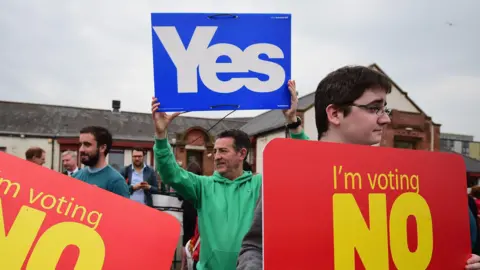
The debate is back to where it was in the immediate aftermath of the 2014 referendum - that the most realistic route to another referendum is to achieve sustained majority support for independence.
