Traps set for killer wasps that target bees

 Getty Images
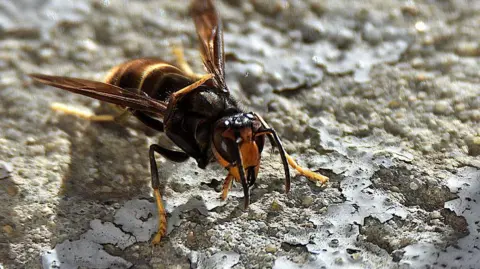
Traps are to be set for yellow-legged hornets after the invasive species, which poses a risk to honey bees, was found in Wales earlier this year.
A dead nest belonging to the insect, also known as the Asian hornet, was found near Wrexham in January, the first confirmed discovery in Wales.
The Welsh government has asked the National Bee Unit to place traps within a 5km (3.1 mile) radius around the site in the Caergwrle area.
Trapping will start in mid April and carry on until the end of June, the National Bee Unit, which is responsible for the government's Bee Health Programme in England and Wales, said.
It added, however, that if yellow-legged hornet sightings were confirmed during this period, it would start work to find and destroy nests.
"This is considered to be the most effective control mechanism against the yellow-legged hornet," the National Bee Unit said.
It said its approach would be "precautionary, proportionate, and led by the best available science and evidence".
Beekeepers and members of the public have been asked by the Welsh government to use an identification guide to distinguish an Asian hornet from similar-looking native insects, and report suspected sightings.
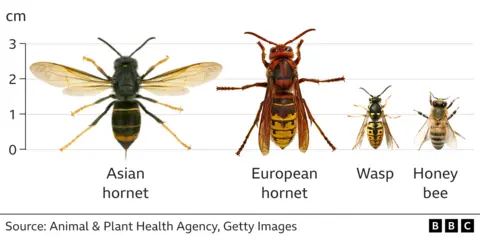
What are Asian hornets?
Yellow-legged hornets are an invasive, non-native species and were first seen in France in 2004.
Since then, there have been sightings of it in numerous countries across Europe as well as parts of the UK.
Asian hornets were first spotted in England in 2016 and action has been taken every year since to "find and destroy nests", according to the Welsh government.
They are active from February to November and are most likely to be seen from July onwards.
The are not generally aggressive, but care should be taken not to approach or disturb a nest.
