'Every minute counts when it comes to new ovarian cancer treatment'

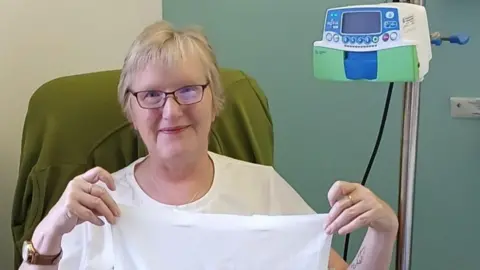 Christine Campbell
For ovarian cancer patient Christine Campbell every minute is "precious".
That is why she says a new drug which has been approved by the medicines watchdog could be another "lifeline" for patients like her in Northern Ireland.
The breakthrough drug - mirvetuximab soravtansine - has been approved for certain patients by the National Institute for Health and Care Excellence (NICE), and NHS England says it will pay for the drug.
But while Stormont's Department of Health tends to also follow NICE treatment recommendations it does not necessarily mean this new drug will be readily available for patients in Northern Ireland.
There are nearly 7,750 cases of ovarian cancer in the UK each year.
Mirvetuximab soravtansine is the first new medicine for hard-to-treat ovarian cancer in 20 years, and has proven both to be kinder on the body and extend lives.
It can only be used for patients with ovarian, peritoneal and fallopian tube cancer if chemotherapy no longer works and if the cancers have the right markings.
Christine, who is from Dundonald, currently uses a different drug called Avastin, but says it is a "miracle" that there could now be two options.
"In July 2023, I thought there was no hope for me. Here we are... years later and a second drug has come on the market in the UK", she told Good Morning Ulster.
"When you are a life-limited patient, every minute counts.
"And because it is a targeted therapy, with less side effects, the quality of life will actually be better than the normal chemotherapy route.
"I'm on my fourth line of chemotherapy, so if my current drug was to stop working, there is the possibility that I could access this drug, which is a miracle in itself.
"I would love to see it become available in Northern Ireland".
 Christine Campbell
How does the drug work?
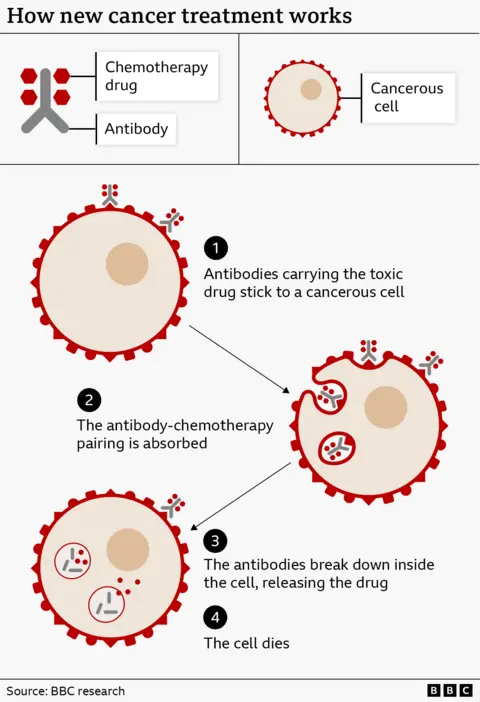
The treatment is known as a "biological missile" as it delivers chemotherapy drugs direct to the cancerous tissue rather than to the whole body - reducing debilitating side-effects.
On average, it can extend lives from 12.8 months on chemotherapy to 16.5 months on the therapy, and has fewer side-effects.
Women are able to keep their hair and it is given by a drip every three weeks, instead of weekly with conventional chemotherapy.
Christine describes her prognosis as a life-limited one.
"Who doesn't want extra days or weeks or months? Every minute is precious", said Christine.
"A seven or eight month extension may not sound like a lot of time, but it is."
"I would like to see it rolled out in Northern Ireland as quickly as possible", Christine said.
"For the people who would benefit from it, other options may have run out and they will need that extra lifeline".
Will patients in NI get the drug?
Analysis: Marie-Louise Connolly - Health Correspondent, BBC News NI
Ultimately it is the Department of Health (DoH) in Northern Ireland who will decide whether a new drug that is approved by NICE will be made available to local patients.
While NICE has no direct statutory authority in Northern Ireland, the DoH routinely reviews NICE guidance and typically endorses and adopts it for the Health and Social Care (HSC) system.
But there are numerous examples where families and patients have accused the DoH of dragging its feet when it comes to making a decision.
Based on access to some other NICE-approved drugs, funding can be part of the problem.
Once the UK's medicines regulator, the Medicines and Healthcare products Regulatory Agency (MHRA), decides about licencing, and then NICE provides guidance around access and funding to the NHS in England, it's over to authorities in Northern Ireland.
They have an endorsement process, which considers any local policy or legal implications for the local health service.
This is a necessary, but sometimes lengthy process.
Sometimes, Northern Ireland's health authorities can make treatment available in advance of the endorsement process, through something known as interim cost per case commission arrangements.
What has the department said?
The Department of Health said it has a "formal link" with NICE and that the body's appraisals "are reviewed locally for their legal and policy applicability in Northern Ireland".
"Where found to be applicable, they are endorsed for implementation within Health and Social Care (HSC) organisations." a statement added.
"This link has ensured that Northern Ireland has access to up-to-date, independent, professional, evidence-based guidance on the value of health care interventions.
"In practice, this means that treatments that have been recommended by NICE for routine use in the NHS in England are also available in Northern Ireland."
