Eisteddfod Crown won by former journalist for poem about abuse

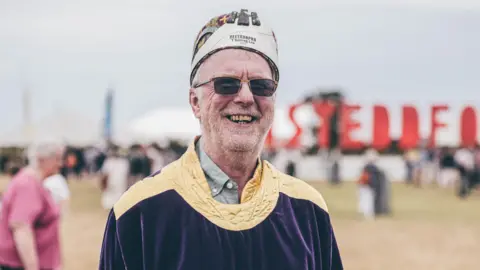 Aled Llywelyn
One of the most prestigious prizes at this year's National Eisteddfod has been won by a former BBC journalist for his poem about abuse and violation.
Martin Huws said his "dream had come true" after being awarded the prize at Wales' largest cultural festival, as well as £750.
Forty-one poets entered the competition this year and were tasked with writing a free-verse poem or collection of poems up to 250 lines on the theme of "Adnabod" (knowing or recognition).
The Eisteddfod is being held in Llantwd, Pembrokeshire, 850 years since the first one took place.
Disgraced newsreader Huw Edwards also submitted a poem for the competition that he said had been a tribute to his father, and had been intended to correct a "poisonous narrative".
Sera Cracroft, an actress and survivor of child sexual abuse, criticised Edwards for competing, and said it would have been "catastrophic" if he had won.
The National Eisteddfod said "nobody, including the judges, know beforehand who has competed", with entries submitted by using pseudonyms and winners' identities only revealed when announced.
Huws told BBC Wales he had felt "a lot of mixed emotions - fear and pride".
"The poems talk about abuse and the impetus was watching Gareth Potter on a programme on the BBC talking about what happened to him at the hands of a former teacher and I respected his courage, and that was the starting point to be honest," he said.
Writing under the pseudonym 'Fan-go', his work was chosen by the judges because it was a "profoundly striking collection in terms of both its subject matter and the bold craftsmanship and creativity of its treatment".
"It addresses one of the most challenging themes imaginable: a harrowing and timeless subject, namely abuse and violation," judge Damian Walford Davies said.
Davies added: "This year's competition displayed considerable richness, both in terms of ideas and craftsmanship.
"It was encouraging to see a wide range of approaches to the set title, 'Knowing/Recognition' [Adnabod], with the most sophisticated entries engaging with the theme in contemporary, subtle, indirect and non-dogmatic ways."
Huws has spent much of his career in journalism, working for Golwg, Western Mail and ITV Wales, before moving to BBC Wales.
Originally from Cardiff, he has lived in Taff's Well, Rhondda Cynon Taff for more than 30 years.
He has published two novels, two collections of short stories, a volume of poetry and a booklet on the history of Cardiff.
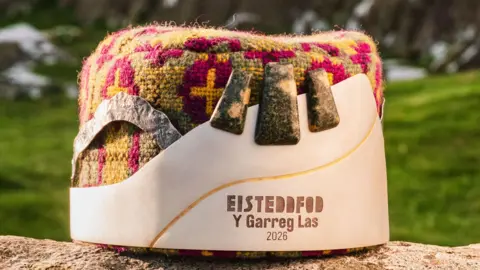 Eisteddfod
The Crown is considered one of the main prizes along with the Chair and Prose Medal.
It is one of almost 200 distinct competitions at the National Eisteddfod, which brings together thousands of competitors in music, literature, art and drawing.
This year's crown was designed and created by Elen and Dylan Bowen, the husband-and-wife team behind Bowen Jewellery.
It was the first time the Bowens had created an Eisteddfod Crown - an achievement they described as a "tremendous honour".
The Prose Medal is a major annual literary award given for a major volume of creative prose under 40,000 words.
The Chair is part of a top poetic contest and honours a winning poem written in Welsh. Entrants must use a traditional form of poetry with strict rules around different forms of alliteration and internal rhyme called "cynghanedd".
