Students get their GCSE and BTec grades as app launches for 750 schools in England

 Getty
GettyPupils in England, Wales and Northern Ireland have received their GCSE, BTecs and other Level 2 results.
Schools and colleges have been distributing grades in person, while pupils at more than 750 schools in England will also be able to see their grades on an app on their phones, which has been rolled out nationally for the first time.
Results this year come as the government in England plans to boost technical education and address a growing number of English and maths GCSE resits.
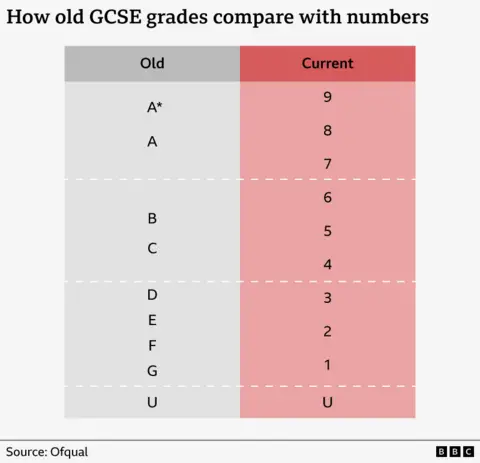
The overall GCSE pass rate has remained stable - with 67.3% of all grades across England, Wales and Northern Ireland at 4/C and above, down very slightly from 67.4% last year.
The pass rate for National 5, Higher and Advanced Higher exams in Scotland rose across the board at the start of the month.
And top A-level results increased slightly again last week – with 28.5% of all grades across England, Wales and Northern Ireland marked at A* or A.
Students have also received results for BTec Tech Awards, BTec Firsts and BTec Level 2 Technical courses on Thursday, as well as for Cambridge Nationals.
Last year, more than 360,000 results for vocational and technical qualifications were given out.
Prime Minister Andy Burnham wants to make more technical subjects available to teenagers, and has announced plans for schools and colleges in England to offer subjects like manufacturing and AI in addition to core academic learning from Year 10.
Speaking to BBC Breakfast on Thursday morning, Education Secretary Lucy Powell said that for too many pupils GCSEs had been "a barrier" rather than a "gateway".
She said the government would bring in a new foundation qualification to help bring down the number of pupils resitting GCSE English and maths each year.
This year, pupils at more than 750 secondary schools in England are able to see their results on their phones.
The Department for Education (DfE) said pupils would still go into school to get their results in envelopes first, but that they would also be able to access their results through the Education Record app from 11:00 BST.
A record of their results will stay in the app for colleges and future employers to review, in a move the government hopes will reduce paperwork for students and teachers.
In England, pupils who do not get at least a grade 4 in GCSE English and maths must continue studying for it alongside their next course, whether this is A-levels, a T-level, or something else.
Resitting is not a requirement, according to the DfE, but colleges will generally enter students into exams when they think they are ready.
GCSE English and maths resits take place in November and May or June.
This year, nearly a quarter of maths and English GCSEs in England were taken by people aged 17 and older this year, making up 24.3% of grades – up from 23.4% last year.
A government-commissioned report in May cited research suggesting that half of 18 to 25-year-olds in England without level 2 qualifications - including GCSEs at grade 4/C and above - have spent time not in employment, education or training.
Skills minister Baroness Jacqui Smith said in October that the DfE planned to introduce a new qualification as a "stepping stone" to GCSE resits, helping students who "too often have been on this demoralising roundabout of taking exams and failing them".
Data shows that girls are more likely than boys to pass GCSEs, but this year the gap between them was the lowest on record - with girls' pass rates dropping and boys' pass rates rising very slightly.
The gap between the highest- and lowest-performing regions in England has widened, with London having the highest pass rate and the West Midlands the lowest.
Disparities in GCSE results are often framed through the lens of a North-South divide, but there are also challenges facing children in coastal and rural parts of England.
For example, in South West England, 40% of children eligible for free school meals obtained a grade 4 in maths and English at GCSE compared with 56% of the same cohort in London.
This is the third year that grading has returned to pre-pandemic standards across all three nations.
The proportion of GCSE passes rose in 2020 and 2021 when exams were cancelled and results were based on teachers' assessments.
That was followed by a phased effort to bring them back down to 2019 levels.

