Bird-snagging netting is 'an expensive death trap'

 Anthony Percival
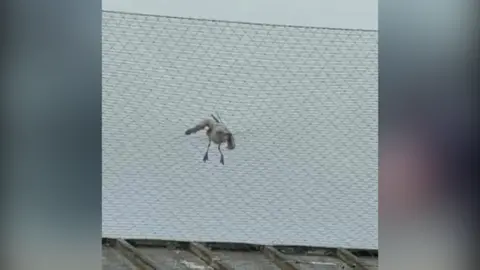
Residents in west London have called for the removal of a newly installed safety net on a Transport for London (TfL) depot in Northfields, after it trapped and killed wild birds.
One man told the BBC that gulls have become trapped and were "dying slow and painful deaths.
"One has been dying loudly for four days."
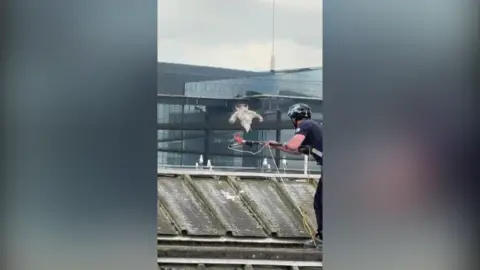
A spokesperson for the Swan Sanctuary in Shepperton, which carried out the rescue, said the net was "not a deterrent for birds, it's an expensive death trap".
 Anthony Percival
TfL said it took animal welfare "very seriously" and all the birds had been released.
It said it was repairing the netting to prevent it happening again and would continue to assess its effectiveness.
Anthony Percival has lived next to the depot for nearly 40 years, with a large section of the roof and netting visible at the end of his garden.
He reported a trapped gull to TfL and local wildlife groups and monitored it as it remained trapped over four days.
"It's quite upsetting, obviously, you could see it was distressed. I think birds have feelings and it was probably wondering how to get out and it was trying its best to get out.
"I was just amazed that it was able to keep doing it and keep trying for for so long really."
He said he and his partner, who are both cabin crew for an airline at Heathrow Airport, had named the trapped gull "Gilbert".
"We were really rooting for him at the end. It was quite emotional really, especially seeing him rescued, I couldn't believe it."
Birds 'at risk'
Percival said he didn't understand why the net had been installed and said birds had been landing on it for "years".
He added: "I'm sure this will happen again."
His neighbour Gav added: "The seagulls are noisy and annoying, but this seems unnecessarily harsh. Surely they could've gainfully employed a hawk or something?"
The wildlife expert from the Swan Sanctuary, said on arriving to rescue the birds he discovered at least five had become trapped in the net. Some were flying around in the void, but two had become physically trapped, one of which had already died.
The living juvenile herring gull was taken to the sanctuary, but it too died after three days.
The expert said: "People don't realise, birds are very intelligent animals, and they do help each other, so when they are calling out, they attract other birds to them, especially with this one being such a young bird.
"Also, their calls attract birds of prey, so they too risk getting trapped in the net.
"Owls, buzzards, kites - they're all at risk."
He added that he supported calls for a ban of bird-deterrent netting and there were "proven, better ways to deter birds".
'Heart-breaking'
Adrenne Read, from TfL, said the netting was installed to help reduce safety risks, including flooding from blocked drainage.
"Unfortunately, since it had been installed, there had been some damage to the netting and a small number of birds became trapped."
The RSPCA said it was "aware" of the incident, and said: "Every year we receive a large number of reports about bird deterrent netting."
It urged people to report any sightings of trapped birds.
The RSPB said the situation at the Northfields depot was "heart-breaking", and had been "assured" measures had been taken to try and prevent the situation repeating.
Listen to the best of BBC Radio London on Sounds and follow BBC London on Facebook, X and Instagram. Send your story ideas to hello.bbclondon@bbc.co.uk
