What you need to know as Ealing heads into local elections

Bethan BellLondon
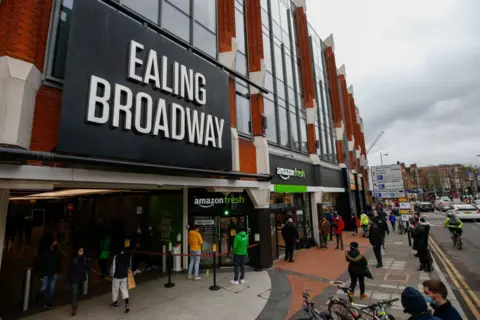
News imageGetty Images An Amazon Fresh cashierless convenience store in the Ealing area, on a busy shopping street. Getty Images
The Amazon Fresh shop opened in Ealing Broadway in March 2021 and closed two years later

What happened in Ealing at the last council election in 2022?

The turnout was 40.3% and there was a small swing of 1.7% from Labour to the Tories.

Labour 59 seats (+2)

Conservatives 5 seats (-3)

Lib Dems 6 seats (+2)

Boundary changes had increased the number of seats from 69 to 70.

Since the election, one Labour councillor has defected to the Lib Dems, another has become an independent, and the Lib Dems won a seat from the Tories in a by-election.

Election expert Tony Travers on what might happen in Ealing

Professor Tony Travers explains what might happen in Ealing

Professor Tony Travers of the London School of Economics said Ealing is a borough which used to be a perfect test of politics in London and indeed across the country; Conservative some of the time, Labour at other points.

Now Labour holds it strongly and given everything else we know about London politics, it looks as if Labour will keep Ealing in 2026.

Why do the local elections in London matter?

At the moment, Labour are dominant in London - they have 21 of its 32 councils, a record-equalling high.

The Conservatives run just five - having lost their former "crown-jewel" councils of Wandsworth and Westminster to Labour at the last borough elections in 2022.

The Liberal Democrats run three councils in south-west London and will be looking to gain Merton from Labour.

The Aspire Party run Tower Hamlets and two boroughs are currently in no overall control.

Nick Bowes, insight director from the London Communications Agency, said: "These are likely to be the most consequential elections in London, certainly for the past 20 years - possibly since the first borough elections in 1964."

He added: "The ways things are fragmenting in the polls it's very difficult to predict exactly what's going to happen but it does look like being a very bad night for Labour and the Conservatives in London."

When are the 2026 local elections in Ealing and who can vote?

More than six million Londoners can vote in the council elections on Thursday 7 May 2026.

All 32 London boroughs are up for election.

There are also elections for the mayor in five boroughs: Croydon, Hackney, Lewisham, Newham and Tower Hamlets.
All candidates in the Ealing Council election are listed on the borough's website.

Use our tool to see what elections are being held in your area.

Key dates in Ealing Council local election

The deadline to register to vote is Monday 20 April 2026.

The deadline to apply for a postal vote is Tuesday 21 April 2026 at 17:00 BST - you must be registered to vote before you can receive a postal vote.

The deadline to change existing postal or proxy voting arrangements is also Tuesday 21 April 2026 at 17:00.

The deadline to apply for a proxy vote is Tuesday 28 April 2026 at 17:00.

Photographic voter ID is required to vote at a polling station - if you do not have valid Voter ID, the deadline to apply for photo ID to vote (called a Voter Authority Certificate) for this election is Tuesday 28 April 2026 at 17:00.

Election Day: Thursday 7 May 2026 from 07:00 to 22:00.

You can find more information about voting in Ealing on the borough's website.

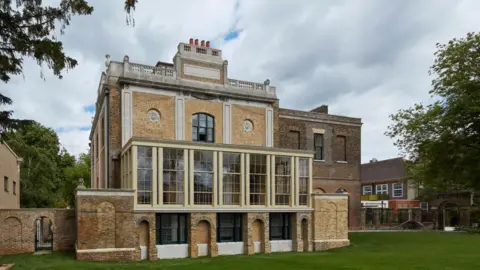
News imageGetty Images A restored early 19th century English country house on three floors stands in front of a lawn. Newer residential buildings are visible in the background. Getty Images
Pitzhanger Manor was the country home of architect Sir John Soane

Where is Ealing and who lives there?

The London Borough of Ealing is in west London and is bordered by Harrow, Hillingdon, Hounslow, Brent and Hammersmith and Fulham.

What's it like? Ealing, known as the Queen of the Suburbs, has a rich history stretching back over a thousand years. It boasts world-famous film studios, award-winning parks, and a thriving food and arts scene.

Neighbourhoods: Seven towns make up the borough: Acton, Ealing, Greenford, Hanwell, Northolt, Perivale, and Southall.

Places of interest: Ealing Studios, Pitzhanger Manor and Gallery, Walpole Park, Northala Fields, Ealing Broadway, Grand Union Canal, Gurdwara Sri Guru Singh Sabha Southall, Wharncliffe Viaduct, Hoover Building, Perivale Wood.

Pub quiz fact: The North Korean embassy is in Ealing, on Gunnersbury Avenue.

Population (2024 estimate): 367,115.

Demographics: According to the 2021 census, 43.2% identify as white, 30.3% as Asian, 10.8% as black, 5.2% as mixed race and 10.6% as another ethnic group.

Average property price: According to the Office for National Statistics (ONS), the average house price in Ealing in January 2026 was £580,000

Average monthly rent: The ONS reported the average monthly rent in January 2026 in £2,052

Council tax: Band D council tax in the borough for 2026/27 is: £2,138

Transport:According to TfL there are 14 Tube stations, five Elizabeth line stations, two London Overground stations and about 700 bus stops in Ealing.
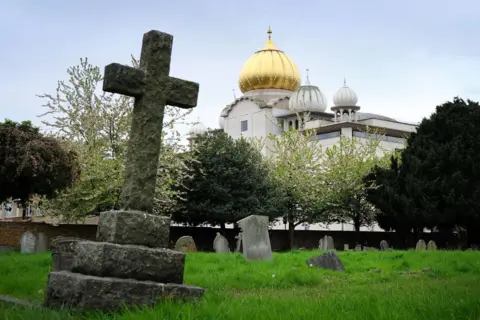
News imageGetty Images The golden dome of the Sri Guru Singh Sabha Sikh temple in Southall rises up behind the graves of Havelock cemeteryGetty Images
The golden dome of the Gurdwara Sri Guru Singh Sabha behind the graves of Havelock cemetery

What is Ealing's local history?

Ealing derives its name from Gillingas, meaning the people of Gilla, who may have been an Anglo-Saxon settler.

Over the centuries, the name changed until Ealing became the standard spelling in the 19th Century.

It was an ancient parish and rural village in Middlesex until the urban expansion of London in the19th Century.

The building of the Great Western Railway in the 1830s, part of which passed through the centre of Ealing, led to the opening of a railway station on Ealing Broadway in 1838.

It became a municipal borough in 1901 and part of Greater London in 1965.

What is Ealing's electoral history?

Since 1965 Ealing has switched hands eight times between Labour and the Conservatives, but Labour have held the borough for the last 16 years, increasing their number of seats at each election.

Listen to the best of BBC Radio London on Sounds and follow BBC London on Facebook, X and Instagram. Send your story ideas to hello.bbclondon@bbc.co.uk

Related internet links