Homegrown fertilisers help during Strait shutdown

 Fiona Irving / BBC
Homegrown biofertilisers offer some protection from the rising cost of artificial imports but their use does pose some challenges, farmers in the South East have said.
A report by The National Preparedness Commission said biofertilisers, like compost and digestate, could make the UK less vulnerable to market turmoil, with the fertiliser price having risen by 80% since the US and Israel's war on Iran began.
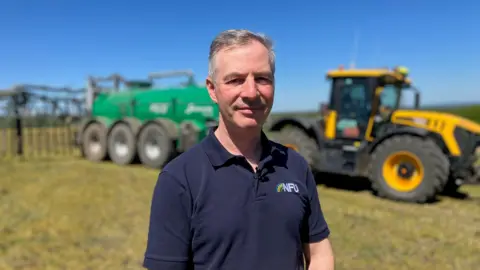
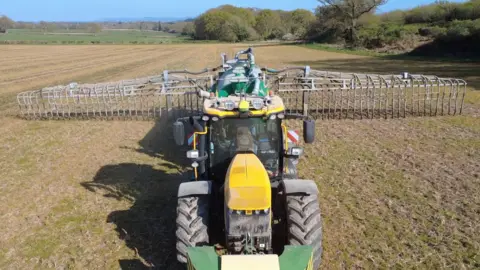
Frans de Boer, a farmer in West Sussex, says the organic digestate he spreads on his fields helps keep him "on a better footing" financially than some other farmers.
He grows maize which he turns into biogas electricity and nitrate rich fertiliser in an anaerobic digester, and has been using digestate on his crop for the past decade.
 Frans de Boer
Biofertilisers are made from organic material like food and green waste, crops and livestock manure, and are heavier to transport and more labour-intensive to spread than the artificial alternative.
de Boer said he was about "80% self-sufficient in nitrogen" but still needed to buy some imported fertiliser "to bridge the gap."
Since the start of the US-Israeli action against Iran at the end of February, the Strait of Hormuz has been effectively blocked, severely restricting the flow of roughly 20% of global oil and 30% of fertilisers.
Jenny Grant from the Renewable Energy Association said there was "huge potential" in the biofertiliser market to "offset some of the challenges" from the Strait of Hormuz shut down.
She said the UK produced "about 25 million tonnes of digestate" and about four million tonnes or so of compost.
Grant also pointed out that, with new rules having come into force requiring weekly food waste collections for all homes in England, there's "a lot more material that's going to come in and enable UK sites to produce more local biofertiliser".
 Fiona Irving / BBC
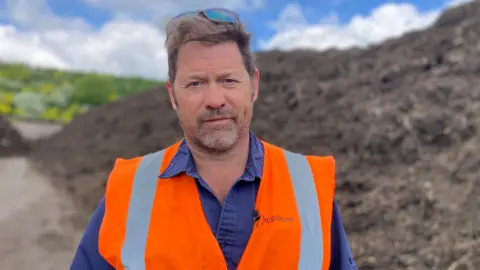
Doug Taylor grows wheat, linseed, beans and oats on his farm near Folkestone.
He also produces about 9,000 tonnes of compost from green waste collections in East Kent.
For the past 20 years he has been using that compost which he calls "an all round soil improver" on the 1,100 acres he farms.
Taylor said, although the opportunity for a UK growth in biofertilisers exists, there needed to be more research into the area.
He said it was expensive to transport because of its weight and spreading "large volumes" was logistically challenging.
Taylor said although biofertilisers would not replace artificial fertilisers, they were better environmentally.
Research has suggested that artificial fertiliser production and use creates greater greenhouse emissions than organic fertilisers.
The recent report by The National Preparedness Commission has highlighted the vulnerability of the UK farming industry to fertiliser shortages, calculating that the UK imports three times more fertiliser than it produces.
The report said there was some "welcome signs of diversification" but the biofertiliser market "remains very small and nascent worldwide".
It said there would need to be changes to how land was used and which crops were grown if the UK moved away from artificial fertilisers "towards lower input and organic systems".
Follow BBC Sussex on Facebook, X, and Instagram and listen to BBC Radio Sussex on Sounds. Send your story ideas to southeasttoday@bbc.co.uk or WhatsApp us on 08081 002250.
